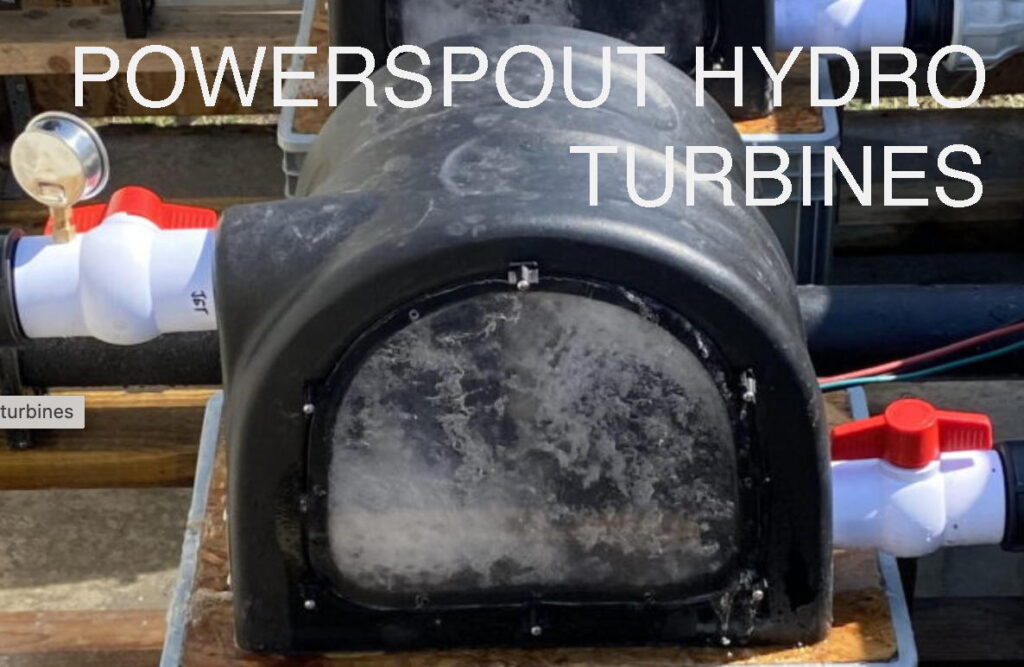
the new Youtube video is here


Plans to build this wind turbine here.


Karl writes:
I registered with the Npower ‘juice’ green electrity tarrif and told them i had a wind turbine i would like to connect to the grid. They sent the forms to register asking what make the turbine was and who intalled it, i also had to fit a generation meter for them to read my power output. The terms and conditions on the application do not mention having to have MCS certified machine or installer so i just told them i did it all and drew a simple diagram of the layout and told them the inverters were g83 compliant.They said it was no problem and signed me up but now after reading your blog i wonder if it will be!
The turbine i have connected is 10′ diameter mounted on a 13 meter pole. I use 3 mastervolt soladin inverters with a dump load controller in between and it ties to the grid via a standard 13 amp plug wired on its own into the house distribution board. I have built 5 more 8′ turbines as in the pictures all with laminated blades caved using templates that fix onto the sides of the blanks and follow bearing guides on a modified 9″ surface planer, it takes 5 minutes to cut the twist and taper in each and they all turn out exactly the same.All i then do is to form the aerofoil shape on the back by hand.
I hope my machine and anyone else’s will be allowed to work with the FIT as the whole idea of green energy should be above and beyond the greed that got our climate in such a mess in the first place
Thanks to Roland for these pictures.


http://www.yougen.co.uk/blog-entry/1428/Three+ways+we+could+improve+UK+feed+in+tariffs/
“There was not a single voice at Monday’s meeting raised in defence of MCS, which is an unaccountable monopoly run by people who may have their hearts in the right place but who are anonymous and naturally most interested in defending the interests of their own businesses. It creates an additional learning barrier and cost for existing, completely skilled construction contractors who might want to enter the market, and thus slows down growth and keeps microrenewables as a relatively niche market accessible only to those in the know.
It also creates a whole heap of completely gratuitous technical arguments (and diversionary hot air) about whose standards should be adopted, and who should be on which committee, at a time when the industry should be focused on creating imaginative propositions for customers.
Personally, I cannot really see why we need to confuse customer protection with promotion of renewables at all, particularly in the context of a scheme which deliberately rewards quality installations over those that work less well.
In the end, a green kWh is a green kWh and can be measured accurately by your generation meter.”
right on.

“I thought you and your wooden blade fans would be interested in this . We’re currently building a short run of 16m blades in wood epoxy in the now disused Vestas workshops in Southampton. We’ve taken an old design which was last built about 10 years ago and redesigned for birch veneer. The blades are for 400Kw Turbowind machines and weigh approx 1 tonne each. The birch veneer is like plywood but with the all grain running in the same direction. It is a fantastically strong material. Each veneer is approx 4mm thick and made up of 3 plys. Its vacuumed into female moulds along with glass and foam sandwich for the trailing edge panel.
I think we are the only big blade builders in the UK now! Crazy!”
Nick Barlow
Designcraft Ltd

My courses calendar is here.
View course locations 2010 in a larger map
23-28th March 2010 CAT in Wales, UK
12-17 April Mondial du Vent, Leucate France
19 au 24 Avril MONTCHAUVET France (40 km de CAEN)
small wind conference 27 – 28 April Glasgow
8-15th and 22-29th May 2010 Scoraig
Saturdays: 19 June, 10 July, 14 August EarthshipFife
29th August – 3rd September CAT Wales
13- 18.September in Ireland (Leitrim)
September 27 — October 1st Paonia, CO
October 18-23 Guemes Island WA
October 25-30 Guemes Island WA
Received from Brian Faux – invitation to sign a petition:
Please sign and pass this on
The Department of Energy and Climate Change intends to reward generators of renewable energy – Solar, Wind, Hydro etc – with a guaranteed price for the electricity they produce: the Feed In Tariff. This will come into effect in April 2010.
However the regulations will be such that that owners of self-built renewable energy systems will be excluded from these rewards even though these are the very people who pioneered home produced electricity. To assure a fair reward for these green pioneers, please sign the petition to 10 Downing St.
http://petitions.number10.gov.uk/GreenPioneers/
‘Usually provided there are 500 signatures or more, it will be passed to officials who work for the Prime Minister in Downing Street, or sent to the relevant Government department for a response.’
This 20-foot waterwheel generates 5.5kw – enough electricity to power two
houses 24 hours a day.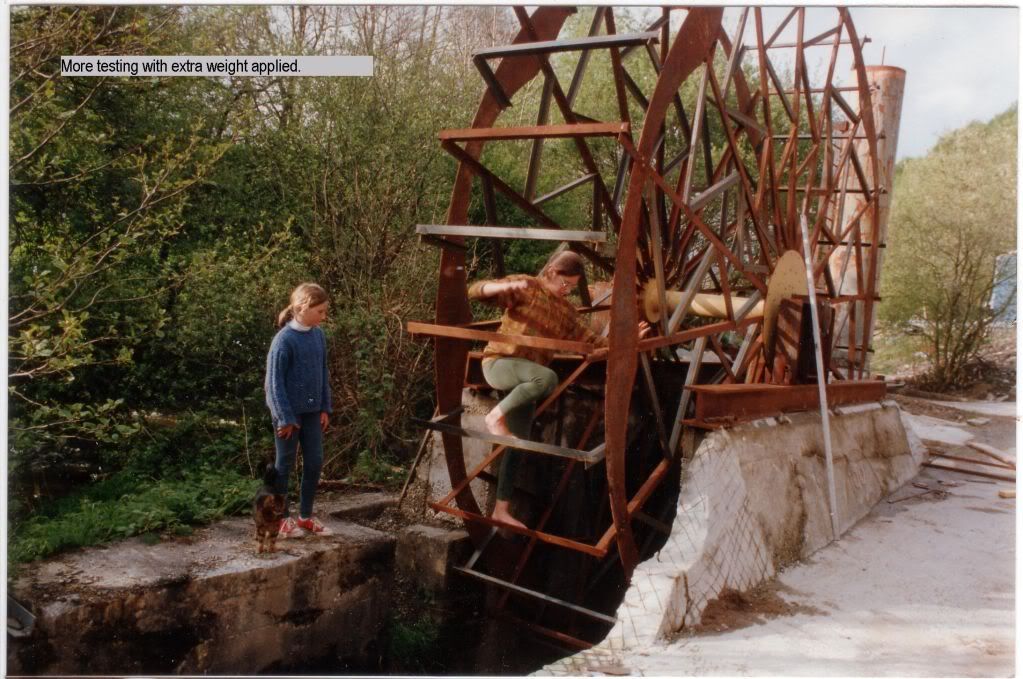
Under the proposed regulations it will be ineligible for the Feed In Tariff.
http://s990.photobucket.com/albums/af26/brianfaux/Waterwheel/
“One of the proposed conditions of the recently announced Feed In Tariffs for renewable energy is that only projects which have Microgeneration Certification Scheme approved installers and equipment will qualify for FIT`s. Individuals that have pioneered the use of renewable resources by building their own Solar,Hydro and Wind installations will not be able to claim the reward promised by the FIT`s. This is a kick in the teeth for those who have led the way to a greener future at their own expense.”
To add a little Kafka to the situation: although the DECC is insisting on MCS certification for systems installed between July 2009 and April 2010 there are, for hydropower, no existing MCS certified installers and no certified machinery. There is in fact no protocol yet agreed by the MCS for the testing of either products or installers.
 Piet Willem Chevalier has successfully launched a project in Mali by training a group to build wind turbines. This group will start manufacturing these wind turbines as a profession, that will open doors to supply electricity to the rural poor, that is absent until now.
I got 42 answers to my (rather cryptic) question:
|
10/20/40 volts
|
7 (16%)
|
|
11/22/44 volts
|
4 (9%)
|
|
11.5/23/46 volts
|
10 (23%)
|
|
11.75/23.5/47 volts
|
12 (28%)
|
|
If it drops below nominal voltage I freak out
|
9 (21%)
|
Battery makers tend to define the capacity of their products in terms of a ‘final voltage’ where the battery is ‘flat’. This voltage might for example be 1.75 volts per cell (10.5, 21, 42 volts depending on the nominal battery voltage 12/24/48 volts). At this point it is said that the state of charge (SOC) is 0%. So the ones who voted for 10 or 11 volts were correct in that respect. By then the battery is really flat.
It’s interesting that the capacity (expressed in Amphours) of a battery is defined in relation to the time it takes to discharge down to this voltage, for example the capacity at the ’20 hour rate’ will be lower than the capacity at the slower ‘100 hour rate’. But at the end of each process the battery will have reached the same arbitrary final voltage, and be considered ‘flat’. Peukert’s Law gives mathematical form to this relation between capacity and rate. Roughly stated, the capacity varies as the square root of the rate (or some similar power depending on a coefficient for the battery). It’s all very tidy.
Peukert’s Law works well for a constant current discharge, but it is not a good model for intermittent, variable loads such as we use in real life. It is not true to say that the battery is actually flat after reaching a certain final voltage. If you leave it a while the voltage will recover, and if you discharge it more gently you can find a lot more capacity. The ‘capacity’ depends more on the average discharge rate than the actual current at a given moment. More here.
Anyway whether you approach 0% SOC fast or slowly, one thing is certain: it’s not going to be good for your battery. There is broad agreement that you will get best long term value from your battery if you do not discharge it beyond 50% SOC. Serious sulphation sets in after that. Just how many amphours you will get and how to determine when you have got there is the hard part to answer. You can use a hydrometer to estimate the SOC, but its a pretty rough instrument, (and it doesn’t read true during a partial recharge, before the stratified acid gets mixed up by the action of gas bubbles). We can maybe say that specific gravity 1.200 – 1.180 represents 50% SOC for a particular battery type at 27 degrees C. But it’s just not practical to go out and take such measurements all the time.
If there is no current (charging or discharging) at the time of the measurement and the battery has had time to recover and stabilise, then we can say that
Cell Open Circuit Voltage =Specific Gravity + 0.845
= 2.025 to 2.045 volts (using the above specific gravity figures for 50% SOC)
Now it seems the people who voted for the last answer got it right! But in reality a working system will not give you this opportunity. In reality the working voltage at 50% SOC will be lower, due to the resistance of the battery and the gradient of ions approaching the plates. So it maybe well be below 2.0 volts per cell. Especially at low temperatures.
The most popular answers were 11.5 and 11.75 volts. These may be reasonable choices, or they may be hitting the battery rather hard – it does depend on a lot of factors such as load current and temperature. A lot of people say that it’s impossible to use a voltage set-point for this purpose and you need to use a battery SOC meter (amphour meter) instead. Quite a costly item, and actually rather tricky to set up well enough to give meaningful answers over a period of time during which the battery SOC may wander up and down, and various losses take place. How for example do you define 100% full SOC? There are several possible criteria but none are perfect.
It’s best to operate a battery in the top 50% of its capacity. The top 20% (above 80% SOC) gets harder to achieve and will result in some gassing, which loses energy but it vital to get there on a windy day for the sake of the battery’s health. Make sure you get up to a good finishing voltage, and be aware that temperature has a big effect on this. 14.8 volts at 25 degrees C is equivalent to 15.5 volts at 0 degrees C. In cold weather your inverter may shut down on over-voltage before the battery gets properly charged up.
If you mostly use the range between 50-80% SOC then you only use 30% of the battery’s energy capacity. A 6-V, 400-Ah battery has energy capacity = 6 x 400 = 2400 Watthours = 2.4kWh. It might cost you about £200. If you can only use 30% of this routinely, then you only get 0.72 kWh from this 6-V battery. If like me you use about 6 kWh per day, then a string of batteries that can last you through a day or two is not cheap!
Finally one great tip I have just learned for making battery maintenance a bit less horrible. Buy a plant sprayer! It’s brilliant. You shove the end of the lance into the battery vent and pull the trigger. Whoosh it fills it up and you can actually see what you are doing at the same time. I tried this for the first time today, and I was amazed.