Chris Olsen photo

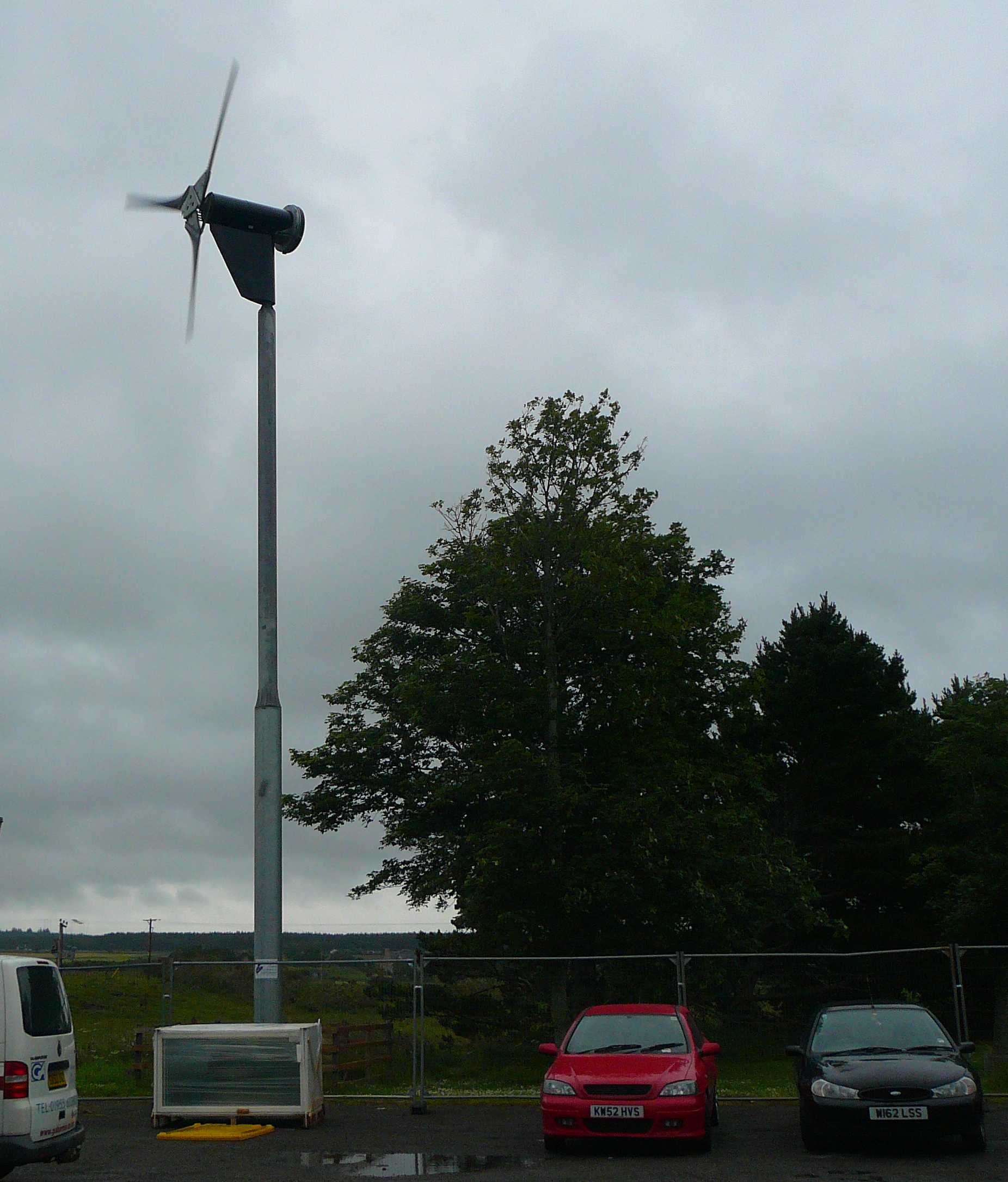
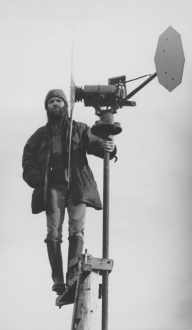
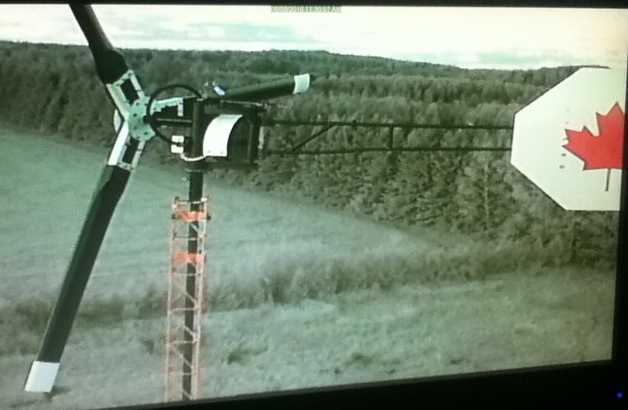
Chris sent me this photo of one of his chain-driven machines, taken with a security camera mounted on a neighbouring turbine.

Chris writes:

This is a photo of one of my 12G turbines on a 200 foot tower that powers an off-grid home in the Boreal Forest of Central Ontario, Canada.  The photo was taken by a remote control security camera mounted on the adjacent tower which also has a 12G turbine on it.  These two machines, combined, have averaged 32 kWh a day on those 200 foot towers, meaning they have each produced an average of 660 watts, 24 hours a day.

These machines are hard at work every day up there, 175 miles from the nearest grid power lines, and the only way you can get to this location where the turbines are is by float plane.  The nearest road, which is just an old logging road that’s not used anymore, is about 40 miles away.  I hauled these turbines up there in May with a De Havilland DHC-2 Beaver converted with a Pratt & Whitney PTA6-A turbine engine in it with 750 shaft hp.  I landed on MacDowell Lake when I delivered the turbines to the remote fishing camp where they are installed.

some people have all the fun 🙂

Posted in construction, People | 4 Comments

Windspeed database still being abused!

This is another rant against misleading salesmen in the small wind industry.

There is a computer model called NOABL that maps the theoretical windspeed over a UK landscape with no trees or buidings.  Properly informed experts have always known that the NOABL ‘data’ needs to be treated with care, and often adjusted drastically.

I did a study eight years ago to try to discredit its use in built-up areas (where people actually live).   Various early reports have shown the same conclusion.  A recent EST report urges caution too.  The MCS approved code of practice gives some drastic reduction factors to be applied in the case of being anywhere near to buildings (or trees).

Still we find that you can enter your postcode in any of a number of websites and be given the NOABL windspeed as if it actually meant something.  Proven Energy offer a few caveats, but when you see the sites their turbines end up on it is clear that they don’t appreciate the effects of sheltering obstructions.

Skystream are actively misleading about NOABL, suggesting that the database is likely to underestimate windspeed (hardly likely in a residential area).

I went to Scaled Energy‘s web site and entered the postcode of Waverley Station, Edinburgh EH1 1BB.  Back came the confident prediction: 5.7 m/s at 10 m height, followed by a stream of exciting figures including the 5 year payback.

I hasten to say that I came across these examples and there must be many more, so I am not trying to single out these companies for criticism.

Ben Cosh of the Green Company studied a large body of secret data collected by EST and found that the ‘MCS adjusted NOABL’ (MIS 3003) model achieves +65% to ‐85% uncertainty in their prediction of windspeed.  The Carbon Trust model achieves +80% to ‐1000%.  That’s a shame because the Carbon Trust model gives a much better intuitive feel for the way the wind behaves among buildings.  But neither model is remotely reliable.

Garbage in = Garbage out

Ben has a very useful list of questions that you should ask your advisor/saleman:
i.What is the minimum expected income for 3 in 4 years (P75) ?
ii.Does this forecast have less than 20% uncertainty?
iii.How does onsite data correlate with long term validated data sets?
iv.What is the measured wind speed at hub height over a representative period?
v.Does your advisor accept liability for the accuracy of energy forecasts?
vi .Does your advisor have professional indemnity insurance that will cover the entire value of your forecast income for the life of the turbine?
vii .Is this professional indemnity insurance valid if your advisor goes bust?
viii.If the bank is using your house as security, what happens in low wind months?

Posted in Rooftop madness, UK small wind scene | 2 Comments

My first ferrite magnet project

Back in the 1980s I had spent ten years building wind turbines that were based on dynamos (USA=’generators’) out of military jeeps.  They were cheap and well made, but they had serious drawbacks.  The magnetism required to make them work took the first 40 watts or so of the power generated, and consumed it within the field coils as a parasitic loss.They also has brushes that required periodic cleaning or renewal.  The standard Scoraig windmill of the day had approximately 1.7 metre diameter 2-bladed high speed ‘propeller’ on an Austin Champ Jeep dynamo modified to produce 12 volts at around 500 rpm cut-in speed.  Given a 10 mph wind you had enough speed and enough power to start working, but low winds meant using the old oil lamps.  In a good stiff breeze you got 300 watts.
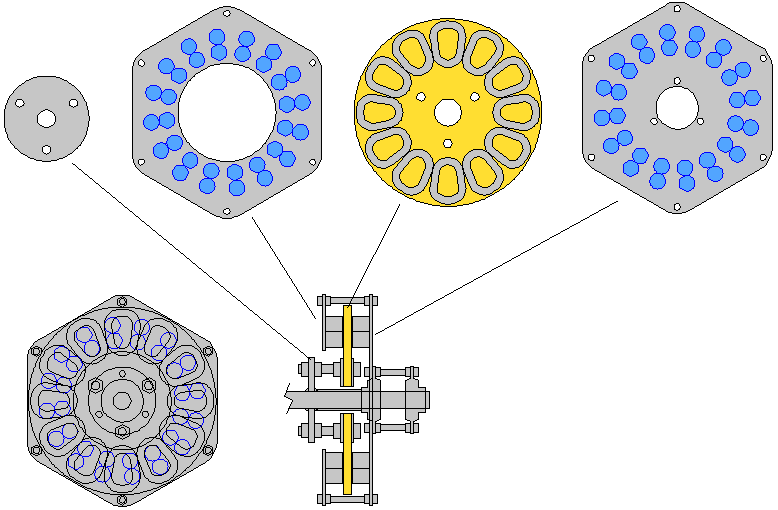
I was hankering for something more like the Bergey and Marlec turbines I had seen that used permanent magnet alternators with neither of the above problems.  I was especially interested in the axial ‘air gap’ design that Marlec had adopted (originally designed by Faraday and used by several others).  Marlec use 2 mechanical configurations, shown here in an illustration from my book ‘Windpower Workshop’.

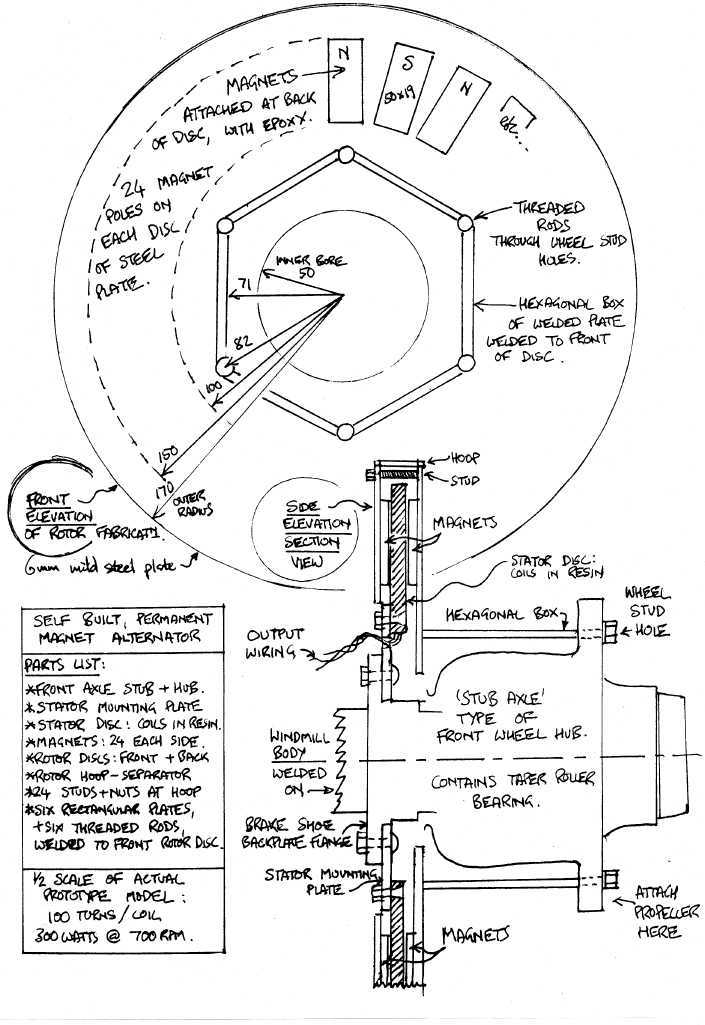
I built and tested my own axial flux alternator in about 1989, and I wrote it up (as a bit of a footnote) in my windmill plans of the day, a booklet called ‘Scrapyard Windpower Realities’.  At the time Marlec were using single phase stators but I chose to go 3-phase and figured out a way of doing this whilst achieving a fairly high density of copper windings in the available air gap space between the magnet rotors.
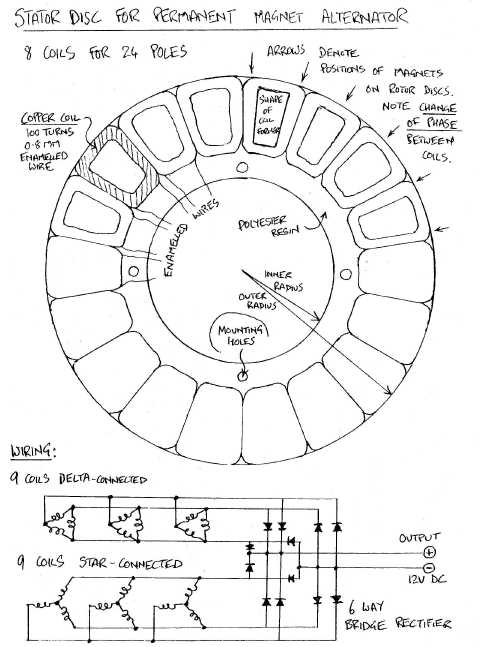
This was in the days when I could still write with a pen.  Now I am so used to typing that I can only scrawl.

I used a combination of delta and star connections in the winding.  The star (wye) connected coils gave improved cut-in (300 rpm, which seemed good in those days) whereas the delta were more efficient at higher speeds.  The idea was to create a sort of cubic curve (power/speed) that would better match the blades.
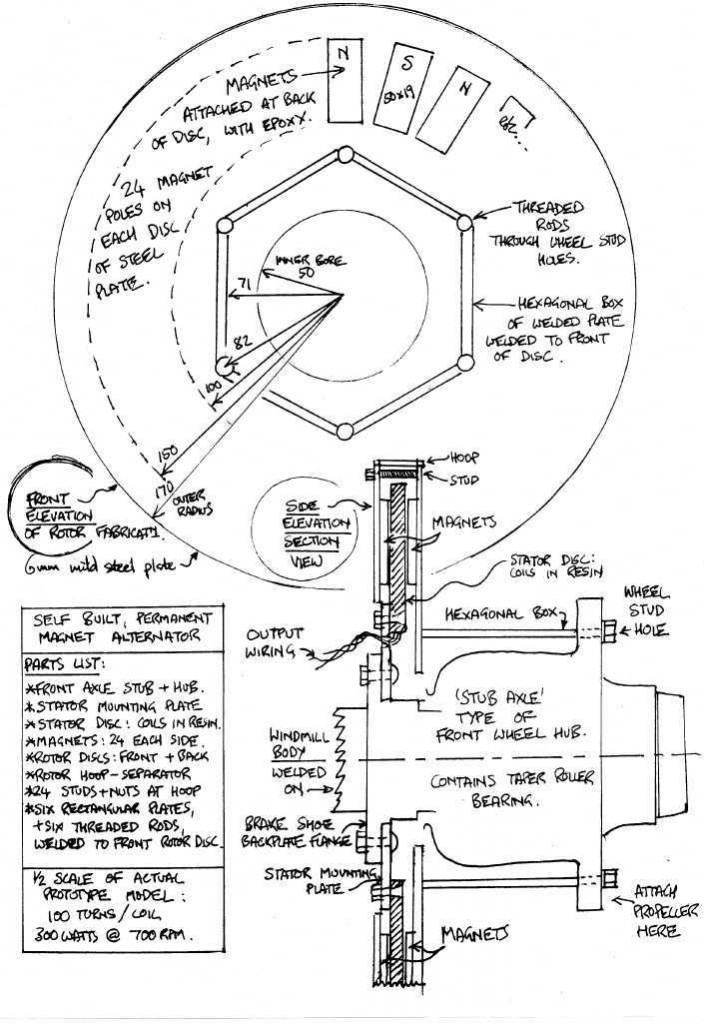
It worked pretty adequately for several years.  In the end the magnets hit the coils for some reason – maybe because they were held in place only by epoxy glue or maybe the stator fell apart due to cracks caused by casting it with pure resin (no powder).

Maximum power was around 300 watts at 700 rpm.  Overall I was disappointed.  Magnets were expensive in those days, and the ones I used were rather thin (6mm) ferrites so the flux was poor.  The construction seemed to me excessively complicated and the performance a bit weak.  It did allow me to use a 3-bladed rotor though, and I gained control over the power/speed characteristics of the machine in a way that had never been possible with modified vehicle alternators and dynamos.

After that I played around with radial flux machines (notably the brake drum design, and the AWP) for about ten years, only returning to the axial style alternator in 1998.  In February 2001 I published another axial flux design in my PMG construction manual that is available free of charge.  It’s by no means the ultimate axial flux design – more like the start of a process of refinement.  And most of the later versions have used neodymium (NdFeB) magnets.  But the axial flux alternators with ferrite (aka ceramic) magnets that I built around that time have proved to be pretty efficient and reliable.
Posted in construction, ferrite magnets, my own projects, wind systems tutorial | Leave a comment

WindEmpowerment

Following the conference in Dakar in February, an association called WindEmpowerment has been set up.

Mission
WindEmpowerment supports the development of locally built wind turbines for sustainable rural electrification. This is achieved by strengthening the capacity of its members through:

  1. Building and sharing financial and human resource connections
  2. Performing joint technical research, sharing technical information and collaborating on key vendor relationships
  3. Strengthening understanding of business and social models for effective implementation of small wind technology

Guiding principles

1) Open information sharing
2) Respect licensing rights where they exist
3) Work together collaboratively
4) Accept of different views and different communication and work styles
5) Work for the success of all
6) Inclusive – get others to join, collaborate with association
7) Make a reasonable effort to build consensus on decisions

Membership criteria
Collaborator classes & qualifications:

  • – Member: Must be an institution, implies voting rights, must align with full mission
  • – Participant: Can be an individual, no voting rights, website access, can just be an interested party

There is also a Facebook page for WindEmpowerment.

Posted in developing world, Notices | Leave a comment

“Yet another axial” down under

Another ferrite magnet alternator project.  This one is on the Backshed discussion board hosted by Glenn ‘Gizmo’.

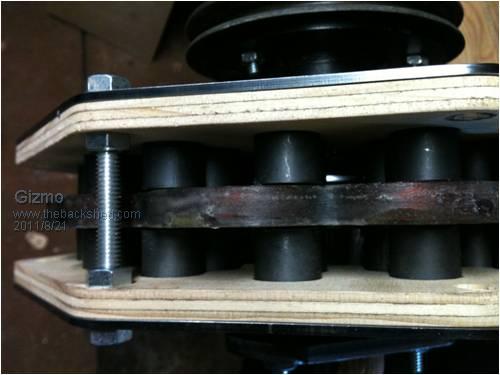
The stator is supported at the centre, which is a bit more compact but the supporting bolts between magnet rotors restrict the overall size, and the stator mounts are more critical.  My first ever pma was a bit like this, and I have been thinking about posting about that one day too.
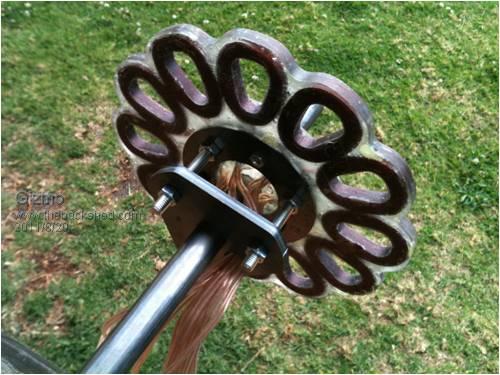
The stator is really quit a beautiful if delicate thing:

12V cut-in is at 170 rpm.  Glenn used 132 turns of 0.91mm wire in each coil and then connected the phases series/parallel in pairs.  The 3 phases are wired star/wye.  I would not expect it to be able to sustain more than about 2-300 watts for long periods.

The magnets (which are surprisingly long) seem to be held in place with plywood.

Posted in construction, ferrite magnets, People | Leave a comment

4200 alternator options

I haven’t built a lot of turbines 4200 mm diameter (14 footers for the North American market). I use 16 magnets the same as the 3600 (12 foot) turbines but put them on a larger disk (450 mm/18 inches) compared with 400mm/16 inches. This allows me to put in a lot more copper to compensate for the lower rpm of the larger 4200 rotor blades.

However Jay Hudnall of Tripalium and Tieole in France has told me that he uses 20 magnets on the larger rotors and gets a higher power output.    With the rising price of neodymium magnets this might not be very attractive to people in low wind areas, but it does offer better efficiency and higher peak output in stronger winds.

For those who wish to charge 48 volt batteries, the 20 magnets recipe is to use 54 turns of 2 mm diameter wire in 15 coils.  For grid tie, using a Windy Boy 2500 inverter use 260 turns of 0.9mm diameter wire.   The 20 magnets allow you to comfortably reach a peak output of 2500 watts instead of the 1700 watts that I would normally recommend.  This inverter also operates at a higher voltage (up to 600 volts) whereas the 1700 only goes up to 400V DC.

Higher voltage and higher peak power will not win you much extra in the low winds when power is scarce, or the medium winds where most of the energy comes, from but it does improve the efficiency and productivity in higher winds for those blessed with really good sites.

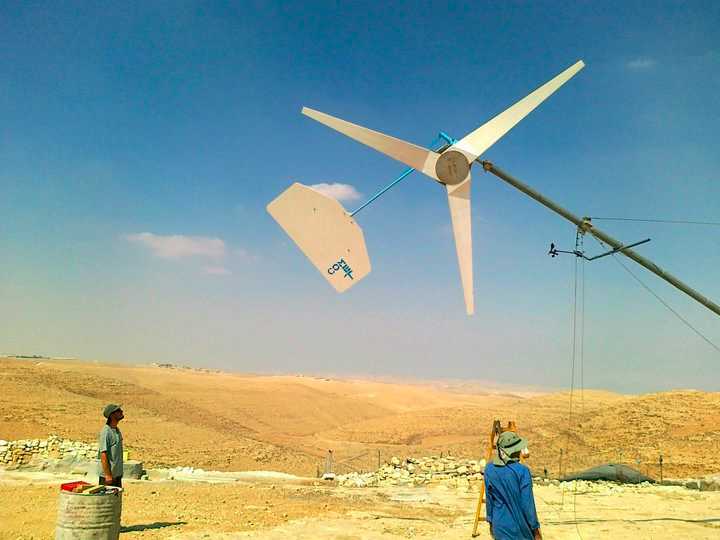
Comet ME in the middle east are using these 20 magnet rotors in their latest project at Tubah.

Posted in CometME, construction, developing world, France, People | 13 Comments

Frans Beudt’s control systems

Frans Beudt  lives in the northwest Netherlands.  Average wind 5,5 m/sec

Youtube channel here

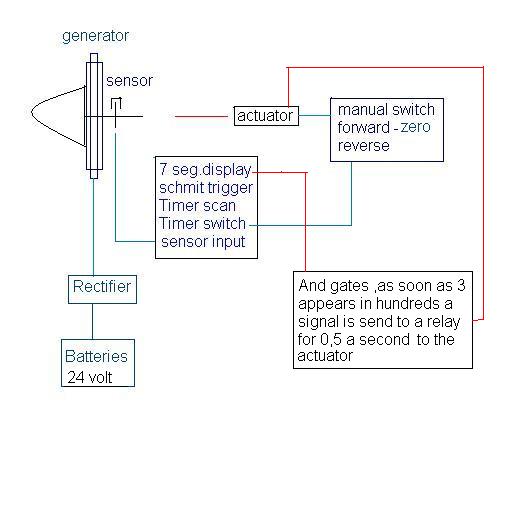
“Testing the windmill at 5 Bft .  Results till now OK ,   Rpm stays around 300 , Amps 20 ,Volt 30 .  Electronic system doing good .”

“The actuator is made of a battery-screwdriver with a threaded rod m6 and a travelling nut , distance adjustable with micro-switches.  The blade-angle can be controlled by Rpm ,Manual, and anemometer with a micro-controller.  A generator can be connected with a timing-belt or co-axial with your design (which I made before succesfully).  It’s not for beginners ,but I like mechanical-engineering.”

Below is an older concept for control by servo on the tail.

” The tail is moving by a small actuator ( as used for adjustment hospital beds).
The generator is made according to your design and it has an electrical break , double safe .  The rotor of 10ft has a lot of extra power . And I see sometimes burned stators on Internet (Alan)  I decided so.”

additional information addes 24th August:

“My findings : In high wind there is a direct effect to a lower constant  rpm 300 .
I can hear a low noise level of stall in high wind.
Nice load current 20 – 25 amps.

The electronical circuit board can be more compact .It takes 400 millies max.
An LCD readout is preferred.
Waiting for more wind .
Regards : Frans.”

Posted in construction, People, Video links | Leave a comment

V3 now sell complete wind turbine kits!

These bespoke kits comprise of a set of three hand-carved blades, a complete alternator, mounting and an electrical system. We have been building these turbines for over 5 years and as a result you can expect the highest degree of craftsmanship. The kit does require some assembly and assumes a certain level of knowledge about renewable energy and wind power. The kits are designed to charge a battery bank and can come as a 12v, 24v or 48v system.

V3 website here

Posted in construction, People, products/technical, UK small wind scene | Leave a comment

Single phase, chain driven alternator project with ferrite magnets

Chris Olsen has been busy experimenting and reporting his findings on the Fieldlines board

This single phase stator for a ten magnet dual-rotor turbine is his answer to the rising cost of neodymium magnets.  As always Chris is pushing against the accepted way of doing things (3-phase, direct drive etc) so his project gives rise to some interesting discussions.

As an update to this post I offer this link to a discussion on the ‘Backshed’ forum where Chris describes his latest (2-bladed) creation and I argue the case for single stator alternators.

Posted in construction, ferrite magnets, People | 4 Comments

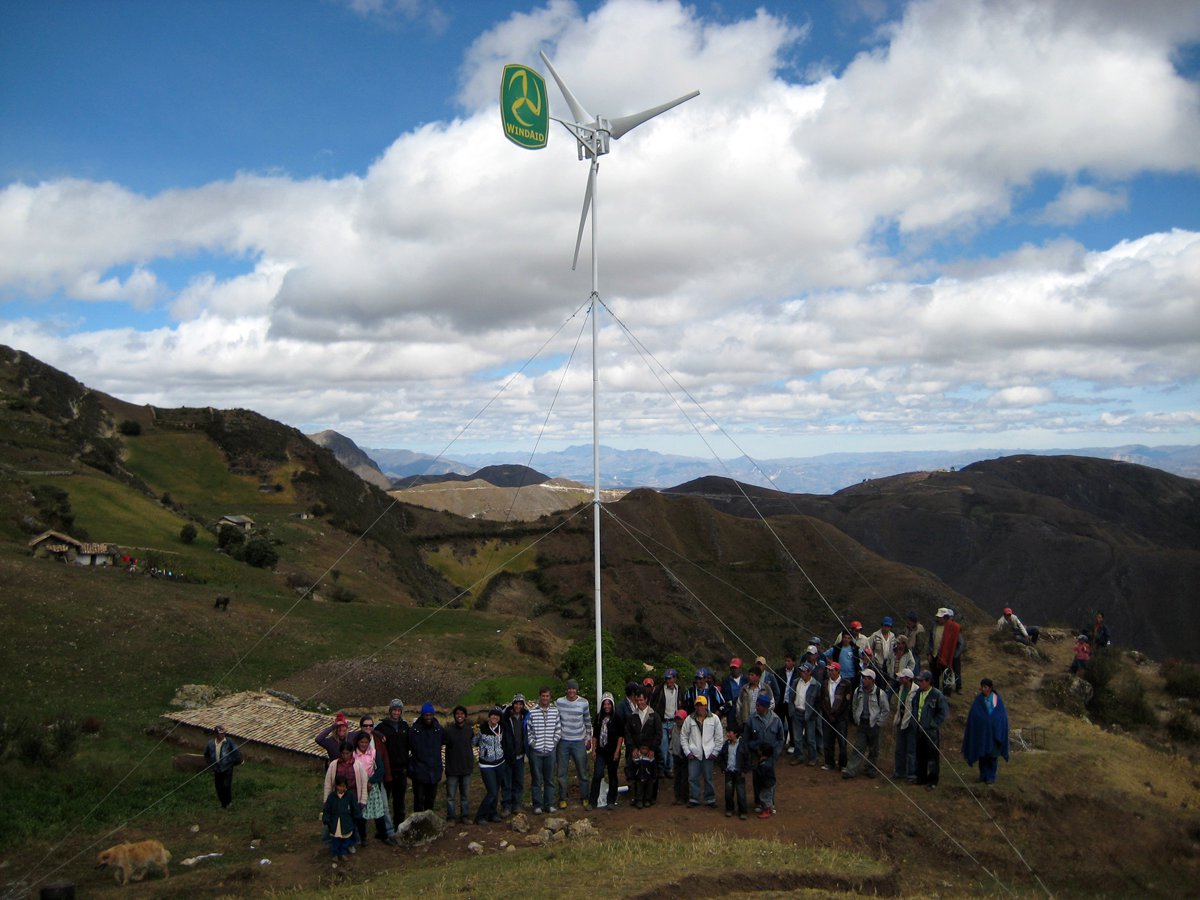
WindAid Volunteer programmes in Peru

WindAid is a non-profit social responsibility organisation based in Trujillo, Peru and we run environmental development projects building wind turbines for communities in Peru without access to electricity.

The dates for our upcoming programmes are:

·  FULL!!! 18th July – 19th August 2011

·  26th September – 28th October 2011- 2 spaces left

·  7th November – 9th December 2011- 6 spaces left

·  30th January – 2nd March 2012

·  26th March – 27th April 2012

Posted in construction, developing world, Notices | 2 Comments