
Charge controllers can contain many things, including meters, fuses/breakers, and even MPPT devices but their main function is to control the way the turbine charges a battery so as to prevent overcharging it.
Solar charge controllers mostly ‘turn off’ or ‘turn down’ the power from the solar PV panels when the battery is full, but most wind turbines (and hydro turbines) need to be kept on load which means the energy needs to be diverted to a heater to prevent noisy over-speeding of the turbine and harmful over-voltage in the wiring.
I have published plans for building ‘dump load’ controllers using relays:
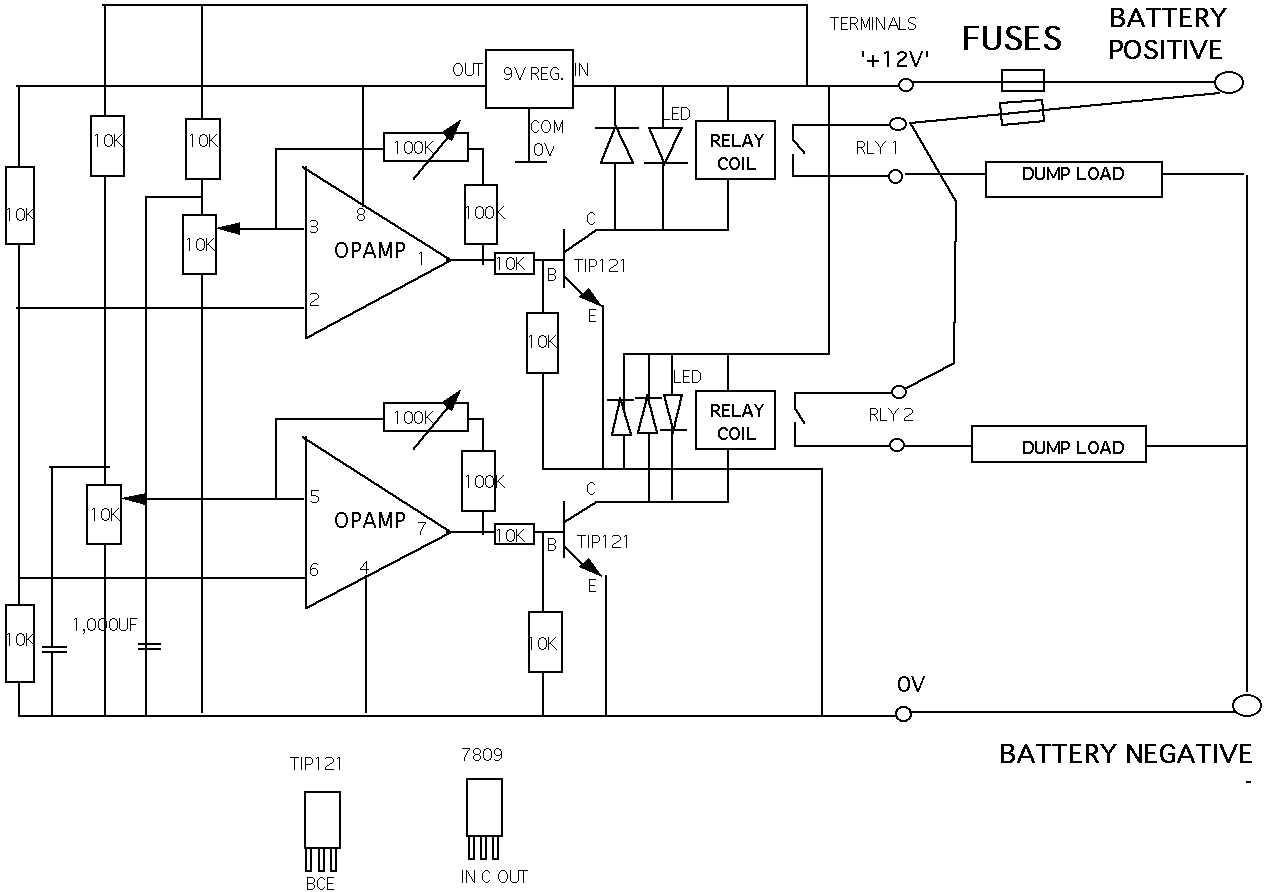
You can also buy controllers that work using relays from a variety of sources. The Morningstar ‘Relay Driver‘ is a software driven version with numerous options including both thresholds and delays.
This relay-based type of controller has some advantages – you can switch AC heaters on and off at grid voltage (via an inverter) or you can switch the turbine over from the battery, directly onto heaters and stall it out into a slow operating speed. The relay is relatively quiet in switching operation (a brief click).
On the downside it requires multiple small heating loads to control the battery smoothly or the voltage will oscillate up and down rather wildly. So you effectively need multiple control boards and multiple loads and multiple wires around the place for smooth charge control.
A much simpler, smoother voltage control can be obtained with a single heating load connected to a PWM (pulse width modulated) solid state controller that you can buy cheaply. These ‘third party’ controllers from Xantrex and Morningstar also have more sophistication. They can adjust their own voltage setting based on temperature and the length of time on charge. These controllers use transistors to switch the heater on and off very rapidly so as to control the amount of power being dumped.
The Xantrex C40 product was originally by Trace Engineering (a great company that got bought out, long ago) and was revolutionary, but is now obsolete. The Morningstar Tristar has much better response in operation, and easier to configure.

Both the Xantrex and the Tristar controller will make a buzzing noise in operation and so will their heating loads. This noise can become an issue with some users. For me it’s the sweet music of renewable energy, but my dump heater is deep in the hot water tank, which damps the sound.
Installing a Tristar controller
Buy a Tristar controller or a Relay Driver
Relay Drivers for load management

A solar charge controller manages the power going into the battery storage from the solar. It ensures that the deep cycle batteries are not overcharged during the day light and the power doesn’t run backwards to the solar panels overnight and drain the batteries. Some charge controllers are available with additional capabilities, like load control and lighting, but to manage the power is primary function. There are two types of solar charge controller PWM and MPPT.
MPPT or Maximum Power Point Tracking is an algorithm that includes charge controllers used for extracting maximum available power from PV module under certain conditions. The voltage at which PV module can produce maximum power is called ‘peak power voltage’
The Enertech provides MPPT Solar Charge Controller at very affordable price and that’s with high quality and Durability.
Pingback: Load Sensing Valve In Trucks | Kiely For Oregon
Hi Hugh, I have a Rutland 910-2 wind turbine + a 300w pv panel. I was previously regulating this with a Marlec HRSi controller. However I inadvertently blew this up (There is very little space to connect the wires). I always felt that the hrsi was over-regulating the wind, whilst solar wss fine. Any advice on a suitable charge controller, off the shelf would suit be best. Regards, Paul
Hi Paul,
When connecting the wires to the controller you should remove the battery fuse and stop the windmill and unplug the solar so that there is no voltage present. Easy to say that after the event, but it’s true of any wiring work. Working live tends to result in sparks flying.
The Marlec web site says the controller is set to 28.8V at 25C which should be OK for most batteries. I’ve never used one so I can’t say how well they work. Maybe they don’t keep the voltage at that level long enough? Some controllers adjust the absorption period based on how long it takes to reach absorption voltage or based on what the lowest previous voltage was. Tristars use the latter approach. I always use tristars in diversion mode for turbines. You can set the absorption voltage to suit the battery type and use.
Have fun
Hugh
Thanks Hugh,
Yeah, a bit annoyed I blew it, wind turbine was down & solar covered whilst wiring. Put wind turbine back up to discover flickering lights and then a loose connection. Should have taken turbine down again rather than poking wire back in!! Didn’t have my best head on!!
Looked at Tristar but seems I would need 2,’1 for wind+ 1 for solar and thus double the cost! Am I understanding this right? If so might just go again on Marlecs HRsi and learn my lesson (there really is very little space to get biggisg wires in, but sure, do-able aswell) Just checking i’m not missing a trick before I go again….
Thanks, again
hi
You can use one tristar provided that it is capable of handling the total current and you have a sufficiently large dump load resistor or heater connected to it. Check out this page http://scoraigwind.co.uk/installing-and-configuring-a-tristar-controller-for-a-wind-system/
If it kills the marlec controller when you connect a runaway windmill to the it then it seems a bit too vulnerable. With Tristar diversion you connect your windmill to the battery (via a fuse) and this won’t kill anything provided you don’t ever disconnect the battery leaving the turbine connected to the controller. Always use a separate battery fuse for the windmill and other battery fuses for controller, inverter etc.
cheers
Hugh
Hi Hugh, I have been considering your advice….
It seems that the TS-45 would be more than able for my Marlec 910-2 (or something similair again when this dies) plus 150W PV. I would buy this from you. can you give me the full price incl delivery to Kerry, SW Ireland. Also can you recommend a suitable dumpload and can you supply this also?
Regards, Paul
Hi Paul,
I can supply a Tristar 45A controller for use in diversion mode for delivery to Kerry in Ireland. Cost would be €205.00EUR including delivery and VAT. If you are interested I can provide an invoice with bank details for payment into my euro account.
For diversion loads I recommend these resistors that you can buy locally. Use two in series for a 24V system to dump 350-400W maximum power.
cheers
Hugh
Hallo Hugh,
I am Marcus from Italy, I have been reading your site with great interest .
I am starting my “Alternative Energy Adventure” with 250W 24V solar panels first with 500w to get up tp 1000-1500Wp, and would like in the future to get a 500w Wind generator, and I would like to use the extra-power for using 220V AC waterpumps / 220V AC water heater witch are at least 50m away from the batteries/regulator. So I am thinking about the Tristar TS60 PWM controller (or a Xantrec C60 but don’t know if it is good enough?), using a relais (switched on by the 24V coming out of the controller) to control the 220V AC load connected to the inverter. To not have the load going on and off continuosly, I am thinking of using a “relais with timer” (for example 5min), would this be ok? Would use the water-pump only when I am looking on it, otherwise the 2000W water heater (500 liters). Is there a way, in the case that the inverter cuts of for some reason, to get an extra DC-dump resistance to connect to prevent the batterie voltage to get to high??
Do you sell the Tristar TS60 or other good stuff such other regulators or a tough inverter (3000w constant), could you sell it to me and send it to Italy? How does it work with the customs?
Thanks
hi Marcus,
I recommend that you use a Tristar (which is a little better than the C60) connected to a DC load so that your batteries will always be controlled, even if the inverter or its heater are not working. The best way to run a 220V heater from this would be to use my “tristar follower” circuit that I published here. (Find it in the drop down menu). If that is too complicated then yes a simpler relay that is on fully with a delay would work ok to get some heat and keep the battery charged. I like to use a “relay driver” for this kind of system, and there is another product called a “voltage controlled switch” or VCS by solar converters that is very easy to set up with two voltages: on for on and one for off. It’s also possible to build something yourself if you are inventive.
I do indeed sell all this stuff including controllers, inverters, relays and so on. I can send it to you in Italy. Just now there is no worry about customs but with Brexit there may be more difficulties one day. If you send me an email at [email protected] then I can suggest a list of things you could use and also their prices.
I hope this helps.
Hugh
Hugh
Thanks for all your years of helping us (lost ? individuals).
I am looking at setting ups a solar and wind turbine system. I am targeting 15kwh per day ( I know this is really high). On the solar side I am thinking:
3.6kw solar panels
Magnum pt-100 charge controller
Magnum ms4448PAE 120/220 in US
48V 850 ah forklift battery
Load diversion at >57V to a square wave inverter tied to battery with SS relays controlled through the pt-100. This will go out to two 40 gallon water heaters daisy chained (change out the bottom controller of the first water heater with an (additional) top controller. Run from the bottom of the first to the top of the second. And maybe a third.) A system that works pretty well.
Winters we get only about two hours of good sun, summer 6. We get mostly 6 Mph winds. Which is a problem… IF I can get my 7Kwh/day in winter that would be great. Sacrifice high speed wind power for low speed. As a guess I would say we get about an hour of 20 mph per week.
What I was thinking was a 20ft axial flow set up for low wind. Tie it together with a hi volt (600v?) mppt controller(2nd controller in system). From what I can tell they are usually set up for 48v at 60 rpm. Which if my numbers are correct would be about 6 mph wind speed (tsp ratio 7?). Maybe set the coils for 100v at 60rpm (45 turns vs 91, stator too thick?) or maybe drop the tsp ratio (5?), both?
The second part of that is; will the load diversion for the solar still function? Say it is midnight and the turbine fires up, brings the batteries to >57, will the water heaters kick in? Assuming so (and the water heaters reach temperature). I program the load diversion from the turbine controller(some other load not the water heaters) to kick in at >58V(battery).
Does any of that sound correct? Some? Or am I better off just going to 6-9KW of solar and let the system shut down at 10am for 8(?) months a year?
Thanks for any direction you can give.
Lazlow
hi Lazlow,
sorry I forgot to reply before. It’s a long message and I am not sure what you are asking. If you have no wind then you will get no power. However you are right that a low wind needs a large turbine with a low power rating. solar may be more reliable. MPPT is tricky because you also need to protect it against over-voltage. My opinion is that MPPT only helps to work over a wide range of winds. If you are focussed on low wind then do not bother with MPPT. Just design for that low wind range. Keep it simple and robust and make sure it furls well in stronger winds and does not get damaged. YOu can use a single diversion load controller for both solar and wind diverting to heat. With a forklift battery I would charge it to 60 volts at first and float at 55 or so. But use a temperature sensor as well.
As for turns per coil I’d need to know the full specification of the magnets and so forth to answer that question.
I hope this helps.
Hugh
Thanks Hugh
I built a spreadsheet to simulate most of the variables and even if I had 10mph winds daily I would still be MUCH better off with more solar than even a 22ft turbine. Most of the “best” solutions I came up with had me furling at 20mph(or below) even when using three #14s. The changes is stator resistance really surprised me on the effect of the total output(bigger wires did not always mean more output). Funny that it is not the money of the alternator that gets in the way as the price of the tower. Building a 80 ft tower to hold up 450lbs of turbine is expensive.
It was a good learning experience. I wish schools would have a semester on energy and go through things like this and solar. Just so everybody would have a better understanding of what is possible and what is not. After doing this it became VERY clear about the lack of truth vendors claiming 1000watts off a six foot turbine in “low” winds.
Thanks a LOT
Lazlow
Hi Hugh,
With a wind turbine of 12-15V, where this the maximum limit (in amp), for apply in the input of a Tristar TS-60?
60 Amp, 100 Amp, or more…?
—-
And I have a curiosity about something: Is it possible that if I had (permanently) 50-60 Amp (fantasy dream, of course), from a wind turbine that work the 24 Hs, I can spare me all the batteries, and apply the 12-15V & 50-60 Amp directly into the inverter input to 230VAC?
In this theory, that can happen if the inverter does not provide any external load (such as at night, that everyone sleeps in your home and almost no energy expenditure, or very, very little), and the turbine continues the run, nonstop ever?
I fear the worst to happen, or not?
Wonderful your job, keep it up!
Regards.
Hi,
I would like to know, How we can we control the charging on day time through the electricity that means during the sunny day i would like to charge the battery through only panel not through electricity.But on night i would like to charge through electricity also.So in this matter i need a help from you.
Subakano,
I think you need an inverter (DC to AC), and with internal battery charger.
Look for Victron Energy: victronenergy.com
Hi Hugh,
Did you ever manage to solve the audible noise coming from the Tristar dump? I hate having to waste that dump heat so have moved the dump load into our bedroom but with the buzz have to divert the dump at night time because of the noise. I would presume you could suppress the noise somehow with a capacitor/inductor in parallel?
Other than burying the dump in a water tank (which I now may so after reading your post) is there any other options?
Hope the weather is treating you good up there in Scoraig. Best wishes from a windy Co Kerry in SW Ireland.
Shane
hi
You can’t filter the current because that would damage the controller if successful. It has to work in pulses. Your best bet is to use a quieter heater. A coil is naturally noisy to maybe try a length of resistance wire threaded around the room? IN the old days I used steel telephone wire that had a plastic coating for a dump load. I wonder if that would be immune to buzzing. I have not tried it though.
Perhaps bury the heating wire in a box of sand like a big storage heater? It’s an interesting problem and one that could worth sharing successful solutions. I just put it in the water tank. Another option is to use a relay driver to turn heaters on and off quietly based onthe % PWM of the tristar.
Hugh
please I need help I buy 48v 200w solar panel and I want to use it with one12v battery how can I do it?
hi
you can simply connect the solar panel to the battery. It will charge, it but it will not produce so much current. It would be better to have a battery that matches the solar panel. But it will work like that. Take care you do not overcharge the battery. If you decided to use a charge controller then make sure it is able to cope with the high Voc of the solar panel. Or use diversion as described here.
Hugh
I have problem with my solar
Ok, thanks for your advise!!
If i use MPPT controller what do you think total charging i have to get??
81V is not showing in controller, it just only showing in my volt-meter in controller it stated between 47.8 up to 52V
Hi
and thanks for reading my post.
Firstly my system
4 * 150W 12v solar panels(parallel for 48v output)
4 * 100 AH deep cycle batteries( 4 in parallel for 48v)
1 * 48v 60amp PWM charge controller
1 *5000 watt Pure sine Inverter
now my problem,
Do i have enough panel to charge this system, i mean is those 4 panels good for charging system around 80% per day??
I am in Yemen and my controller in meddle of day stating 7 amps? so is this mean 7 for all panels or mean 7 amps for each panel??
I use my volt-meter and measured panel output and it give me 81V !!!
Thanks in advance
hi Maher,
You need to connect in series for 48 volts (nominal) and if you got 81 volts that means that you did connect them in series. That is open circuit voltage or Voc and it’s OK.
7 amps is OK output for 150 watt solar panel and if you have them in series for 48 volts they all bave to produce 7 amps at the same time to get 7 amps output to your battery. You can maybe expect to get 9 amps from them. It depends on the sun and the temperature and stuff.
You should only use 50% of your battery each day. So you would want 50 Amphours or more, and in fact you can maybe get that – I don’t know. Not in Scotland! I would suggest you should aim to use about 40 Ah each day with that system and it will put back 50 Ah and the battery will be happy. After some days, check the specific gravity of the battery. If it is low then you are using too much. The size of the battery is OK but you need to be realistic in what you use.
Have fun
Hugh
thank you for quick reply !!!
Sorry i connected it in parallel, so they give 81V.
just my question again is it 7 amps for each panel and that mean 28 amps per hour or no?
I know the controller would only showing 7 amps but in fact it is 7 28 amps
81V is not showing in controller, it just only showing in my volt-meter in controller it stated between 47.8 up to 52V
The controller should be connected first to the battery. This will be at 48 – 52 volts. When you connect the solar array it will no longer be open circuit and its voltage will fall to meet the battery voltage.
you connect the positive of one panel to the negative of the next and this is called series and gives a higher total voltage. However the current is the same as the current in each panel which is only 7 amps and not 28 amps. For 28 amps at 12 volts you would connect all the positives together and all the negatives together, and this is parallel. Parallel gives lower voltage and higher current. Power is the same in either situation.
Thank you.
this not good as 7 A/h not enough for me!!
I have other idea, i would connect my panels in parallel and this mean 12V and around 30 amps this would be charge my 4 batteries around 200 AH per day and at night i have to discounting controller and connection batteries in series and use my inverter!!
Do you think it is good idea
Also i have two panels 250w (24v) i have to connect it in series and get 48V but i am not sure what would amps i would get???
W. Regard
hi Maher,
first of all I have to make clear that there is no such thing as A/h amps per hour. Amps is a rate of charge. 7 amps at 50 volts is 350 watts of power. Over 7 hours that makes 7 x 7 = 50 amphours of charge into the battery which is very good.
You will not improve anything by changing between series and parallel. Whatever the voltage of your inverter, use the batteries and the solar PV array at that voltage. 48 is a good choice. 7 amps is a good rate of charge and 350 Watts is ok for those panels. You will not see the full “Watts peak” unless you use an MPPT controller, and its better value to buy more panels than the buy one of those. I expect that sometimes you will see as much as 9 or 10 amps in good sun. Take care you do not cast a shadow over any part of any one of the panels.
Hugh
Thank you
I feel a bit more confident after your comments, by the way its a 48 volt system.
thanks again Richard
Hello Hugh
Please can you advise,
I have a small pv system, 2.7kw pv panels, trace c40 charge controller large battery bank 48 x 2 volt deep cycle lead acid.
The system is 18 years old and as never pushed out the full 2.7 kw I have only seen it once at 2100 watts and believe this was due to edge of cloud effect.
I am looking to buy some more pv capacity.
My question is would it be OK to install another c40 controller alongside my existing one.
thanks Richard
hi
It’s not clear what your nominal battery voltage is but the Wp of the PV would very likely only be obtained when the battery voltage is a bit higher than the normal range. So it’s no surprise that you only got 75-80% of this Wp rating.
Yes you can conect more PV through its own controller which could be another C40 or a Tristar. The tristar has faster response which can be handy for wind but makes little difference for PV.
Make sure you connect the PV arrays separately to the 2 controllers. Do not parallel them upstream of the controllers. The controllers will not necessarily agree on the timing of when to move to afloat stage, but in the end this does not actually matter.
Hugh
I have purchased 300w solar collectors and a 400w verticle wind turbine and 150ah deep cycle Gel battery, for remote off-grid use. Potentially producing 25amps. The manufacturer assures that the dual controller supplied will work without problems (?).
To have more choice in siting the solar collector, I have opted for 20m of 10mm cable rather than the usual 5 or 10m of 6mm cable. What options are there to minimise voltage loss? Add additional relay in the 20m cable ?
hi David,
I obviously can’t comment on whether the controller will cope as you give no info about it. A lot depends on how closely you monitor the system. If you keep an eye it will likely be fine but if you leave it for periods of time then it would be wise to allow a factor of safety in case the wind turbine produces more than it is rated to produce.
You can save on loss in the cable by using MPPT control but for such a short run you would do much better to pay for the copper. Actually the loss in PV output will only be a “problem” when the battery voltage is high, and the chances are that the system will already be regulating the output by then, so I would not lose sleep over a bit of volt-drop in the cable.
Hugh
Hi Hugh, I have been studying charge controllers like the one you’ve posted as I think this is a safer option for me & my project. I am wondering if you could tell me why these designs tend to involve two op amps or comparators?
Thanks
hi Chris,
In my homebrew design I use a dual op amp chip for each board. I would usually install more than one board in reality. The reason is that relay-based charge controllers are a bit rough in action. If the load is big enough to dump the full power then it is much too large most of the time when you only want to dump a little power. Multiple small loads make for smoother control of voltage with less switching, and less wild swings up and down of the battery voltage. With pwm devices (such as the tristar) the switching can be extremely rapid and it is fine to use a single load.
Have fun
Hugh
i am a student doing project on pwm solar charge controller without microcontroller so wat are the requirement of this project plz give details of the some circuit.
hi Prasant,
Check out this link for a controller you can build without a microprocessor. Unlike the ones on my own site is uses a FET to switch. http://www.ghurd.info/
Maybe if you bring the on and off voltages very close together it will work like PWM? Very fast?
I hope this helps. You can also try asking on this discussion board to see if anyone else is working on this idea. https://groups.google.com/forum/#!categories/wind-empowerment/students-looking-for-projects
Have fun
Hugh
Yes I am happy to share my finished design. I will research these methods further and hopefully find something that fits my project. I am planning to do my design work in Multisim.
Thanks for the tips 🙂
Hi Hugh,
I am planning to build a charge controller for an Axail Flux Windmill as my 3rd year university project. The windmill has been built by previous students following the “A Wind Turbine Recipe Book”. I have been looking at the Schematic you posted but my research has so far pointed me towards PWM. I was wondering why you chose a relay based design? Any help would be appreciated.
Thanks
hi Chris,
I did mess around using transistors of one sort and another to switch high currents in the 1990s, but they seemed to die rather often so I decided that relays worked more reliably for me as an amateur electronics person. That’s not to say using transistors won’t work for you. If you do go that route I am sure the technology has moved on since the days I tried it, and you will find something more robust for a fraction of the cost.
Make sure your current and voltage ratings are much higher than the duty you expect them to perform.
I always work with analogue electronics projects but I suspect that nowadays it would be best to use an arduino or a raspberry pie to drive the whole thing and do most of the design work in software. A microprocessor can pretty much talk straight to a FET . Or so I am told 🙂
Have fun, and maybe publish the result for us?
Hugh
Hi Hugh,
I have got 600W SPV panels, a 30 A charge controller and 200 AH Battery. I connect the battery to an inverter and light my house. My load is approx 250 W at 230 V AC.
What happens is – in the evening, the battery runs out of charge and then the inverter shuts down, then I have to manually switch to the mains grid power and turn ON the supply in the house.
Do you know any circuit which will sense battery voltage and switch the supply from Inverter to mains grid and vise a versa.
What that circuit should do is – as the battery discharges to 11.20 volts (i.e. 50%) it should trigger a relay from NO to NC (i.e. a 12v relay coild should turn off the relay below 12 v DC). Relay’s pole is connected to the Load, NC is connected to the mains grid and NO is connected to the inverter output.
Thanks,
Mandar
Check my site to see diy wind generator controller. Part list and all. Just solder it together.
hi nykanen43, I had a quick look at your site where you show a circuit for a relay based controller. Looks un-necessarily complicated for a DIY circuit, but presumably works well. One hint: set the controller to reset and re-start charging before the voltage drops as low as 11.9. If you stop it charging at 14.8 volts and then you are out of action until 11.9 volts you will cycle the battery right down. Better to come back in at 13 volts or over, so that you keep the battery in a well charged state so long as the wind is blowing.
Hello i have a PWM EPSOLAR charge controller VS 4048 which can take maximum PV voltage upto 96 volts , maximum amps of 40 amps and maximum nominal battary voltage 64 volts . i want to connect a 3 kw array of solar panels to this controller with an indvial panel is of 100 watts and having these specification
Isc: 5.80 – 6.50 Amp
Ipm: 5.1 – 5.6 Amp
Vpm: 17.7 – 18 Volts
Voc: 21.2 – 21.4 Volts
with total nominal voltage of 48 volts and 400 AMP/HOUR in battery bank
can i connect my pv array and charge controller with this VS 4048 charge controller if not then how much i could connect to this charge contoller
hi
I do not know this controller. Nor these panels/modules.
You can put 3 or 4 panels in series. If you have 3kW you have 30 of them? But you can only use 40 amps at 48V which is 2kW or twenty panels. Maybe try five parallel strings of four in series each string. Connect the rest in series strings of 3 and use a tristar to control them. why not run a heater off this lot?
have fun
Hugh
250 metres is a long way to go with 48 volts yes so it is worth considering a higher voltage for the transmission. Mostly what I do in such cases is to wind a stator for about 100-150 volts working and use transformers to step the power down to battery voltage at the rectifier. This can be a bit complex to design because transformers are designed to work at grid frequency (50Hz here in UK) and the wind turbine may be working at a lower frequency. So you need to consider that as well as the ratio between primary and secondary turns in choosing your transformers. Maybe I ought to post a worked example on the blog because it’s a process.
Another way to go is to convert to DC and use a fancy controller. The only one that is supported for doing conversions like this on a wind turbine is the midnite classic. You’d also need a clipper to go with that, and a fair bit of geeky enthusiasm to learn how to work them both.
Another option is to keep your batteries and inverter at the wind turbine. This always comes up in such discussions but I can’t remember anyone ever actually doing this in practice. It should work fine so long as you don’t need bit surges of power for starting motors (fridges etc).
Another option that is getting more popular is to use a grid-connect inverter with the wind turbine and feed the power into your local ‘grid’ as created by the inverter. There are some inverters that can cope with this ‘AC coupling’ approach (“sunny island” by SMA for example). They will use that power to charge the battery if there is no demand for it. You’d again need a protection device (like the clipper) to prevent damage to the inverter in the event that the power is not being used for any reason.
So there are a few options there to think about.
Hello ,
I live in a remote site on the sheltered side of a mountain . 250metres away at the peak of the mountain is an ideal windy spot . I´m looking at a 1000w wind turbine which will be probably be made using your designs . The problem I have is staying with 24v (or better 48v) or invert to 240v ac . I don´t want to spend a fortune in thick gauge wire (trying the scrape yards). If I convert from dc to ac , do I need a charge controller , a battery & a (?watts) inverter . Do I leave the inverter permanently on or have another fine double wires , with a switch down at the house .
Question : Does there exist a type of inverter that could connect directly after the rectifier of the PMG of the wind turbine ?
Wind turbine – ?voltage regulator ? -special inverter – Cheap cable down to the house to my inverter/charger that accepts 240v ac (from a small generator).( I know that an inverter takes the energy from the battery depending on the load . This is the reverse & would invert the energy depending on the amount that the wind turbine made .)
Thanks alot Hugh .Hope I haven´t fried your head , but there might be a market here because the most ideal place for a wind turbine is probably quite a distance from a sheltered house .
hi hugh, i did the course in ireland run by eddie at imecofarm and will soon be making one of your turbines, got the magnets and wire so nearly ready to go.
i also recently bought a liten 1kw turbine aswell, 48v system and 4 12v batteries at the moment. its been running great for a month but i think the controller has blown a resistor and is not switching to its built in dump load in the last day or 2 and i think it went over voltage and damaged the 2500w inverter i had connected. haven’t got it connected in to house permanently yet, have just been testing it out. was not that happy with the controller anyway so am thinking to get one of the controllers you sell, the morningstar or tristar.
maybe you could recommend whats the best way to use the power. prefer the idea of batteries with inverter rather than just heating water.
and give me prices of the controllers
thanks in advance
fergal
hi Fergal,
The most likely reason the controller and inverter would be damaged is that the battery was not connected securely. If there is a momentary loss of connection then the voltage will shoot up and destroy the electronics. The wind turbine can produce several times higher than the battery voltage when disconnected.
Since you already have the batteries it’s a good idea to keep them and get another inverter and controller to convert and manage the power. You can use the dumped power for some useful heating maybe. For the power that you do not use directly by inverter.
Here are up to date prices for Morningstar stuff including VAT:
Morningstar Tristar 3 function 12/24/48V, 45A charge or load € 176.54
Morningstar Tristar 3 function 12/24/48V, 60A charge or load € 234.29
Battery temp sensor & 10m cable € 29.69
Relay Driver € 151.79
shipping € 35.00
In addition you would maybe need resistors.
cheers
Hugh
Hlw,i am a student studying Electrical and Electronics Engineering II year at Katmandu University Nepal,me and my group are doing project on “charge controller for wind energy system ” we are not allowed to do project underprinciple of PWM or MPPT due to our level of understanding during googling i found this site http://scoraigwind.com/circuits/chargecontrol.htm which i find helpful but i require more and detailed information about the circuit.hope for kind support.
hi Sailesh, Yes I am happy to support your project and answer questions. I am not an expert at electronics but I have designed and built a lot of circuits that work fine for may years.
Have fun, Hugh
Hi hugh,
I’m working on a oversized solar/wind project to reduce battery size and winter geektime privation 😉
Let me explain.
First its not mppt, neither pwm. only shunt at the moment wich is not cool
Secondly I’d like to handle as many PV as I want by adding with the needed relay boards. wich is cool
I live in a off-grid place, so I listen to solar pro and bought 800w of solar pannel, a 600w windturbine, a 30A 24v mppt controler and a 275Ah 24v battery.
Most of the time its perfect. but sometime in winter, it can be cloudy and without wind
for weeks.
On mppt controler, its specified X watts max and you can configure the
charge rate so if you dont have a big battery no problem.
But they are expensive, no modular and most of them didnt even monitor and log.
worst you must absolutly have exactly the same panel spec and the same orientation in order to calcul the mpp. so you can forget second hand,or a new brand lower in price to complete your system later.
For exemple with my system, now in winter, with a bright day I only charge 15A. I could add twice the number of panel but in a month, they will produce more than 30A and the controler will likely cut all the input or even die.
So I was thinking to throw my controler away and use a diversion load when batteries are full, just like a windmill.
But, you cant charge a battery at more than 10% of its capacity. So this idea doesnt work as I cant add more panel either.
Well I thought we can use relais to plug/unplug dynamicaly the number
of panel and the windturbine needed to stay the closest to max charge rate as possible (pv and turbine are cheap now, under 1$ /watt so I can by a lot more, than battery and
expensive controler, they live 30 years, controleur 10 and battery even less)
SO in winter, let say I have 3kwc pluged and in cloudy/windless days I charge.
In half season some pannel are pluged the morning but unpluged the afternoon. I charge.
In summer nearly all panel are unpluged but I still charge. full battery @ 8am 🙂
As the relay board have 3 holes (common no nf), we can use it to charge the battery or to dump to a load (heating water or being connected to a inverter to get the full 3kw power if we need it)
The relay board would be controled either by a arduino or a raspberry
(I prefer raspi as I can do mesurement, relay control, distant acces, remote webcam etc all in one)
I was thinking to use a tinkerforge voltagecurrent bricklet and a temp sensor as well. this is cheap modulable opensource hardware/software.
Relay board from denkovi (4 8 ou 16 relay, more relay more precise would be the control as we could put les amps on each) so there will be not much electric arc and we avoid the high cost mosfet relay.
Everybody tells me, dont bother,buy a bigger controler, but the point is not here.
The point is to do a as more opensource as possible hardware/software, modular cheap controler either for solar windturbine or hydrogenerator.
What would be cool is also to find a way to use the same inverter, from the battery and from the diversion load, so at day time, we dont use the battery at all. but the problem is that the open voltage will make the inverter suffer for a millisec each time we start using it, and condensator can really help with the battery but not with a open circuit solar array.
Like that a person who want to be off grid can just have a small battery who hold only 1 day of power. Its reducing the initial and maintenance cost tu up to 80% over 30 years of lifetime.
Its greener as battery are not green thing
With a device like this we can give acces to solar to everybody, not only well payd people, and we put less polluant in rivers 😉
We would not be mpp as we will always have enough power and we want non symilar PV and windturbine but a pwm would be good to keep batterys un sulfated.
At the moment it would cost 35€ for the raspi, 22+16+7€ for the tinkerforce masterbrick voltage/current bricklet and temp sensor, 48€ for a 8x relay usb board.
You can already handle a 2800wc solar field/ windturbine separated in 15amps 24v relay. and a 20Amps rcharge rate.
You need to add a 16€ bricklet for each 20amps rate charge slice you need and a 48€ board for each 2800wc you want to handle.
What do you think about that?
Hugh, in a similar question:
5 x 236watt polycrystalline solar panels using a PWM charge controller **and** a Sunforce 600watt/30 amp A/C wind turbine using a dedicated MPPT charge controller.
using a single 12v battery bank consisting of 6vdc series connected golf cart batteries for @ 1,000amp hours. a 5,000 watt modified sine wave inverter to provide incidental power take off from the battery array.
My concern is using separate charge controllers, that when the turbine is spinning, it may artifically cause the solar charge controller to read a higher voltage and shutoff the solar panels, or vice versa due to battery interconnect at same terminals. I get the impression that that when both charge controllers are channeling energy to the battery, that one of them is wasted due to the inflated voltage that would appear.
Any thoughts? I was hoping for a smart wind/solar integrated controller that would combine both sources internally before outputting to the battery array. Your comments about the xantrex being outdated technology is appreciated, as i was considering multiple C60 units.
PS: Thanks for writing your book on wind turbines – that is what got me interested in renewable energy.
hi roger,
Yes you may well find that the wind turbine may push the voltage up and turn off the solar PV. However this is not a fault in control. When the batteries are getting enough then you can’t use more. It would be better if the sun shone when the wind does not blow. But when they both come at once you need a big battery or you need to use more power (do the washing).
If you want to maximise the benefits of the wind and solar sources then you need to use the dumped power, or schedule your power use to dump less. Buying a bigger battery is probably the least attractive option as batteries are expensive and short-lived. Using a tristar for water heating is a good way to maximise the benefits.
The Xantrex units work OK but they are primitive compared with the Tristar and they have sluggish response for wind systems.
have fun
Hugh
Hi Hugh – we have a small 500W turbine and also a solar PV array. My problem is that I cannot find a single controller that will manage both sources efficiently. Currently we use a Steca controller for the PV and a little PWM kit controller that looks after the wind. Trouble is it causes misreporting of battery state, and on a day that is sunny and windy, can create issues as the voltage hits it’d top level.
Any suggestions? I did take a look at the Tristar a while ago, but couldn’t decide whether it did one or the other, but not both. I’m also beefing up our PV from 200w to 2kW soon, so the smaller units won’t cope.
all the best
Steve
I am not sure what voltage you are using so it’s hard to know what size controller you need. But charge controllers can work well independently if they have the same or similar settings. One exception is where they try to measure amphours in and out, but that is a rare feature. Otherwise a committee of controllers seems to be a good solution. Or one big one is fine too, diverting everything, if you can find one big enough and suitable loads for it.
Hugh
i need a note on relay dt is use in charge controller,all d procedure.
Hi I am not sure exactly what you are asking. You can use automotive relays for a 12-V charge controller. You can find more details of the charge controller shown above on my old web page at http://scoraigwind.com/circuits/chargecontrol.htm and in an old FAQ that I did http://www.scoraigwind.com/faq.html#battery_and_charge_control
I hope this helps. Hugh