
The important thing to be aware of when using a Tristar on a wind (or a wind and solar) system is that you need to use Diversion Mode. This is covered in the manual but rather as an afterthought, so the details are not immediately clear. You need to connect a dump load between the yellow ‘Load+’ terminal and battery negative (or Tristar negative). Here is how it is shown in the manual:
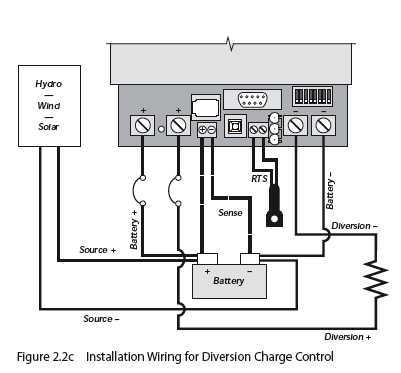 All of the charging sources are connected directly to the battery, and so is the controller. Charging current does not pass ‘through the controller’ on its way to the battery. Current is diverted to the dump load (via the controller) when the need arises. This causes much confusion but it works very well, and it’s the usual and the best way to control a wind/battery (or hydro/battery) system. Here is another way to draw a typical setup:
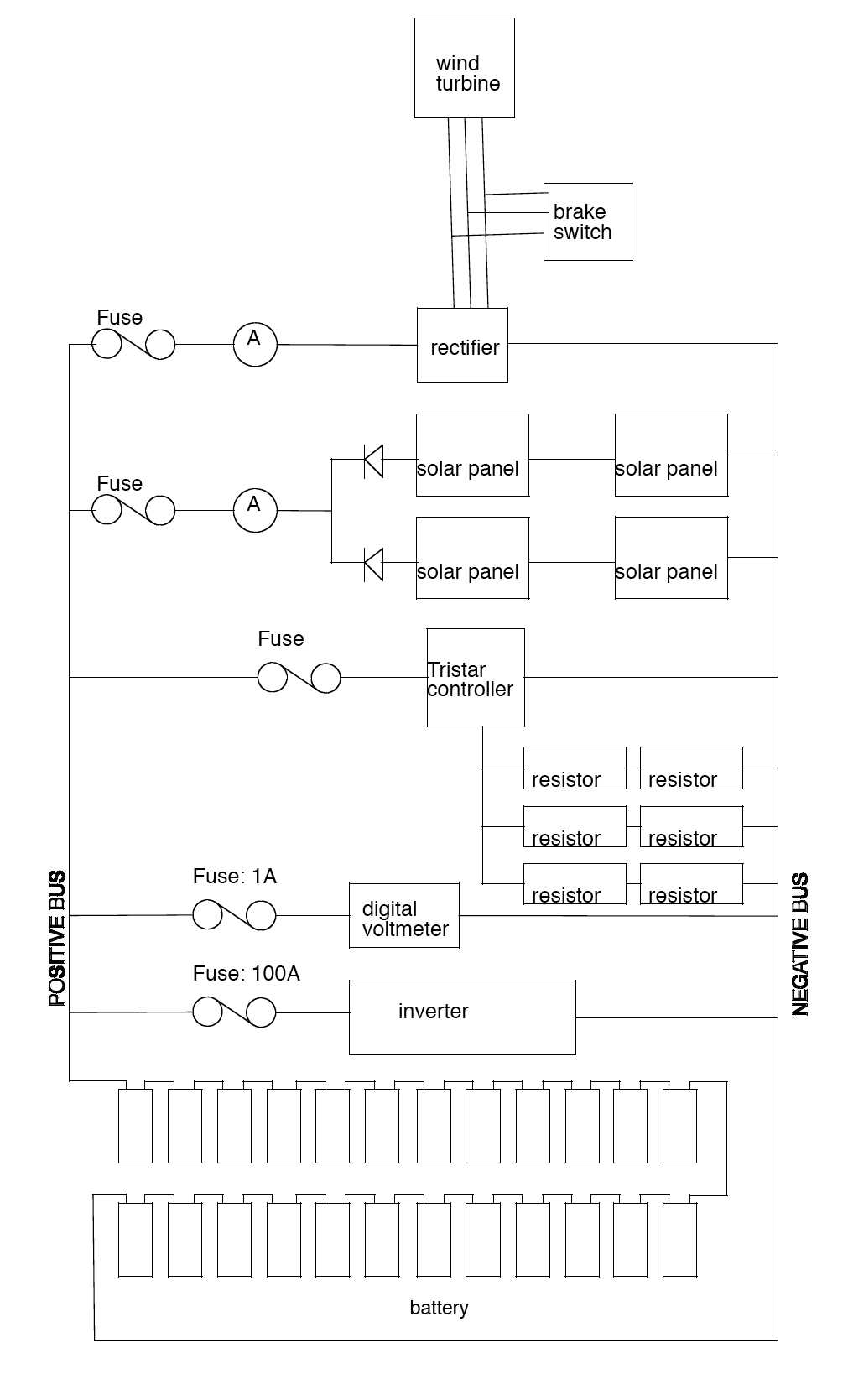 Each circuit from the battery is protected by its own fuse (or breaker) which must be suitable for the wire size used in that circuit. Never use one single battery fuse shared by the wind turbine and other equipment. If it is blown or is removed then the wind turbine remains directly connected to the inverter or the controller without a battery. This will result in the voltage going high and the electronics being damaged. The controller will not protect you if the battery is removed from the circuit.
If you must have a single fuse on the battery (or a battery switch) then make sure that the wind turbine is disconnected (and/or shorted out by its brake switch) before you open that switch. In some cases this disconnection of the turbine can be achieved by using a double-pole fuseholder. One fuse for the turbine, but still a single simple action to disconnect the battery.
The diagram shows blocking diodes on the solar PV. This is normal practice if the solar is to be connected to the battery without its own dedicated controller. I would not say it is essential, but it’s recommended so as to prevent reverse current at night. With a 12V system you probably lose more energy in the diode than you would at night.
Choose the dump load(s) based on the maximum current you could get from the wind and solar combined. (The US code requires that you allow 150% of the maximum current. This allows for gusts of wind etc. But few people do this.)
Load resistance increases when you add more loads in series. Current in each load depends on the voltage divided by the total resistance. More loads connected in parallel will use more current. You can learn more about choosing dump load resistors here.
Take care that the dump loads have plenty of ventilation or they will get dangerously hot. Allow space around the resistor(s) and keep combustible materials away. Keep it well away from the controller itself too. The controller must not overheat or it will cut out or even fail.
Make sure that the Tristar can handle the full current that the loads draw from the battery at the maximum voltage (equalising voltage for example could be over 30 volts on a 24 volt system). If necessary you can use more than one Tristar controller in parallel. Each Tristar will need its own resistive diversion load that is appropriately sized. They can all be wired to the same battery bank.
(The US code requires that you have a second independent means of charge control. If the Tristar shuts down, or its load fail to work then your battery could ultimately explode. But few people do this. Tristars are very reliable and most people keep an eye on things.)
Before energising the Tristar you should configure its dip switches. This procedure is clearly described in Appendix 2 (at the back of the manual).
 Switches 1 and 7 are always turned ON (UP).
Use 2 and 3 to configure the nominal battery voltage.
Use 4,5 and 6 to fine tune the desired charging voltage based on the battery type and usage. Switch 8 allows you to choose automatic or manual equalisation of the battery.
If the battery voltage is low (12V), or the battery is a long way from the controller, or thin wires are used, then its a good idea to run a separate pair of wires from the battery-sensing terminals to the battery terminals (with a small fuse) so as to accurately read the true battery voltage.
If the system is high budget, or subject to swings in temperature, or if there is any danger of a battery overheating (small battery), then buy and fit the optional temperature sensor. I normally fit one. It will adjust the charging to make sure the battery gets enough in cold weather and will protect it against damage if it gets hot.
Buy a Tristar charge controller (UK only)

With a wind installation using a Tristar to control a diversion load, how might I automate braking/shorting the AC if the diversion was insufficient. Could the Morningstar relay driver triggered by a high battery voltage be used? It looks like it will talk to the Tristar.
hi
You can use a relay driver or there is a lower cost eBay market relay that you can use to trigger a brake contactor based on voltage. The relay driver can be coupled to the Tristar and used to operate a brake based on the duty cycle of the dump which is a better approach as it will keep on charging as long as possible but brake when the dump is fully active. I have also in the past designed a system that operates a trip (brake stays on until reset) when the average voltage of the dump reaches a critical level. I used a resistor to connect the dump to the coil and trimmed the resistance until it operated a relay to trip the trip relay at just the right point when the dump is maxed out. This is lower cost but you have to reset the trip.
cheers
Hugh
Hi,
By way of introduction, my name is Seamus. I have a fully re-conditioned Jacobs 20kw turbine that’s ready to go on my tower. However, I am hoping to have a 30-minute conversation with someone that has experience with this turbine that could provide me with a schematic of the cabling between the Choke and the controller/inverter unit. I also need advice on other issues such as the tail configuration, blade spring settings, and a few other bits.
I’d say 30 minutes should cover all aspects of my questions. If you have experience with this turbine, I would be more than happy to pay you for your time and provide me with the info I need. If not, I’d appreciate it if you were able to refer me to someone that might be able to help me. Thank you for your time in reading my note.
With kind regards, Seamus
Hello,
I have existing off-grid solar power system with Pylontech litium battery bank, dc coupled solar charger and two parallel running charger/inverters, all in 48volt busbars.
Those are Victron made, with own charging algorithms.
Plan is to add 2kw wind generator with tristar ts-60 in diversion mode (using smart shunt) to busbars.
Question is, can i use ts-60 .. with dump load .. instead battery, to use big electrolyte capacitor .. as power source, and feed current to busbars through bolt diode?
Will ts-60 work with capacitor .. capacitor have no upper voltage limit and internal resistance is quite low? Capacitor is also often totally empty if windpower is long missing .. if i don’t arrange some small charging over diode.
Point to use diode is that i don’t want to burn any other power from battery to dump load .. and let Victron finalize charging.
Wind power voltage must be set somehow lower than 52,4V so ts-60 never take care about charging batteries to 100%. Just auxiliary source when busbar is lower than 51V.
Thanks,
Jarkko
Hi Hugh. Are you still selling the TriStar controllers? I have 2x320w panels at the moment going into a 60amp Epever controller into a 12v battery. I have a 600w Aerogen 6 wind turbine that I’d like to add into the system to work in unison charging the battery. To help in the winter, I have lots of wind where I am. My question is would I still use the Epever controller and add the TriStar into the system or would I be able to run the panels and the turbine through the same controller. What would be the best/cheapest way to get the panels and turbine set up?
Kind regards,
Isaac Pryce.
HI again Isaac,
Yes you can use the MPPT controller to do its MPPT hting to the solar panels and also have a diversion controller. Make sure that the diversion load is big enough to handl ethe wind output at least. Then set the controllers to level of voltage depending on your priorities. If you want to dump as much as possible then set the solar to a higher voltage than the tristar. If you wish to avoid dumping power then do the opposite. If you do not care, then set them at the same voltage. If the dump load is going flat out, and the voltage rises further then the MPPT will regulate the solar so it is safe. Just make sure all the settings are close to what the battery thrives on.
cheers
Hugh
Hi Hugh,
Interesting approach with the positive and negative bus. But this does seem to imply that the batteries will also partially drain if the dump resistors are switched on?
Regards,
Bram Peirs
fromwastetowind.com
Hi Bram,
The pwm controller adjusts the current so as to keep the battery charge rate exactly right, based on the principle of holding a particular voltage for that stage in the charging process. It will not discharge the battery. A discharging battery has a falling voltage which would instantly turn off the diversion controller.
There are crude controllers on the market that use a large relay to switch the wind turbine from charging the battery to feeding a resistor. These are not so good for the battery. Normal user activity will then discharge the battery. Instead it should be kept on charge with a current that tapers gradually downward but maintains the voltage at the absorption level (and later at the float level).
A lead acid battery is not like a bucket that you can simply fill up and then it is full. It can accept a high charge current at first, but later this needs to be reduced in order to complete the process and charge the battery fully over a period of hours at constant voltage. This must be done well or the battery life will be disappointing. So it’s a good idea to invest in a proper pwm controller and manage the charging process accurately like this.
cheers
Hugh
I understand the first scheme. But at the second scheme I do not see the dumpload connection anymore.????
We connect to 4.2 kw solar system with 3.5 kw inverter and 2.4 kw battery grid tied.
And I made an 3 x 1.5 kw = 4.5 kw 48 volt imersion heater dumpload to go in to the CH system
The turbine is 1.5 kw 110 volt 3 phase. We have ordered a 110 volt 3 phase breaker, bridge rectifier and the tristar 60 a PWM.
And can you recommend a place where we can order cable and busbars ( can probably make a bus bar ) I understand that a preference is 16 square mm??????
hi
The dump loads are the “resistors” shown in the second diagram.
The tristar will not work at 110V. Maximum is about 68Vdc
110Vac 3-phase when rectified will give you about 150Vdc.
What is the voltage of your battery?
cheers
Hugh
Hi Hugh – great resource thank you!
A couple of beginners questions, I have a 2kw grid tied inverter with limiter connected to 2kw solar array.
I would like to add a small wind turbine (less than 500w)
I was thinking of using the Tristar set-up pictured above – can you see of any problems that might occur?
Also the inverter is 48v and the turbine is only 24v.
Would a boost converter be realistic to charge the 48v battery bank from the 24v turbine?
My idea for later is to use a reversible air conditioning unit as the resistor/dump load.
Thank you in advance
Peter
hi Peter,
It’s not clear to me whether you have a battery. The article above is about battery systems and not about grid tie. I recommend that you use a 48V wind turbine to charge a 48V battery. Bear in mind that the voltage of the turbine is very unstable and so the battery is what stabilises and defines the operating voltage. If using a motorised device such as air con as a dump load you will not be able to use PWM switching. as in the tristar. This is only for resistive loads such as heaters. A motorised load needs to be controlled in a very slow cycle using a relay to turn it fully on for periods of time.
Have fun,
Hugh
Hi, the information here is very helpful. We have an offgrid PV system(4.5Kw) (MUST 3500 inverter, built in charge controller etc).
We’re located in an area 300 m high and sandwiched between two mountain ranges so although great in summer, bad in winter and require the extra to top up our battery bank and reduce/eliminate the petrol gen use.
We are looking at adding a 450 or 800 watt wind turbine to our system and from what I’ve seen and you’ve confirmed a Tristar controller is exactly what we need.
How does the configuration above effect the PV system during high PV times (we often have wind at these times)? The PV system reduces the power input when full battery charge is reached and trickes it into the batteries as I think you said often happens in another post (we have no power dump system in place but we have plenty of options). Sometimes we are generating 4 kW of power that has been trickled down.
If the configuration above is setup will it bypass the PV load/controller and allow all of the potential excess (PV and wind) to go through the Tristar charge controller/load dump or will the solar PV system operate as it currently does? Would it be that we set a slightly higher voltage cut off in the Tristar than the PV system so the PV system has opportunity to shut its input off first?
It may be a silly question I’ve asked and i’m not even sure how our PV system charges the batteries. Hopefully I am making sense.
Thanks.
Hi Hannah,
You will not overload the Ttristar with PV so long as the dump load is correctly chosen but you can potentially see a situation where the solar turns the load full on before the wind turbine is working. However once the wind turbine starts to work it will push the voltage up to the point where the solar charge controller limits the solar power. And at that point the diversion of power by the Tristar will be enough to prevent the wind turbine from overcharging the battery if necessary.
You can choose to set the Tristar above or below your solar charger’s battery voltage set point. If below then you will get maximum diversion, which is ideal for heating water. If above you will only get diversion in windy weather. However this ranking of set points is complicated by the fact that each controller will choose a time to go from absorb to float set points and this may upset what you are trying to do.
I hope this makes sense.
cheers
Hugh
Hi there, hope you are all ok
I have a communication station on a mountain, so, we have installed a solar panel over there.
My doubts are,
• What kind of connection should we do make if we have some electronic devices as a load (100w) and a battery bank?
• The right configuration is in a diversion mode or Solar Charging and Load Control mode?
• Should we connect the load in parallel with the battery or with solar panel ?
I will really apreciate if you can help us
Thanks in advance
Cheers
LP
hi
It’s not normal practice to use a diversion controller on a solar PV system. It’s a good idea if you do need the surplus power, or if you have a turbine. But for a communications station with only PV it has no obvious advantage. So I suggest you connect your devices to the battery and then the solar panel to the battery via a controller. That’s the basic layout. However you may run your battery flat and damage it so a refinement would be to get a solar controller with a load output that turns off when the battery gets low. You may wish to use MPPT or not based on the relative advantages of MPPT or PWM. PWM is lower cost and if the solar panel is suitably matched to the battery it will work well enough. You can get a low power low cost PWM solar controller with a load output and that’s all you need. You do not need a dump load.
cheers
Hugh
Hello
Am asking about tristar ts-60 when connected to 48 v system with gel batteries delivering power to an off grid inverter what should the settings be for 4,5 and 6 dip switches.
Also what is the difference between lighting mode and load control or charging control and when do we use each of them ?
hi
In the installation and operation manual section on battery information you can read
Gel:
Gel batteries have characteristics similar to AGM, except a silica additive
immobilizes the electrolyte to prevent leakage from the case. And like AGM,
it is important to never exceed the manufacturer’s maximum charging
voltages. Typically, a gel battery is recharged in cycling applications from
14.1V to 14.4V. The gel design is very sensitive to overcharging.
It is important to ask for the correct manufacturer’s settings.
The section on diversion charge control describes the standard programs for the diversion mode. “off-off-on” will probably work best.
Use lighting mode for lights, and diversion mode for battery charge control. Diversion is useful for turbines (wind and water) because it prevents overspeed by keeping them on load. It is also a good way to maximise energy usage if you can put the heaters somewhere that is beneficial such as in a water tank.
cheers
Hugh
Hi hugh,
In addition to my wind turbine I would like to install solar panels for charging the batteries.
My current installation is a wind turbine of diameter 2400 in 24v,
the regulator is the tristar ts 45 in mode derivation on a resistance of 1 ohms 1000 watts and two battery 12v 110 ampere.
I would like your opinion on the power that I can add in solar panel,
must there be a regulator mppt for the solar panel or diodes,
the tristar ts 45 will support the addition of solar panel without risk of being overloaded,
thank you,
Lawrence.
oops I forgot there is a discharge resistance of 1ohms 1000 watts for the derivation
Hi Hugh
I built the wind turbine 2400 diameter 24v which turns with the tristar ts 45 on two battery 12v 110ah, I would add in addition to the charge of the solar panel battery to make a hybrid installation, can you advise me for the choice of material, power and for conexion. thank you.
laurent.
Hi
I can advise you but you have to ask me questions. I don’t know what you are asking me exactly.
cheers
Hugh
bravo in the way you go!
I want to buy a Tristar 60A PWM, but i must be sure i take all the correct elements
I have solar panel: Voc: 28.3V
Isc: 7.63
Vmp:22.6
Imp: 6.86
And a Wind Turbine (self made): 30A
12-20V
I want to connect 3x Solar panel in parallel, and put schotky diode to connect with wind turbine, with a 12V Battery, all this in diversion load (with Dump load 3x300W)
my question is, what kind of circuit breaker must i use?
like in this installation:
http://scoraigwind.co.uk/wp-content/uploads/2011/09/blogdiag.jpg
and what kind of 3 phase rectifier must i use?
I know that the installion will make 50A and 42V( wind and solar combined), Is this ok for a 12volt Battery? What you recommend?
thanks
Hi Hugh I am using a tristar45 as the diversion charge controler on a 48v system I have set the dip switch as the book for sealed batterys ie 55.2 but nothing is going into the dump heaters , even when the batterys are below 55.2 there is 17v comming from the tristar. Any ideas?
hi
I am on the road so sorry for slow replies here.
The tristar starts to divert when the voltage rises to the chosen level. so it will not divert at a lower voltage. 17V is maybe a stray reading. Make sure a heater is connected. The output voltage to the heater should be zero until you reach the chosen level and then it starts to pulse on and off quite fast.
cheers
Hugh
please could you advise me of what controler I must use to charge batteries from a wind turbine.The existing system is running on solar with a expert inverter that has its own charge controler.
The reason is to have wind charging at night then I set the inverter to run from batteries and not eskom
Hi Peter,
In most cases the Tristar controller in diversion mode is the best solution for a wind turbine. You don’t provide any specifics so it’s hard to say more. Connect the wind turbine directly to the battery. Make sure the Tristar is working, or the turbine may damage the battery. Always keep the battery connected – never connect the spinning wind turbine to a controller without the battery as this will instantly damage the controller.
It is possible that sometimes the Tristar will divert power to your dump load when there is no wind, only solar power. But in the end the combination of having some dump load and having a solar charge controller will effectively manage your battery charging with both wind and solar sources.
I hope this helps.
cheers
Hugh
Hello Hugh,
I have a 3Kw wind turbine and controller in my 24v system with a large battery bank (2000AHrs) I would like to use TriStar 45’s in Diversion charge control mode with three 1Kw heaters as dump load. Please advise me, can I put three TriStars in parallel each with their own dump load.
Kind regards, Mike
hi Mike,
As discussed on the phone, you can use 3 TS45 controllers in parallel, each one operating a 1kW 24V heating load. They may not always agree but the differences will not be significant, so you can ignore them. If you need any renewable energy equipment (controllers, inverters, batteries, solar PV, hydro turbine, etc) then do not hesitate to ask me for a quote.
cheers
Hugh
Hi Hugh, great info, very helpful. I have a 48v battery bank connected to a sunny island, 240vac generator and 4.5kw solar via a sunny boy. I’m about to add a wind turbine through the trisatr 45amp chgarge controller and a load dump resistor, my question is, does the above wiring diagram work for the set up I just described? My only concern would be if the sunny island calls for a full or equalization charge from the generator, would the float / eqaulization charge be drained by the resistor? Hope that makes sense, thanks,
Rob
hi Rob,
Using the sunny island with renewables can be a headwreck sometimes. If your solar and wind are the main source of energy then the SI will be pretty sure to lose track of the SOC along the line. At some point it will be sure that you have plenty of % when suddenly the battery voltage plummets, and SOC is revised from 70% down to 15% and the whole system crashes down. I would not leave the generator management up to the SI when using wind and solar. I would do it manually based on observation of battery voltage.
Setting the tristar charging voltages above the SI’s ones should prevent wasting generator power in the diversion load. But if the wind kicks in during a generator run and pushes the voltage above the SI’s target then you may get reverse power error and a locked out generator. All good fun. Figure that one out.
I would disable the “Frequency shift power control” and use the solar for heating water via your diversion system if possible. If you change the parameter #250.28 (ChrgCtlOp) to “DCOnly” the FSPC is disabled. Or you might want to keep FSPC and use the SI’s own diversion control relay option but I find that pretty clunky. If you have a reasonably recent SI model then this will be available with the charming name ExtPwrDer.
I hope this helps. The SI can be very time consuming to negotiate with.
cheers
Hugh
Thanks Hugh, not finding the SI very user friendly ! I’m going to purchase your wind turbine book.
Rob
Hi, I have 8 x 250W panels, where 2 each are connected in series and the 4 sets of series connected in parallel. They are connected to a 60A, 48V charge controller (PWM) and 4 x 12V batteries in series. However, using my meter, i have never gotten an output from the panel of more than 4.5Amps and 65V and the batteries are not charging. Is this normal, what could the problem be?
hi Chuka,
My guess is that you have bad connections in the system. Try measuring the voltages of the individual batteries and see if they are adding up to the voltage of the controller output and then do similar checks on the panels and the controller input.
65 volts is very high for charging the batteries. If they are really seeing that voltage and not charging then they are probably beyond being useful as batteries. But more likely you have poor connections between the parts of the system.
cheers
Hugh
thanks huge.
i found this on ebay.co.uk on very good price and low cost shipping to Greece. is that suitable, it is 0.75ohm
http://www.ebay.co.uk/itm/322554233075
hi
At 14 volts this will draw 18.7 amps and dissipate 260 watts. At 28 volts it will be more than 1000 watts. I forget your battery voltage.
Watts = voltage squared / resistance.
I hope this helps
Hugh
hi hugh
i have on my hand a used wind turbine i bought from second hand store but the seller didn’t know anything about characteristics.
so i get it and start make a tests.
the body is Aluminium alloy and stainless steel components with 3 blades Glass Reinforced, Rotor Diameter: 1 metre
opend the 4 screws of the bottom of the turbine where the mounting pole fitted.
and there is 3 cables from the motor connected to the rectifier.
so when i make the test on very high wind speed, connect the turbine with multimeter and i had power 90volts.
so i wonder how many Output Voltage is: 12, 24 or 48V.
becouse i want to use it with tristar ts45 on my 12v system
hi Georgios,
You can try it connected to the 12V battery and see what happens. Maybe it is OK for 12V but most likely it is designed for 24V and it will turn too slowly to work properly. It will do no harm to try it. But the blades may stall at the low speed for 12V operation. If they do then you could consider using a 24V battery. Maybe it will work fine. It is just possible for a 12V wind turbine to reach 90V output when disconnected in a very high wind.
Have fun
Hugh
thank you Hugh.
finnaly the turbine is 300w 12volt
my last question is
i have additional 2×125 solar panel 12v
and i would like to use mix with the wind turbine, the tristar ts45 as division load controler.
how many watt resistor i need and ohms?
hi Georgios,
It’s great that your turbine is for 12V. Altogether you will have maybe 20-25A from wind and 20A from solar. So the 45A should be fine. You need to use 3 resistors, each one 1 ohm resistance. Connect them in parallel. Wattage of each resistor must be at least 200W. Better 300W.
Have fun!
Hugh
Thank you Hugh
looking on ebay i found many dump load resistors on 0.73 ohm or 2.9 ohm. i couldn’t find 1 ohm resistor. so if I’m not use 1 ohm resistor what’s the difference.
do you know any eshop in UK selling dump loads?
hi Georgios,
Sorry for the long silence. I do not check this comments page often.
You can get good resistors from Farnell or RS in the uk and they also have sites for greece.
This one is good for 24V systems (1000W 1ohm)
This one is OK for 12V (up to 14V operating and slightly overloaded above that (200W 1ohm)
They will use the same stock numbers in the Greek online store.
cheers
Hugh
hi hugh ,
thanks to your blog , I am understanding the set up I need ( I think ) for my narrowboat , it 24 volts , solar and wind , I would love to use the power that is dumped when battery bank is full to run cooler and heater appliances so this is what I would like to do but not sure if is will work .
main battery bank setup = wind turbine then brake , resistor , mpv tristar charger with dump load , resistor , battery bank , inverter .
second battery bank setup = dump load cable from main battery bank , diode , resistor , mpv charger , resistor , battery bank , inverter , the dump load from this mpv charge would go to a resistor in case no load on appliances .
my view is safety first so will this work ? , can it be done a different way or can it be done at all
many thanks
Robert
hi Robert,
I can’t completely follow your description but my instinct is that this is too complex. don’t use two batteries unless you need to keep one to start the engine or whatever. Charge your battery as a first priority. If you find that you have surplus energy then try to use it without interfering with the optimal charging of the battery.
A heater is ideal for surplus power provided that you don’t mind variable, unreliable heat. For example to heat water where you also have a backup source if you need hot water and there is no surplus power from wind and solar. It’s great to use a surplus and save on fuel.
Most narrowboats are under trees and canal banks and not in ideal places for wind or solar, so don’t expect too much surplus.
cheers
Hugh
hi hugh , thanks for the reply .
guess the question really is , would a mpv charge controller except the power coming in to it from the dump load from another mpv as if it was from solar of wind or would it recognise it as power from another mpv and do nothing with the incoming power , hope that made sense
many thanks
Robert
hi Robert,
I can’t see any advantage to feeding power from one MPPT controller (is this what you mean) into another. Dump loads are often driven with PWM (is this what you mean) which is a string of pulses and this would not be suitable to feed into any controller.
Going back to what you are trying to do, it’s a case of wanting to use a motorised appliance as a dump load. It will not run off the pwm power that is used for dumping into heaters. You will need to cycle it on and off. This will not be perfect for the battery but it will work so long as you choose suitable settings for on/off threshold voltages and suitable time delays. The device you need is a relay driver.
http://scoraigwind.co.uk/relay-driver-for-load-management/
cheers
Hugh
hi hugh , yes i meant feed power from one mpw to another mpw , I feel a little foolish as I hadn’t realized the power from the dump load wasn’t dc , I am a joiner by trade so electronics are new to me so please bare with me .
if I understand this correctly , i can feed the power from the dump load into a relay driver , which turns it back into dc ? , then feed that dc straight into a second battery bank with an inverter , the power from the inverter can then supply say a small 240 v air con unit or fan heaters and when the battery bank start to run down , they just switch off , i understand i will need resistors along the way just in case the inverter or 240 v appliances pact in .
the batteries life span maybe short i believe .
sorry to be a pain
thanks again for the help and advise
Robert
hi robert,
Not a pain at all but hard to follow at times. When you write mpw, I think you mean a PWM diversion controller (such as the tristar in diversion mode). PWM means pulse width modulation and the controller sends pulses of DC to the resistor. If you want to run aircon you will need smooth power. This can be AC or DC according to it’s ratings. But not pulses.
You do not need a second battery. This is not helpful. Connect all of the batteries together as one and keep them charged up (until the wind stops and you need to use them).
OK now how to run the fan heaters or aircon? Run them off the inverter through a relay. YOu do not want the relay to turn off and on too fast so you use a relay driver to control it (control the relay). This means programming the relay driver with a computer (windows laptop usually) via RS232 dongle. When the voltage is high (or the duty cycle of the Tristar is above a certain level) it will kick the fan heater or whatever on and it will stay on a few minutes and use the surplus energy. It’s crude, but it can work.
cheers
Hugh
Hello,
I would like to connect a 48V wind turbine type Piggott of 2m40 to the grid, do you have a brand / model of regulator + load shedding resistance to advise me to place before the inverter? (I do not put a battery)
My inverter is a windmaster mastervolt.
thank you in advance
hi Morgan,
You can use a windmaster with a 48-V winding in the turbine. this is a popular choice actually.
I do recommend you also connect a protection circuit. I can supply an LDR 96-15 if you need one. This is what a lot of people use for this inverter. http://scoraigwind.co.uk/ldr-load-control-boards/
cheers
Hugh
Hi Hugh, thanks a lot for your response, i couldn’t figure that out from the manual I downloaded. I think I might run the pump as a whole separate set-up, as I already have 4x 35w panels, that way I wouldn’t need to match panels for the Tristar set-up, which I still need to buy. Then I’d use the Tristar with panels, wind turbine and dump load to water heating. Thanks again – much appreciated! Craig (Madagascar)
Hi Hugh, I’m planning on buying a Tristar TS45 for an off-grid set-up and would like to know if the following would work? 800W panels in series(24V) with a wind turbine 300W charging 4x 100ah batteries in series(to run a medium sized chest fridge-freezer combo, some small appliances occasionally and led lights). I’d like to use the dump load function to run a 24v Shurflo 9300 well pump, once the tanks are full(1000L) using the float switch to divert the dump load to a water heating element – will the TS45 work for this? Any advice on settings/circuit breakers,etc would be highly appreciated, I’m also new to this: – ) Thank you, Craig
hi Craig,
The TS45 cannot itself run a pump as a diversion load, no. What you should do is connect the tristar to a relay driver so that the relay driver energises a relay that operates the pump. That way you can set delays and minimum run times and stuff so that the pump does not stop and start incessantly. You’d need to have a computer and download MSview software and connect to the relay driver (RD) using a USB to serial adapter (unless you have an older computer with RS232 built in).
http://scoraigwind.co.uk/relay-driver-for-load-management/
I would suggest you drive a 24 volt water heating element off the tristar. The RD can operate a relay based on the duty cycle of the TS. This is the % of the time that the pulse width modulation is “on”. When the duty cycle reaches a high enough level to show that you have surplus power (say more than 20% for more than one minute) then turn on the pump relay for a minimum run of (say) two minutes or whatever. If it drops to zero then turn the pump off (subject to the delay). Once the tanks are full this relay will achieve nothing and the heater will be able to work without interruption.
cheers,
HUgh
Am 36 volts system ‘ am using TriStar Ts-45 please advise on dip switch settings
hi Ernest,
You can’t do that with dip switches. You will need to connect a computer to the Tristar (windows and RS232) and run the MSview software and set the voltages with the Tristar Wizard. Let me know if you can do this and I will advise suitable settings for you. what type of battery is it?
Hugh
Wow! Very informative. I read through it all and hope I didn’t miss this question somewhere.
I’ve got 390 watts of solar connected to a Bluesky 3024I mppt controller
An AmplePower 110 amp alternator through a Balmar regulator
6 Trojan T-105 6v batteries configured to a 12v bank
The alternator and solar are connected to the batteries through their separate controllers. I just purchased a D400 wind generator and see I should add a diversion load through a tristar controller, but with the 110 amp alternator, how can it be set to not divert that load too? Can a diode be installed somewhere in the wiring to only allow diversion of the wind generator?
Thanks for the much needed assistance,
Matt
hi
Yes this is a good question. There are several solutions.
1. Allow the dump load to dump the generator power. this is the simplest and it can be OK with a large generator and a useful dump load such as a water heater. Mostly it is a waste of fuel though.
2. Turn off the diversion controller when the generator is on and put it back on again after. This is a simple solution but a bit of a pain and important to remember to put it back on.
3. Use higher voltage for diversion and lower for generator charging. This solves the problem but actually you do want to push the voltage up when the generator is on so as to get a short, effective charge.
4. A complex but effective solution is to insert a diode into the battery sensing wires of the diversion controller. Use a relay with normally closed contacts to bypass this diode in normal conditions but when the generator comes on the relay is energised, contacts open and the supply to the sensing contacts is via the diode and hence about 0.7 volts lower than battery voltage. You can use a string of diodes to drop up to about 4 volts but if you reach 5 volts, the tristar will register an error. Mke sure the diode is conducting (forward) and you will get a predictable voltage loss in it that can fool the tristar into not diverting as the battery reaches a high voltage.
I hope this helps.
Hugh
Hugh,
Thanks for the reply. I think option three… turning the controller off, is going to be best for us.
Could a high amp diode be installed on the positive bus with only the Tristars positive and wind generator combined on the anode side? If the sensing side of the Tristar is on the cathode side of the diode, wouldn’t the diversion load only draw down the power from the wind gen when the Tristar activates it?
If the alternator and solar are connected to the battery side, and voltage rises above the set point on the Tristar, the diversion mode would be activated, and since the diversion is behind the diode’s anode side, the battery and alternators extra power wouldn’t flow to the diversion.
I’m guessing I’m totally wrong on this, but my primitive understanding seemed to show this as an option. Maybe it will kill the Morningstar?
Matt
Hi Matthew,
You are correct that is another option that I failed to mention. It will work as you describe but you are losing out in the diode as it will waste some power. A better solution for isolating the tristar is to use a separate rectifier (if you have access to the ac wiring at all). I have done this using a rectifier to feed the tristar load negative from the AC wires off the wind turbine. It did work, but I am slightly suspicious as I did have a failure of a tristar using that configuration and was unable to find another cause. Possibly there are some inductive kicks off the alternator winding when the tristar does its switching. I guess that’s why I let that one fall by the way when I listed the other ideas.
cheers
Hugh
i have wind turbine with on grid controller but i don’t have the manual for the controller also i can’t find it online
how can i connect the controller with dump load and inverter ?
hi Bayan,
It would help if you told us the make and model or at least a bit of information about this “on grid controller”. Or post a photo we can see.
cheers
Hugh
How do I connect a 3 phase Wind Turbine to a Tristar 45 controller. Do I just put a Bridge Rectifier between the Turbine and controller?
Your blog is addictive reading. I am setting up a 400w wind turbine to power my garage up in the UK.
hi Martyn,
Connect the turbine to the battery with a rectifier. Do not connect the controller to the turbine. Connect the controller (in diversion mode) to the battery as well. If you connect a wind turbine to a controller like a solar controller you will probably damage the controller. The maximum voltage (Voc) is much too high. A solar panel has a lower Voc so it is safe to connect like that.
Normally you would use a diversion controller to limit the current to the battery. It diverts the current rather than blocking it.
Hugh
Hi there,
Brilliant site, I’ve learnt a lot: thanks! I hope you don’t mind if I ask you a question or two:
I’ve been running 1000w of PV through a 30a eTracer mppt regulator into my 48v battery bank for a few months. After not really seeing the sun for most of last November and December I added a 600w wind turbine (le-600). I was sold a Tristar 45A which I’ve set up in diversion mode with two 24v 500w dump loads wired in series.
Do you think my settings for the two controllers are ok?
I’ve set the Tristar to [email protected] [email protected] and [email protected]
the mppt reg is set to [email protected] [email protected] and float@54V
I’ve set the tristar higher to avoid it taking the full load of wind+solar.
From what I can gather I’d have been better off with one controller dealing with the solar and wind but I’m trying to work with what I’ve got… is it practical?
Mark
hi
It depends on whether your diversion load is doing anything useful. If so then you should definitely do it the other way around and set the float of the Tristar diversion below the eTracer. You will not damage the diversion controller with overload provided you have selected a suitable resistive diversion load whose current is within the rating of the controller. If it cannot limit the voltage rise then the other controller will limit it at its higher setting, when the combined current is too much. But this will not damage the Tristar. (It may display an error in protest.)
have fun
Hugh
Hello! Very interesting roject! I like it. Can you tell me, where did you get Charge controllers. I can’t find it anywhere. I was looking here http://hardware.eu/obo I know that obo does such things. But they don’t have. Also amazon didn’t help((((
I am not a very good business man but I kind of hope that people might notice that I sell them at competitive prices myself 🙁
http://scoraigwind.co.uk/buy-a-charge-controller/
Hello all
can someone help me with morningstar Tristar mppt 60. So this summer we install the small solar system, with my friend, after this i try to conect from my PC to see on statistic how its work. Its work ok, but just on my WiFi at home, so if i try to connect from my office its doesnt work. now my frind came to me and say that he know how it to change, we change network setting on the web, where i check all data before he coming and he change the setting to Use statistic IP address and after this i cant connection but it dont work. So can some one say me how i can change it maybe i can reset for issuing setting?
Thanks
Regards from Czech republic
hi Vadim,
Network stuff is very tricky. I would say that if you want to get to see your Tristar MPPT on the internet then you will need to enable port forwarding for it in your router software. And get a static IP address on the internet for your router. Setting a static IP address in your Tristar is not enough by itself.
Another way to access the settings in the controller is to use RS232 and the MSview software. That way you can get access to the network settings without using the network. You can get an RS232-USB adapter and download the MSview software off the Morningstar website.
I do not know how to reset the controller to factory defaults, sorry. Maybe try asking Morningstar about that?
Hugh
I am using the tristar-60 with a 10 foot otherpower wind turbine. I have a 48 volt system (8 – 6 volt energizer flooded batteries), but I am not sure what the ideal dip switch settings are for switches 4,5, & 6 for my batteries. The the manual says that the three options for flooded lead acid batteries would kick the dump load on at either 57.6, 58.4, or 59.2 volts. I have not frame of reference for what is best here. Any ideas? I was going to go with the lowest voltage to be safe. The battery manufacturer does not seem to have any helpful info about this on the internet. ANy help would be greatly appreciated.
hi
I would try a middle setting and then monitor water consumption. If you are using a lot of water then set a lower voltage. If you never need to top up then set a higher voltage. The correct answer probably depends on how much time you spend diverting power. If the batteries rarely get up to 58 volts then it is a shame to dump power, and best to hit them hard. If they are up at 58 all the time then better to go easy and set 57.6 for absorb charge.
cheers,
Hugh
Thanks for the feedback. I’ll follow that plan.
Dear Sir,
Kindly send us quote for below;
Morningstar TriStar MPPT-45 Charge Controller
Morningstar TriStar MPPT-60 Charge Controller
Please advice price
Andy Brooks
UMass Memorial Medical Center
Worcester, MA 01605
(508)319-9334
Sorry but I am in the UK and it makes no sense to ship these across here and then back to the USA. I suggest you find a local supplier.
all the best,
Hugh
Thanks for the info Hugh! I have TriStar TS-45 that I was using for my 12v PMA turbine. I bought an Air-X turbine, which turned out to be a 24v version. Can the TS-45 take the 24v input and transform down to 12v? I know my solar controller is a MPPT version and does this for the 24v solar panels, but the TS-45 is PWM spin have my doubts. Any idea?
The Tristar TS-45 is only capable of PWM switching of current in pulses. On a wind system you should use it to control a dump load so as to limit the current to the battery by diverting some to dump. It is not a good idea to use it in solar mode between the wind turbine and the battery as the voltage may well rise to high, destroying it. In any case it will not convert the voltage down. You need an MPPT controller for this. Again there is a danger of damage to an MPPT controller in wind applications. Overall I recommend the simplest is to use a 24-volt wind turbine for 24 volt batteries and a 12 volt one for 12.
Dear sir,
i installed TS-60 for 48v i connected tow 250w in series which is 40+40v = 80v is it ok?
and can i use with online inverter ? problem is inverter also charge with panel at the same time .
regards.
basir
yes you can use these two solar panels in series on a TS-60. And yes the inverter is ok to charge the battery at the same time as the solar.
Hugh
Hi,
Pls how can i DIP set the tristar TS-45 with 48 volts system that is setting the switches 4,5,6 and also i am using a lead acid batteries 4 12volts each connected to give 48volts final.
Thank you.
Saleh.
hi Saleh,
Set switch 2 on and switch 3 on (both on) for 48 volts
The settings of switches 4,5,6 depends on the battery type. For example a sealed battery needs a lower setting than a flooded (wet) battery. Ask your battery supplier what voltage you should select.
Hugh
Hello Hugh
Sorry to be a pest but just to clarify, I should have the dip switches configured as follows
1 – Off
2 – On (12v)
3 – Off (12v)
4,5,6 off and connect with laptop to configure charge voltage to 14.4 volts as you recommended
7 – On
8 – Off
Thanks very much Fred
hi
If you want to do diversion load control for 12 volts and aim to charge up to 14.4 volts as would be normal for a battery that is not sealed then these are the settings you need:
1 – on
2 – off
3 – on (for 12v)
4 – off
5 – on
6 – on (14.4 volts)
7 – on (diversion)
8 – off (manual equalise if desired).
I hope this helps. You do not need a laptop but if using one you would set 5,6,7 all on.
If in doubt, read appendix II on page 55 of the manual for diversion control settings.
Hugh
Hello Hugh
Thanks very much for such a fast response
regarding the dip switches I have a couple of queries….
1 – on
2+3 what should they be for 12v system
7 on for diversion charge control mode
8-off for on/off charging
The remaining dip switches will be off.
The other thing is, I have a diesel generator which I use once every week to give the batteries a full charge, should I fit blocking diodes to both the turbine and the solar panels to prevent any damage etc..
Thanks for all your help with this
Regards
Fred
1 is on for load control yes. 12V battery means 2 is off, 3 is on. See appendix II at the back of the manual.
4,5 and 6 off means you will dump at 13.8 volts. This will only float the battery. It will not get properly charged up if it has been discharged.
7 is on for diversion. Yes.
8 is for equalisation where on is auto and off is manual eq.
Why not give the batteries a full charge up to 14.4 or so volts with your wind and solar? Generator won’t hurt them by the way.
Hugh
Hi
I was looking for a little advice. Can I connect solar panels and a wind turbine to the batteries and only use the one controller or would I require 2 controllers. I currently have a TS-60 controller
Thanks very much
Fred
hi Fred,
Yes indeed I often do this. One controller in diversion mode. Make sure your dump load is big enough to take all the current from both sources and still not too big for the controller (60 amps). Put fuses on the battery end of all cables. It’s also a good idea in such cases to put a blocking diode on the wire from solar to battery although not essential.
have fun
Hugh
Yes that will work fine. Just connect the solar PV in parallel and then through the TS controller to the battery. This is not a good idea with MPPT but will work fine with PWM.
sir, is it recommended to connect 140w/12v of Mono-crystalline together with 140w/12v of polycrystalline panel on PWM 45amps Tri-Star regulator.
OK I have looked back over all of this and it started 2 years ago but it seems to me that you have the solar and the wind turbine both connected to the battery (as in figure 2.2c), and then you have this Tristar 60 and only enough resistance to dump 48 amps (at 100% duty). The solar is producing 25 amps and mostly likely the wind turbine is producing more than 23 amps so it is pushing the battery voltage up too high and the inverter is cutting out.
You say the tristar gives an alarm but you don’t say what that alarm is.
It was High voltage disconnect R – G sequencing
I see what is going on i will change the water heater to 1265 watt
Now i will have 0.62 or 1451 watt dump load
http://www.altestore.com/store/Charge-Controllers/Dump-Loads-Dump-Load-Controllers/Diversion-LoadsDump-Loads/Water-Heating-Element-for-24V-or-48V-DC-1-NPT-Male/p2327/
Thks for all comments cheers
Louis
From privious conversation: if the voltage is going too high this may be due to the wind turbine. If the Tristar is controlling the solar and you also have wind without control of=r the wind turbine diversion is set higher than the solar then you can get high voltage disconnect in the solar controller.
To be honest I do not have a clear picture of your set-up so it’s hard to answer.
Hugh
Here is my setup (tristar -60) I have both solar (1200Watt) and wind and it setup like figure 2.2c
Turbine connects directly to 24 volt battery.When the solar panel reach 29.2 and suddently there is wind or gust of wind (they was gust when the controller gave me a alarm or a diconnect so the inverter shut down at 31 volt…so i need to restart it) the voltage went higher then 29.2
How to avoid this situation: I think my tristar is setup to high at 29.2 or on-off-off i will try 28.8 or 28.4, if there is a guest wind the voltage might not reach the 31 volt that would shutdown the inverter.
Any comments appreciate or any other solution
Thks Louis
OK i suspect that the voltage at the battery is higher than the voltage at the Tristar due to losses in the wiring. Make sure that the Tristar has a very good thick copper connection to the battery and/or connect the battery sensing terminals to the battery.
Also be aware that when the temperature is low then the compensation will push the voltage upwards somewhat.
Finally maybe your wind turbine produces high surges of current that are more than the Tristar (and its load) can dump, and so the voltage rises? I don’t know much about your load. What is the resistance in ohms?
Some ideas for you there anyway.
Hugh
the water heater is 0.96 and another resistor box of 1.6 all in parallel for a total of 0.6
The wires are copper number 4 and 2 feet long from tristar to ground bar to battery….ground bar needed to much wires connected at the battery
tks
In the process of setting up the system mentioned above. It will be PV panel only to start with. I want to use the excess electricity for water heating. My question is, doing it this way, with the solar panel directly connected to the batteries, do the batteries not miss out on the better(?) PWM charging mode? Does it affect battery life?
Thanks
hi Mario,
There is quite a lot of stuff mentioned above. It would be great if you could help me by describing it again or pointing me exactly to it.
thanks
Hugh
Hi Hugh,
sorry for the “loose” wording. What I meant was that I was implementing the Tristar Ts-60 in diversion mode as per your article (fig 2.2c) at the very beginning. With the solar source directly connected to the battery, and the controller “just” diverting power when the battery is charged, I was wondering if the battery missed out on the more “gentle” PWM charge modes, and the last stage of charging to ensure maximum capacity. Also does it affect the battery life expectancy.
It will be setup with 24volt battery system, using 60cell PV panels in parallel (Vmax 29.52v). Also as equilisation needs 31V it wont happen, but then is it important?
hi Mario,
Do not confuse PWM with MPPT. MPPT can give you more power than a directly connected solar panel but it costs so much that you can better spend the money on more PV panels. We are not talking about MPPT.
PWM means pulse-width-modulation and it is a way to control the average current into the battery by switching very rapidly. IN solar mode the tristar uses PWM to interrupt the solar current. In diversion mode it uses PWM to divert the current to a heater. So in the end the result is almost identical and the current that goes to the battery is controlled very accurately so as to maintain the desired voltage.
Diversion mode can do bulk, absorption, float and equalise charging just the same as the solar charge mode can do. The advantage is that you can use the surplus energy as heat. Often this is no use because you do not need heat when the sun is bright but for water heating yes it can save you from having to light a fire to heat water on a hot afternoon.
OK now I see that your solar panels have “Vmax=29.2”. I am not sure what Vmax means but maybe it is the voltage for maximum output (also called Vmpp)? However Voc when you get no current will be higher than Vmax. With 60 cells is it likely that Voc will be around 36 or 37 volts. So although you will get a bit less current at 30 volts than at 29.2 volts you will still get some current. Current does not fall to zero until a much higher voltage.
so in summary you can use solar or diversion mode and the batteries will be well charged. If you only have 60 cells in your panels then you will get more current compared to other panels with more cells and the same power rating (as they have higher Vmpp, and so lower Impp). And you will be able to equalise, at a lower current, but who cares … you won’t need a lot of current to equalise. So it’s all good.
Hugh
Hi Hugh,
I agree PWM and MPPT are two different things, no confusion there. You have opened my mind to the correct thinking on the PWM and how it works in diversion mode. I had not realised the TS-xx actually used PWM to do this. I guess more reading of the manual is called for. When its set up I will be better placed to actually “see” it working, I will get an oscilloscope on it.
Thanks very much for the reply.
Mario
PS did you get a good view of the eclipse this morning up there?
I have read a lot of stories of solar controllers damaged for the lack of monitoring of their systems in charge and load modes. Short duration bursts of charge power is not an issue with modern day electronic protection circuits. Sustained periods of wind overload conditions can be detrimental to your equipment. You can monitor and alert yourself to these condition as they occur and react to a problem situation before resulting in a failed solar charge controller. We produce the SirusSolar ds-201 to monitor your charge controller data by making it accessible via your network or wireless network. On grid or off grid if you own a smart phone or laptop, you could have advanced monitoring capabilities that are only present on higher end models. We offer this add on option to users and installers of the MPPT 45 , 60 products and the older existing Tristar TS-45 and TS-60 PWM installations. Good info Thank you. http://www.sirussolar.com
Hi Hugh
Very informative threads – I’m learning a lot.
I have a question about using a Tristar controller on a grid tied system?
I have a 3 phase turbine fed to a DC rectifier that will output a realistic max of 2000w and 50v but normally considerably less obviously!
I’ve been miss sold a 48-55V grid tied inverter that I’m stuck with now, the company sold it as suitable for the voltage and for wind and solar – then rather unhelpfully changed their online specs and now say it can’t cope with the power spikes from wind, but won’t accept a return- nice.
If I use a Tristar 45 or 60 in between the rectifier and the inverter, will this help smooth out the spikes in voltage and allow me to keep my current inverter? Does it accept spiked input but output a steady current?
If yes, is it a case of turbine to rectifier to Tristar to inverter to grid, with a dump fed from the Tristar?
Any help will literally be a godsend!
Kindest Regards
Daemon
Hi Daemon,
It might help others is you mentioned the name of the wind company as they are not behaving well here. Yes you can use a tristar for this but it’s not warrantied to work without a battery. It will work using a capacitor and there may be enough capacitance in the inverter but it would be better to use some dedicated to the controller as well.
there are other products that can be used at lower cost possibly, and designed to work with caps, for example the LDR which is mentioned in another page here http://scoraigwind.co.uk/ldr-load-control-boards/ or these ones made in the UK http://www.powerpal.co.uk/ppelc.html
Let me know if you wish to order anything from me as I also sell these things at competitive prices as well as offering free advice.
cheers
Hugh
Hi There, this is a great forum and id appreciate any help with our situation.
we have upgraded a standalone hydro system, was producing 300watt now 700watt.
We have a hydro unit producing now 700watts into batteries with a TS-45 PWM Load diversion to a hot water cylinder.
The issue we have now is that the hot water cylinder is boiling frequently and we would rather see the power go to a air dump when that water is up to say 70 degrees. The air dump would then help to heat the house.
We have a spare TS45 and curious to know the best way to switch between the hot water dump and air dump.
Morningstar in their diversion manual do say that two tristars can be used for diversion but im unsure how to set that up and if we can get them to talk to each other.
We have though of using a large relay to switch the load to the air-dump using a thermostat but unsure if this is the best way to go.
Cheers for any help.
Patrick
Interacting through the battery is OK actually. Keep an eye on your battery and check the specific gravity at times to see if it is being charged enough. Make changes to one or both controllers if you need to charge them more.
Hugh
I have a 1 Kw of solar arrays with Tristar MPPT-60 controller on a 24V system and I just bought a Hummer 500W windturbine to upgrade the system to a hybrid one. Which device is the best choice to buy next beetwen a Relay Driver and a TriStar TS-45. And if is the Relay Driver which is the most appropiate configuration for that system ???
I would use the tristar with a suitable dump load around one ohm and one kilowatt. This will regulate the battery very precisely and allows for the turbine producing a bit more than it is rated to. You can use the same settings as the MPPT unit.
Or if you prefer to heat water, and don’t like using DC loads then the relay driver might be a good choice as you can switch an AC heater on and off using your inverter to heat water and regulate the battery that way.
I`ve just read tech brochure of windturbine controller and it seems already has an halogen buildin dump load system. Don`t need anymore a TS-45 for diversion, the only question that remains, can MPPT-60 controller communicate with windturbine controller? In my diagram the controllers can only interact through the battery bank. There is another way for them to communicate for establishing the best charging state???
Hi ,
i need you help , i have a solar system with 4 batteries of 12 v , a Tristar controleur TS-60 and a onduler 48v/220 3kva.
i cannot confugure the Dip switch of the Tristat.
please help me the Dip switch configuration
see page 10 of the manual…..
For solar mode One is On
for 48 volt battery, 2 is ON 3 is OFF
4, 5 and 6 depend on the battery type and I have no information
7 and 8 can be off.
have fun
Hugh
I have a hydro setup with a Tristar TS-45 as my primary diversion load controller. I would like to put in a second TS-45 as the independent backup diversion. Is it possible to do this and still have the first TS-45 do automatic equalization? It seems like when it tries to equalize, it will hit the set point for the second TS-45 before it can get to the equalization voltage. I hate to rely on myself for manual equalization. Any thoughts?
hi Tim,
If you use the same settings on the two controllers then at some point they will both arrive at the conclusion that an EQ charge is due. They will then allow the other to EQ the battery. If one gets there first it will stop dumping until the other one arrives at the idea on its own. If they are both set to auto EQ then this will not take long.
Even if the “pwm voltage” is higher on the second controller it should still go to EQ once per month so long as the dip switch is set for that.
cheers
Hugh
Thanks for all that
Yes all understood.
The frequency is around 500 hz for ideal turbine speed with the ideal winding config so yes a ferrite based transformer would be essential (iron cores would not work well).
I will experiment in winding options and may find that there is a better combination for the lower voltage and higher current but keeping the power at an optimum.
Many thanks again
Ian
Hi Hugh
I am still a little confused
If I was using a solar panel and not a hydro the solar controller would by means of PWM control the average voltage down to the correct charging voltage for the batteries.
For 24volt (nominal) panels that is a Voc of around 42V and about 32 volts at about max power even with a non MPPT controller.
The controller spec says that it can handle 125Voc but normal running of 68Vat full current.
So voltage wise there should be no difference between a hydro or solar panel if below these maximums. The higher the voltage the lower the duty cycle on the pwm
I do take your point re the inductance but this 3 phase alternator is rectified with a 3phase bridge rectifier and to filter the spikes has a capacitive filter which should cancel the inductance and isolate the tristar from the alternator.
If higher voltages are fed directly to the battery and relying on a diversion load only to control the charge on the battery (solar or hydro) then as the battery charges it will get full volts applied between the PWM pulses to the diversion load. The duration of the pulses will get shorter as the battery becomes charged and more power is diverted to the diversion load (pulse time is longer for the load).
The battery will absorb these pulses but how does this effect battery life.
The solar controller mode is doing a similar thing but the controlled side is the incoming solar/hydro and the controlled current is flowing into the battery. I would expect the tristar to have an inductor in the circuit to limit the inrush current for each pulse so the battery should be better protected in this mode.
I will do some tests (current and voltage waveforms) on this before putting this into the real battery.
There is one other option available since the hydro is ac all the way to the battery shed and that is to put a 3phase transformer (2:1) at that end and drop the volts but double the current prior to rectifying it and it will be much the same as the present 31V dc for the diversion control to manage.
Ian
Hi Ian,
Sorry if this is confusing. 🙂
You may be right that a tristar controller would survive being connected between the hydro and the battery in solar charging mode but there are good reasons why this approach is not recommended for wind and hydro (alternator) applications. When the controller switches off the connection (to limit the charging current) the hydro is disconnected and will run faster, increasing the wear and tear. In most cases the increased voltage is a worry as it can damage the controller. You miss out on the benefits of diverting power into useful purposes such as heating water. And finally there is no gain in efficiency over a diversion controller. When the battery is below the absorption set-point, the controller will be conducting full-time and the turbine will be operating at battery voltage. There is no ‘step-down’ in voltage or ‘step-up’ in current as you would see with an MPPT controller.
Yes a transformer is a possible option although you need to check the frequency is suitable. I have used custom wound toroidal transformers for this purpose. If the cable run is short and the owner will not change the battery voltage then changing the alternator stator winding may be a better (simpler) option than transformers.
cheers
Hugh
Hi Hugh
Thanks for the good comments.
The tristars are both standard TS45 (no MPPT)
The hydro has been rewired to give a max oc voltage of 70V which is well inside the 125V max of the tristar.
Since the tristar in charging mode uses PWM to control the average charging on the battery which is what it is designed to do, by setting its max voltage out to say 30V the second tristar in diversion mode will then PWM the diversion load to hold the battery down to the correct float or absorption values.
If the diversion load should ever fail the max voltage would not exceed 30V.
If the charge controller should ever fail to “full on” then the diversion controller would protect the batteries. There will be alarms to identify these conditions.
Yes I agree it would be much better with a 48V system or even 96V but I have no control over the owners system (been there for 14Years).
I could very easily make an over volts disconnect to shut down the system if the volts across the battery ever exceed say 31 volts.
Many thanks
Ian
OK so the tristar you have in solar charge control mode is purely there as a safety backup for the possibility that the diversion controller fails. It cannot make the hydro run at a higher voltage. That is only possible using the TSMPPT controller. Personally I’d have two diversion controllers instead but I suppose this should work provided you are right about the Voc figure. Actually I am not sure that morningstar would approve of this configuration as the hydro will have some internal inductive reactance that may cause a voltage kick when the PWM turns off and exceed the max voltage that way. It’s not designed to work in series with an alternator like this. And I see no benefit to it either.
cheers
Hugh
I am helping out one of my engineering students to fix a 14 year old off grid installation with micro hydro which is seriously under performing. With a few fixes (missing ‘O’ rings and partial blockages-old rolls of tread tape on the pipes) and some changes so far we have a 300% increase in output and should be able to do a little bit more but we need to upgrade the controllers configuration.
The original installation had a tristar ts45 configured as diversion control with 24v batteries. Now with the turbine rewired to give out 48v to reduce losses in the cable and tune the turbine to the sweet-spot of its power the student has purchased another tristar to control the charging 48v to 24v and wants to use the other as diversion control.
I understand this should be fine but the key to this working right is the voltage settings on both controllers.
This is the problem as I see it.
If the charge controller is set to normal battery voltage settings the diversion controller will never operate.
My thoughts are to set the charge controller to maybe the equalise voltage (approx 30V) and let the diversion controller control down from there to normal battery levels with PWM and the usual charging algorithms.
I also wonder (for the diversion controller) if the sensing terminals can be wired across the battery while the main power feed can be connected directly to the incoming 48v so the diversion current does not have to go through the charge controller first.
Any help would be appreciated
Ian Williamson NZ
Hi Ian,
I understand that you are using a tristar MPPT between a hydro running at optimum 48 volts and a 24V nominal battery. Take care the hydro does not exceed 150V DC on open circuit or you will damage the tristar MPPT. If it’s a basic tristar then don’t do it you will damage it for sure and there is no gain trying to do this. Use a 48V battery instead!
The diversion controller can be used to manage the battery charging, yes but take care that is is well sized and well cooled because there will likely be a lot of energy dumped and if it fails there could be damage to the battery and danger of explosion. Set it a bit lower than the MPPT unit so that it diverts before the MPPT unit opens the circuit and lets the hydro overspeed. But as above I would strongly advise over-voltage protection for the MPPT unit if the hydro can exceed the controller’s max Voc.
Personally I would recommend using a 48V system and set both tristars on diversion duty, but if one is a MPPT unit then there may be an option to use a 24V battery on a 48V hydro.
I hope this helps.
Hugh
Is there any noticeable difference in power gain between MPPT and PWM tristar unit? i’m still waiting for my magnet to arrive, so can’t say anything about my system yet…
I’m still unsure whether to buy controller, or make simple one based on plans available on net.
Thanks for sharing your ideas
The pwm diversion controller does not gain any power whereas with the MPPT there is a possibility of gaining some power in stronger winds by running the turbine at a higher voltage than the battery voltage. You also need to protect the controller against overvoltage so it ends up complex and costly and I am not sure it is worth it. I recommend using the simpler PWM diversion control shown here. Or you can use a home-made one and that should work pretty well. That’s all I did for years. The tristar PWM controllers are just a bit more sophisticated in their battery management than a simple relay-based controller you could make as a project.
Hi Hugh,
Thanks for your great book and instructions! I built your 3.0 m 800W turbine with a group of skilled Camerounians to electrify a village in the mountaneous north-western region of Cameroun. I would like to install it with a 180W Solar Module (36 Vmp). I have a question concerning your figure of a typical setup for a solar-wind-battery system. How can I ensure that both, the wind and the solar system are feeding in, even if they might have different output voltages. For example if the wind speed is low and the turbines output voltage is high enough to load the battery but lower than the solar systems voltage. Or can the turbine just feed in, if the solar output voltage ist low enough?
Thanks in advance!
Best, Anja
hi Anja,
It is fundamental to understand that the battery controls the voltage and not the wind or solar. The wind turbine voltage rises with speed until it reaches the battery voltage but after that is stops rising. Once the current starts to load it then the speed does not rise so much, and there is also internal impedance in the machine and the transmission. so the voltage is actually the same as the battery at the point of connection to the battery. Same with solar it finds its operating point at battery voltage and produces the current that it can at that voltage. So when they are all three connected there is actually only one “system voltage” which is determined by the state of the battery(charged/discharged) and by its rate of charge.
I hope that helps. Hugh
Hi Hugh,
I have a windmill with a permanent magnet generator so it goes up to 100VDC, could I use the Tristar with the schema you give in your post (with a 12V battery bank). I find it strange to connect my generator (after rectifier) directly to the battery.
Thanks a lot for your post!
Sergio
do not connect this directly to the battery as it will work at very low rpm and very low power so it is not well matched for you.
Hi Hugh,
A very useful page, thanks.
Can you comment on the feasibility of using two Schnieder or Tristar controllers, both in load diversion capability? I envisage having one diverting power to a thermostat isolated water heating element, and the second as a backup, with a higher set-point voltage, that diverts it to an air heater.
What sort of difference in set point voltage would you want to avoid the air heater prematurely kicking in? Does that leave enough headroom for battery safety?
Thanks
hi Chris,
Yes you can do this with a fairly small difference in voltage but the danger is that they may not agree as to when to do absorption charging and when to float. Overall they will look after the battery well, but your priority may not be what you expected. You might get stuck on air heating if that controller decides to float the battery and the water heating controller is still trying to do an abosorption charge. However it ought to work most of the time OK.
Hugh
hi Vlatko,
Bulk is a stage in the charging process. It is healthy. The stages are: bulk, abosrb, float, equalise. Bulk is the stage when the voltage has not yet reached the PWM setpoint where the controller begins to limit the charging current.
Best
Hugh
Hi Hugh,
i have a charge controller PMV TS 60.
when i check the diagnostics, it shows state: bulk.
also on the operative display shows BULK.
it is properly installed, and i cannot find anywhere in the manual meaning of this state.
can you please inform if there is something not right? what does it mean?
thanks a lot in advance
Sorry I had assumed you meant in diversion since that is the theme of this post that you commented on. In solar mode you’d need a high source impedance. I have never done it but using rectified AC to a capacitor could give high spikes of current on the PWM cycle that might overload the controller. I am sure you could contact morningstar support and they would be helpful.
Hugh
Understood about the diversion controller… indeed, my plan was to use the TriStar in Solar mode, and just replace the array of solar panels with a 120v or so DC source that is grid powered. The inefficiencies are also clear – but one does not care too much since it’s grid-powered. The key question, I guess, is would the TriStar behave with such an unclean DC source?? Also, it’s programing expects nights without sun, which may affect the charging cycles if sun is available 24/7 😉
I guess only MorningStar would know the answer to these questions – I wish I had a way to contact them and ask… ideas?
Thanks!
Yahel.
This might seem slightly off-topic, yes it does involve alternate power source fed to a TriStar controller…
Given how informative this blog is, I’m hopeful for some guidance…
We’re a non-profit WISP running multiple 48v radio sites – most of these have grid power.
I’m trying to find affordable, yet high quality *mains* chargers, that ideally have temperature compensation and if possible, no fans (passive cooling).
The TriStar-45 is by far the most affordable unit out there that meet these demands – *but*, could it be fed by mains power?
Ideally without an additional costly AC-DC power supply?
We’re looking at load of less than 4A (@48v)… so probably a 6A system to feed the TriStar would suffice to slowly charge the batteries when grid resumes…
The TriStar is manual suggest a 125V input maximum – and I’m thinking, how costly would it be to get 120VAC mains to feed the TriStar?
A simple full-cycle rectifier would bring the voltage too high, but maybe a half-cycle (single diode) could do the job (with a big enough capacitor)? Would the TriStar be unhappy about the ugly nature of this DC source? Would the 60hz ripples interfere with things?
Any alternative suggestions would be highly appreciated!
hi
Interesting idea. We are talking about the MPPT version here, and not the lower cost diversion load controller that is the main subject of my blog posts. The diversion controller will not convert the voltage, just divert the excess current.
You can rectify the grid AC but the peak will be higher than the rms so more than the controller can deal with. Maybe you could use half wave and smooth with capacitors and it could be ok but you’d need very large caps. Or go for the 600V controller but that is rather expensive.
I hope this helps. Hugh
I think the TriStar-45 is the diversion-load controller… They don’t market it as such, which makes understanding the differences between the controllers a challenge… It’s certainly is *not* the MPPT controller, but it is a PWM charger – pretty low-cost, less than $140 USD online.
The spec suggest up to 125VDC input (when set for 48v systems) – so what does that mean?
Even if I just get a transformer to lower the AC to, say, 50 or 60v, it may still make for a rather low-cost (and possibly excellent) charger (we use AGM batteries). Although, using a transformer for that power (6A * 48v) may tilt the price against that approach, and thereby I was trying to avoid a transformer…. Alternative chargers on the market, start at about $170 (Tycone power) and do not offer temperature compensation, nor fanless (these actually have an extra-noisy fan – I hear it as I type 😉
Thoughts?
Thanks for your time!
(and apologies for the slightly off-topic discussion).
hi Yahel,
You need to understand what a diversion load controller actually is. The wind turbine, (and solar and other sources including possibly a mains powered source of 48-V charge) are connected to the battery directly. the rate of charge of the battery is controlled by bleeding off some current to a diversion load via the tristar. The voltage is regulated in this way. The diversion load controller is not a voltage converter as such. It is not suitable for your application. Do not place it between the mains grid input and the battery.
You could use it in solar mode between a DC input and the battery. Then you would need to be careful not to exceed the maximum input voltage. This might be feasible using half wave rectifier and a very huge capacitor as discussed before. Maybe also a resistor before the capacitor? All very inefficient.
Hugh
Hi again,
We’ve ended up with 2 topics here. The simple one is using MPPT for wind, and if I understand you correctly, there is a minor gain. Question: the Tristar MPPT doesn’t have a dump output, so how does that work with a wind generator?
The more complex issue is the AC water heater. You are advising to use the relay driver (as per your other blog), provided I find a way to limit the current. As I haven’t found a less powerful element that will fit, I would have to find some other way to do this. I don’t know much about AC, but isn’t that easy to do with something like a dimmer? But I still wonder if there is a way to use PWM on this? If I understand your response to Ben, PWM will work on an FM80 AUX terminal presumably set as Diversion:Solid ST, albeit with noise. As for using it on the Tristar, you wrote that it is still a work in progress due to noise. Am I correct in all this? Is this electrical noise, or hearing noise? If hearing, well no issue in a water heater. If electrical, then my concern would be how this affect the batteries and the inverter. Wow, lots to digest here!
Thanks once again,
Dov
OK topic one. At some windspeed your wind turbine will not need MPPT but at others it can benefit. The AWP turbine that I am running sees only small increases in power in low winds and maybe also 40% higher peak power but not much gain in the middle where most of the energy is produced. Other turbines may see more dramatic results.
I see charge control (diversion) as a separate issue from MPPT and I use a tristar for that.
You seem to want to try the SSR approach to running this big heater off an inverter. I’ll see if I can find a diagram for you. try this link for the diagram (I don’t seem to be able to embed it):
http://scoraigwind.co.uk/?attachment_id=2485
Hugh
Hi Hugh,
Thanks for the quick response! You are right that the Kiss is small for a land application, but for a boat it is fine, especially as the trade winds blow. I also have 500W of solar, so the wind is mainly a supplemental for poor sun days. However on good sun days, which is most days in the Caribbean, most of the Kiss output during the day is surplus, and in the evening the output will slowly change from surplus to usable to charge the batteries, as I use lights and fans, and of course the fridge continues on. As I am a liveaboard, I don’t mind a bit of complication for long term use, so if there is working method to use that surplus for 110V heating element from PWM, can you elaborate? I really would like that surplus power to heat my water, even if only somewhat.
Separate issue: Your name was mentioned in a Midnight Solar webinar, as having used MPPT for wind. How does that work? There is also an entry above (from Steve in January 2012) that talks about wind on Tristar MPPT60, but unfortunately not many details.
Thanks again,
Dov
OK there are several possibilities. Using a relay driver to turn the big AC heater on and off is one but the operation would be very rough with brief high loads on the battery and possibly flickering lights. I wonder if you could change the heater for a smaller one or find a DC one to fit the tank or use it in series with another heater to reduce the current it consumes?
I have been using a midnite classic for about a year now and have been meaning to write a review of my experiences. It’s a nice product and has increased the output of my wind turbine slightly. I doubt if I could afford to buy one with my own money and the manual is pretty hard going but midnite are learning and their newer kid controller seems even better from what I hear.
I have not used tristar MPPT controllers for wind yet but I believe they are sending me one to try. So watch this space. My main concern will be over-voltage protection.
Hugh,
I just found your website. What a wonderful wealth of knowledge you have, and how wonderful that you share it. It’s unfortunate that I recently purchased a Tristar, otherwise I would have purchased through you. None the less, I hope you don’t mind answering a question for me. The topic has been touched upon above, but not conclusively (or at least not conclusively enough for my level of knowledge).
I’m on a boat, am about to begin installing a KISS wind generator with a Tristar 60. I would like to use my 110V water heater via a small inexpensive inverter as a dump load, but was concerned whether the PWM switching would work on the input of the inverter. You’ve mentioned connecting the output side of the inverter to the diversion output of the Tristar, along with some capacitance (and I assume relays, or the Morningstar relay driver). Can you elaborate your conclusions thus far? (and am I correct that the PWM would not work on the input side of the inverter; also the heating element is 1200W, much more than I would ever dump – is that a problem, and if so how do I solve that – a lower wattage element is not available).
Many Thanks In Advance,
Dov
Hi Dov,
You are right you can’t use PWM on the DC input to the inverter as it has a lot of capacitors and is not a suitable load for the tristar. As I wrote earlier I have been experimenting with using an RC network to smooth the voltage on a resistive load and feeding this into the input end of SSRs (phase angle firing and simple zero crossing) to operate a grid voltage heater via an inverter as a slave to the tristar. It does work. Some issues as I wrote.
You can also use a relay driver to do this job more slowly, without noise issues. See http://scoraigwind.co.uk/relay-driver-for-load-management/
My instinct is that the Kiss turbine is probably small and it will be rare that you have a lot of surplus power so bear that in mind before making life really complicated 🙂
Hugh
oops
1 resistor dumpload box of 6 resistor of 10 homs in parallel 345 watts…not 690 watts
hi Louis,
yes the TS60 will handle both the pv and the wind but you need to have enough dump capacity.
A 10 ohm resistor will draw about 3 amps at 29 volts for a total of 80-90 watts each resistor.
Connect 6 in parallel to dump 18 amps or so.
Connect more to the controller in parallel to these to make up 45 or more amps load.
cheers
Hugh
Ok for 45 amps
How about the water heater of 632 watts at 24 volt..will it work.
Anything will work but that is not enough power on its own so youd need to put it in parallel with something else if you want to be able to meet the peak.
Of course although you say at 24 volts the power will be a bit higher at 28-30 volts. 20% more voltage will put 44% more power into the heater.
Good day,
Here is my system:
5 solar panels of 250 watts each at 24 volt
1 wind turbine also 24 volt
4 US battery 6 volt deep cycle
1 dumpload water heater….can handle 630 watt
1 resistor dumpload box of 6 resistor of 5 homs in parallel 690 watts
6000 watt converter
Last week my controller stop working it was a Coleman air see website
http://www.colemanair.us/vp_asp/scripts/shopexd.asp?bc=no&ccode=C440-HVA
This controller has no charging stage…I set it up to 29 volt…when reaching 29 volt it dumps to a 24 volt dc Water heater element …see webite http://www.altestore.com/store/Charge-Controllers/Dump-Loads-Dump-Load-Controllers/Diversion-LoadsDump-Loads/Water-Heating-Element-for-12V-or-24V-DC-1-NPT-Male/p2326/
I have a simple question:
I have bought a Tristar TRS-60 amps and will connect both Solar and Wind to it.
I will be in the Diversion mode. My question is the water element will be enough ?
Right now I get 25 amps at 24 volt for solar…the wind turbine when it really windy produce 20 amps at around 25 volt dc.
I have a total of 45 amps…maybe 60 on good days
I have 2 dumpload (water heater 630watt and resistor box 690 watt)
Can I just used the water dumpload… or should I used both and if both should they be in series or parallel
Thanks
Louis Lattion
Hi Hugh
Great you share your knowledge like this! I will try to do the same in the future….
We are building our off grid home….all from scratch. At the moment I got a question regarding, Water heating with PV.
Solar: Array 3Kwp, Outback VFX3048, (3Kw) FM80, Mate, FNDC and the whole shebang, 620Ah at 48V, 7Kva genset. All based to supply us with 4Kwh/day.
I have in mind to use a 500L (big to bridge cloudy days) hot water cylinder, with a wetback coil that is connected to our wood range, which heats the water in winter. In summer we cook on LPG gas.
I would like to use all of the electricity gained by the panels, store it in batteries and then when full heat the water in the house. I don’t want to compromise the batteries and I don’t want to run the generator to heat the water.
Whether we will have enough hot water from the PV…. Only the future will tell! (it wouldn’t be a biggie to put 3 more panels up there, cables are in already)
We have AC240V elements (the lowest available is 1.8Kw) in the water heater.
I would like to go the regulated way – just to use every Watt not needed in the batteries!
But which is the best way to go regulated? I’m a big tinkerer, do a lot on the build myself and can easily solder boards and components – but if there is a good quality solution on the market I don’t mind paying for it.
All comments much appreciated!
Ben
I’d say the best for you is to use a tristar connected to a water heater that works at 48 volts. Then if the water gets too hot turn on a pump to circulate it so it heats your bathroom. Then if it gets hotter due to pump failure operate a system alarm or shut-down trip.
Consider using an induction hob and electric kettle when battery voltage is high if/when you do not need the hot water.
cheers
Hugh
The thing is just that the ‘power plant’ is in the shed, which is 50m away from the house, cables are laid already, and there is no provision for a low voltage cable. …. we have a 3 phase mains cable, there is one phase spare / available. We could do the diversion in the shed, only if we use 240V and use the common ground cable.
Is a Tristar working better, than the AUX Outputs of either the FM80 or Inverter? I have read, people use the PWM option if these AUX Output, connected to a SSR, like this AC loads can be used.
Not an option in your view?
Cheers
Yes, Ben, Sorry I missed the fact that you are using FM80 and indeed you can use the aux output to drive an SSR on the AC output of the inverter. This will load the inverter but only when there is surplus power from solar or diesel so it should never overload it. It may cause power quality issues but worth trying for sure.
Thank You Hugh!
With ‘power quality issues’ I suppose you mean the so called ‘noise’ it can do?
Yes I mean noise produced by the switching which can come through in appliances.
I don’t have personal experience with using AUX output of MPPT controllers myself, but I have lately been messing with using SSRs driven by the load output of diversion load Tristars. (drive the SSR off the load circuit, smoothed a bit by a capacitor.) It seems a great system to dump directly on the AC side in a proportional manner using conventional AC heaters and AC wiring. And it does work fairly well but I am getting complaints about noisy heaters (on phase angle control firing). If I use “zero-crossing, burst firing” instead then that makes the light flicker. So it’s a bit of a work in progress for me just now. But I do hope it is the way forward to a simpler diversion arrangement that does not need DC heaters or a relay driver set-up.
Great Blog!!
Sailing vessel, two battery banks, all AGM, house 3x8D 225 Ah each and starting(secondary house) 3 x 92 Ah.
One alternator and a regulator.
One battery charger (when on shorepower).
Building solar system comprising of 2x 280 W Bosch panels amd mornigstar MPPT TS 45.
How do I make all of this work???
Thx
V
hi Vladimir,
I don’t have much experience of boat systems with 2 batteries but the tristar is only designed to charge one. You could adapt it to charge two separate batteries using blocking diodes or you could simply charge the main battery with the solar system. Perhaps the simplest is to have a switch you can use to put the batteries in parallel together when charging and then separate them during discharge so as to maintain the starter in case the battery goes flat during use. This would work so long as you remember to do it.
Hugh
Hello! First I want to say this is really helpful info, thanks.
I have a question I hope you could help me with, I’m building a wind turbine with tristar as a controller, I was wondering if i connect the load to the system, will it actually create a resistance so it would be harder for the turbine to spin and therefore charge the battery? or will it just divert the excess current?
The diversion load is connected to the battery and so it will have a slight effect on the voltage, but make no difference to the current that the wind turbine produces.
If you were to connect the load directly to the turbine without a battery then it would draw current directly off the turbine which might be too much for the wind at the time, and so it might stall the wind turbine as you suggest above. But no, if it is connected to the battery via a Tristar then the Tristar will simply feed it with enough current to prevent the battery overcharging and this will have no effect on the wind turbine operation at all.
Hugh
Hi
My immediate reaction was that the higher temperatures were causing a temperature compensation effect. The default temperature compensation can make surprisingly large changes to the voltage. But you have set the temp comp to zero apparently.
I don’t know anything about LiFeP04 batteries. Could they have gone very high impedance and the voltage has high ripple content?
It seems possible that you have a defective unit and I would certainly be contacting my supplier and would probably want a replacement.
Hugh,
Know this is not quite related to wind but you state used Tristars a lot.
Have a TS-MPPT45, 48v config, 500w solar, Voc 100. Currently overkill I know but future upgrade pending and needed custom charge ability.
What I am seeing is suddenly the battery sense, battery terminal voltages are both reading about 1.5v high in the unit.
This occurs even at no load. This has been picked up by a secondary amp/hour charge battery meter and confirmed with a multimeter at the TS-mppt45 terminals and at battery. Was working correctly for 9months before. Its summer here and judging from the logs system has not been charging correctly for at least 4 weeks.
Custom charge profile, 58.5V Equal15min, Asorb 56v 15min, Float 54.4V. (LiFeP04)
Temp comp set to 0/deg. Wired in 1.5m of 16mm2 (6awg?) and 0.75mm2 for sense.
I’m a little concerned about just upping the charge profile incase it suddenly reverts.
Have you seen this sort of issue before with false volt readings?
i have a tlg 500w wind turbine, i had a intella charger which seemed to burn up at some point here resently, i just bought a TS-60 with the display and i also bought a switch panel to turn on the turbine/free spin/brake and it also has a rectifier to convert my 3 phase ac coming down from the turbine to 12v dc.
my question is if i wire the ts-60 as divert like mentioned above for wind turbines do i need to buy a second ts-60 for charge control?
i appologize in advance if my question seems silly, im new at this and still very much in the learning phase.
thanks in advance
Carlos
Hi Carlos,
The answer is no. You are using diversion to control the charge. In solar charge control mode the controller sits between the solar and the battery so that it can limit the current. With a turbine you need to change to diversion mode with a dump load but the end result for the battery is the same. The current is diminished as required to give the correct charge rate, as found by monitoring the battery voltage. The diversion controller does this by diverting some of the current instead of blocking it.
I hope this makes sense. Hugh
Makes perfect sense. Thank you
I am not going to argue with you about the power rating, Doug, but simply state that I would not push that stator above 500 watts for too long. I have heard a lot of discussion of burned stators on the otherpower forum whereas I don’t see burned stators with my own recipe designs. I am sure it is a beautiful machine and I am only trying to keep it that way.
If you want to connect to the grid then my advice is do not bother with batteries. These turbines are great for bringing power where there is none. If you already have grid on the other hand, then do not bother with batteries – just feed the power straight in using a grid tie inverter and an over-voltage protection controller. for example the LDR circuit.
Have fun!
Hugh
Hugh I went to dump wasted energy in to.grid tie power inverter with dump load controller Hugh how do you get 500 Watts This is frum the Progetto generatore eolico da 1 KW This is a 10 foot diameter turbine conservatively rated at 800 Watts, although the alternator has proven to withstand sustained output of 1000 Watts in bench testing. The blades are beautifully hand carved from Western Red Cedar, they are the same blades we sell here. All of the holes are drilled in the blades and the hub so assembly is simple and straight forward. Once the blades are finished, and assembled – you will need to balance them on the wind turbine.
I have Build our 10 foot diameter wind turbine.This stator is wound with 9 coils for 3-phase operation with a pair of magnet rotors each containing 12 magnets
http://www.otherpower.com/turbineplans.html I am look at Morningstar TriStar TS-60 Diversion Load Controller 60 amp To be my Charge Controllers. this is what i want to do to you two Batteries 24 v right ? The Morningstar dump to1000w grid tie power inverter with dump load controller Is this to big ?What size Amp meter ? And what else do i need to be make energy ? Thank you.
hi
I am assuming you are using 1 strand of #14 gage wire and each coil has 70 turns. The maximum safe output of that otherpower design is about 500 watts. So around 20 amps. I’d say a tristar 45 amp controller would be OK for this system. It needs a diversion load to go with that voltage (28 volts on charge) and current. You also need a voltmeter (0-50V) and an ammeter (0-50A) a rectifier and fuses. The wind turbine may produce surges of power up to maybe 100 amps but if it produces more than 20 or 25 amps average it will overheat.
You do not need a grid tie inverter. You need a stand-alone inverter to get AC from your battery.
Have fun! Make sure that your tail furls well.
Hugh
hi Bob,
Sorry you had such bad experience. I have seen cases of blown FETs but very rarely. Most systems I install have tristars in them, and I can only remember a handful of failures (2 or 3 over ten years or so). Morningstar honoured their warranty. It’s obviously a good idea to monitor the system carefully in case a blown FET does drain the battery but I actually can’t remember this occurring to any system that I have been involved with. Lightning surges are an obvious possibility but I’d say that if the turbine is grounded and the battery is not then this is less likely. I wonder if you sized the load correctly?
hi hugh,
dump load is around 16 amps/500 watts. 24volt system. the turbine never produced much more than about 30 amps even in a force ten gale. the dump load came in ok when the turbine was connected. max from the battery charger is 50 amps, but as i only have 2 fets working at the moment i am just charging the batteries without the controller connected. want to see if i can find out why it blew before i connect the new one. i an trying to get ms view to work but need to read the help files a bit more thoroughly as i am not having any joy at the moment. the program can see the controller but struggling to collect any data. probably me being a but rusty.
hi hugh, as regards the reliability of tristar controllers i question that,up to a point. i have 2 that have suddenly just stopped working. one after 2 years, one after 4 years. morningstar replaced both FOC so not complaints about thier service. both had blown fets. the last one caused lots of problems as it shorted and drained my battery bank totally. took me a while to discover where all my power was going. put a ammeter in circuit and got 12 amps between the controller and the battery neg opps. i am only using solar at the moment so taken a long time to recharge my 800 amp hours of battery bank. took longer than i would have liked as the genny also died,but thats another story. battery bank is now back up to something reasonable. first thought is static. i don’t have the controller or the battery bank grounded. we get very little lightning around here. i do have the turbine grounded,but at the moment it is on the ground. any thoughts? i have always been told ground everything or nothing at all. i will replace the fets in the dead controllers as both seem to be working on the remaining fets a the moment. not too worried with only solar about overcharging in the winter.
Hi Hugh
Is it possible to use a water heater on a 48v, 1100w windturbine whithout batteries “in the middle”. And if it is. Do you have any idea to how to build the system? im trying to do it so cheap as possible 🙂
see this page http://www.scoraigwind.co.uk/ldr-load-control-boards for details of the LDR controller for this purpose.
Hugh
Can i connect the TS-MPPT-60 to my Load to log the energy details ?? or i have to use normal TS-60 for the above application ?
hi Mathew the MPPT controller is not a load controller. It’s not often used for wind. It’s mainly a MPPT device to maximise solar power. If you want to use a dump load to regulate your battery then the TS60 is a better choice. It also has onboard data you can access with a laptop or with the optional meter.
Thanks !! i have connected the TS-45 in load mode to drive a load from the battery ( with out solar panel connected ) . my intention was to take the load Kwh reading but the meter display was showing only Voltage ,Current and Wattage but the Kwh counter was showing always zero .
You may need to contact Morningstar about this. When I use the tristar in diversion load control mode then it does collect data for amphours and kWh.
Hi, I want to run an eclectic energy D400 24V wind turbine with approximately 500W of solar panels. We’re thinking of running a tri star ts45 for the wind turbine with a dump resistor and a ts-60 for the solar panels. All of this is going to be going into 6 deep cycle 125AH batteries. Do you have any tips on how to do this?
Very useful blog and has been a lot of help.
Thanks
hi Graham,
Since the combined current from the two sources will be less than 45 amps I woudl suggest using just one diversion load controller for both sources. Feed the PV into the battery via a blocking diode and use (for example) 4 @3R, 300W resistors in parallel as a dump load. You could also consider using a relay driver to operate a water heater on the system, via the inverter to simplify things. That way your surplus wind and solar power will give you hot water.
Hugh
I would run all 3 inverters and all 3 solar arrays into the same battery myself. But there may be some advantage to doing it your way I don’t know.
hi hugh, is it possible to feed a wind turbine of 4kw into 3 separate battery banks at same time, theses existing banks are controlled by solar controllers with xantrex inverter/chargers with diesel backup. unit is 18kw,wanting wind to top up batteries during night and day on low sun. cheers mike.
hi Mike,
Yes you can feed 3 separate batteries although I don’t see why you would want to separate them. I’d recommend putting a diversion load controller onto each battery. I presume you are using blocking diodes to separate them whilst on charge? Or you can use 3 rectifiers all fed by the wind turbine’s AC. either way the battery voltage will be the same for all 3 when on charge.
thanks for the reply hugh, current installation is a 18kw system off grid with 3 banks of batteries being fed via separate solar controllers and powering xantrex inverter units at 6kw each, all linked and running in parallel, this all has diesel backup for charging and running mains when batteries down low, plan is to install 4kw wind turbine to supplement solar system. cheers mike.
also forgot to add any help as to why the mppt controller is not auto equalizing? (usually the batteries are 100% full by 2pm)
hi Richard,
I am not quite up to speed on this, sorry. Why are you using both controllers? Is the pwm controller in diversion mode or solar mode? Apparently solar according to the dip settings you give. Are the controllers connected in series or parallel? presumably in series. Why?
Can you shed a bit more light on what your control philosophy is and how you actually wired these controllers?
Chances are that the pwm controller is preventing equalisation of the battery by blocking it off at a lower battery voltage.
Hi and thanks for the reply.
I am using the two controllers because the 6 x 125W panels are not compatible with the 8 x Hyundai 200W on the same controller (I think?) Both controllers are in solar mode and connected parallel to the 24V battery bank. I shut down PWM controller and did a manual equalise on the MPPT yesterday and it worked fine did the full 180 minutes at 32V. I think you are spot on with the PWM preventing the correct charging/ equalizing from taking place. I have emailed Morningstar and await a reply but I reckon this problem outlines the issues of using two controllers on a hybrid system… I thought as they are from same manufacturer that would be okay… perhaps not. I was thinking of selling the 6 x 125W panels and adding a wind turbine on the PWM controller in diversion mode but am having second thoughts now.
OK now I have caught up and noticed that you are operating 2 different PV arrays. I see no problem with this.
I woudl say that the MPPT controller should be able to equalise the battery on its own given time, even though the PWM controller is connected. The PWM cannot prevent this, and I suspect that turning it off actually made no difference (just a coincidence in other words).
If you turn off the MPPT then the battery voltage will fall and the PWM will start, so that is normal. If you wish to accelerate the eq then push and hold the button on the PWM controller so that it is also doing an eq at the same time. This will add to the PV current although it may still turn off before the MPPT due to slightly different eq settings.
I see no problem with using multiple controllers on the same battery, although the behaviour is confusing at times. It’s a bit like having multiple cooks in the kitchen. If they are all good cooks then the food will be good.
Hi Hugh
My mppt controller has gone pop am waiting for rma number to return under warranty. They have told me it will take a month to turn round in the meantime will I get away with connecting 200w panels direct to battery bank in parallel? if I keep an eye on voltage and open circuit on breakers when it gets above 30 ish (24v bank 435 ah) I hate the thought of no solar power for a month or more we are in the middle of summer here in the Algarve not a cloud in sight. open circuit voltage measured on the panels is 29.8v in full sun (tech sheet says 33.1 voc)
thanks for your help
Hello Hugh & Hi to all
Just called back to have a look at the blog some nice information for a newbie like me. I have just got round to fitting a network cable from my home network to the Tristar mppt 60A fed by 8 x Hyundai 200W. The data log has revealed over the past 90 days the four Trojan L16’s (24V 435Ah) have not been equalized at all even though I have the mppt controller set to auto equalize every 14 days (4,5,6 on-on-off) In parallel I also have a Tristar PWM 60A (set to manual equalize) which was left over from a previous 12V setup along with 6 x 125W panels, this is also set to 24V. During the middle of the day when all panels in full sunshine a DC clamp meter reveals around 50 amps coming from the mppt controller but nothing from the pwm?? (If I switch off the PV array to the mppt controller the pwm immediately kicks in with 25 amps??) I did email Morningstar technical 4 months ago when I set everything up and they replied within a day to say it was fine to have the two controllers together but suggested the mppt do the equalizing due to the higher voltage. Any help as to why the pwm is shutting down would be most helpful I have checked both dip settings they are the following
mppt off-on-off-on-on-off-on-off
pwm off-on-off-on-on-off-off-off
TIA
Hi all
We have installed a TriStar-45 PWM controller together with a windmill and some solarpanels.
Installed according to the manual for Diversion.
So far we have boiled 4 batteries.
At the moment Dip-switch 1 is on, dip-switch 7 is off.
Anyone done a successful installation in Diversity-mode ?
Best Regards
Jan-Erik
hi Jan-Erik,
you are correct in putting dip switch 1 on.
But dip switch 7 should also be on.
In appendix 2 (which is the part for Diversion) you should read that dip switch 7 has to be on for diversion.
Also I suggest you verify the load can draw enough current for the input sources.
all the best,
Hugh
Nice informative blog. Am just wondering, cant a dc water heater be used as a resistive load? Thinking of buying a 3kw aeleos turbine then I use a heating coil to act as a dumping load. Anyone with experience with this kind of a setup?
Yes I do recommend using water heating as a dump.
It’s fairly easy to find a DC water heater that will work with a tristar or an LDR. The main problem is the thermostat. If you want to use a stat to switch the DC then it may burn the stat contacts and you would do better to use a relay. Make it a changeover relay to energise a space heating load instead and keep the turbine/battery loaded.
Another approach that may be simpler is to use an AC element on the inverter and switch it using relay driver logic.
I did this AC dump load control with a Watlow temperature controller and a Dinomite duty cycle relay. The half wave switching made my lights flicker unacceptably. I went back to on/off control. I think duty cycle PWM probably works better on the DC side.
Can you use a Tristar 60 on a grid tie wind installation (48v) without batteries? We are using an Outback grid tie inverter (24v), which does not like to voltage spikes created by the turbines. It doesn’t like the erratic function of the ON/OFF dump controller either. Batteries and solar may be added later, as funds allow, but for now it is a grid tie only system, and it sounds like the Tristar could recoup wasted energy and smooth the input for the inverter.
Thank you.
You can use a tristar without batteries but you would void the warranty by doing so. Having said that, it would probably work quite well provided you use enough capacitance. to be honest I have not ever worked out the capacitance that would be needed. I suspect that the tristar works at a lower frequency than the LDR and so would need more capacitance to smooth the voltage ripple out.
The solar converters LDR unit is designed to work with capacitors in the absence of batteries, so it could be a better choice.
Or if the inverter is designed to work with a battery, why not use a battery. You could for example use two car batteries at low cost and see how that goes. Or find a decent secondhand deal. The batteries would not need to be cycled significantly so they would not need to be great performers.
I want to by and setup a 4 solar array of 24 volt
It will be off the grid
Her is what I will get:
4 24 solar array
1 TriStar MPPT 60 amps
4 12 volt battery 100 amps /hours deep cycle
1 6000 Watt 24 Volt DC to 110 Volt AC Royal Power Inverter ( PI-6000-24V )
I will run all the lights and fridge and water pump
I have a question regarding the Tristar MPPt 60 amps:
Can I install a wind turbine of 700 watts later using the same Trista MPPt 60 or will I need to by a another one and if yes can I by just the Tristar PVM, it’s less expensive ?
Can a Tristar MPPT 60 amps be used for wind and solar at the same time ?
Thanks a lot
hi Louis,
I don’t think that you can use the Tristar MPPT for wind at this time. If you did then it would have to be a dedicated controller, and you could not feed both solar and wind into one controller, as the MPPT would not be the same for both. Yes you can use a simple tristar PWM for both. Solar PV is so cheap that it’s marginal whether you benefit from spending on MPPT. Maybe just buy another solar module?
Hugh
Good day.
My setup:
5 solar panel @250w
Tristar 60 amps is configure for 28.8 volt in the diversion load
For 6 volt battery…24 volt system
Using a 817 watts water (resistor of 0.96 ohms) heater connected in series..see websites ( http://www.altestore.com/store/Charge-Controllers/Dump-Loads-Dump-Load-Controllers/Diversion-LoadsDump-Loads/Water-Heating-Element-for-12V-or-24V-DC-1-NPT-Male/p2326/)
Here is my question:
My PWM goes up to 77 %,right now it’s winter so it will probably go higher in summer, so I try to install a box of resister (10 ohms in parallel for 1.66 ohms) in series with the water element and the water element is .96 homs
Now I get a alarm
The water element says that I should not go higher of 75 % of the 817 watts
So what would be the best resister to have ?
Thanks in advanced
oops
it should read
The water element on the website says that I should not go higher of 75 % of the 817 watts
So what would be the best resister to have ?
There is much confusion about derating of diversion loads. In fact if you are using a 60 amp tristar then you can divert 60 amps with it. Your 24V heater only uses 29 amps at 29 volts so it is only using half the controller’s capacity. That’s fine. You can use two of them like that in fact.
Hugh
Thanks for the reply.
One last question what the meaning of 77 % of pwm ? This is what I have now.
Is it better at 99 % or closed to 0 % ?
hi Louis,
You ask “One last question what the meaning of 77 % of pwm ? This is what I have now. Is it better at 99 % or closed to 0 % ?”
The controller needs to have freedom to use any % that it needs in order to divert the exact right amount of current to the load. f you have no surplus then 0% is best and it will not divert. if you have to dispose of 40 amps and your loads are able to take 60 amps then the controller will choose about 67% so as to divert the required 40 amps. I hope this helps.
Hugh
tsr-60 amps
5* 250 solar panel + turbine
24 volt system
I am confuse about the reading of 5 volt dc at the water heater for dumpload. (815 watts)
The meter says 310 [email protected] amps at 29.2volt.
When I measure with a voltmeter at the dumpload I get 5 volt dc….it doesn’t add up.
I should get 29.2 volt or so
I try another meter with same voltage reading
Any comment
Thks
hi Louis,
If the dump load is connected to the tristar then it is normal to see a lower (average) voltage than the 29.2 volts. The average voltage will be lower than the 29.2 because the heater is only on for part of the time. It will be at 29.2 volts (or something else adjusted for temperature) for some % of the time and at zero for the rest of the time. The controller will adjust the % so as to divert just the right amoujnt of power so as to keep the battery charging at 29.2 volts.
It’s tricky reading this stuff with meters. The signal is not a constant DC. It’s a series of pulses.
Hugh
I tough about that but wasnt sure…thks
The signal is not a constant DC. It’s a series of pulses.
Another issue: i have install a TRS and i got 2 alarm (high voltage) around 25 amp (analogue meter from my solar panel) of charging..them it stop doing …. any though
if the voltage is going too high this may be due to the wind turbine. If the Tristar is controlling the solar and you also have wind without control of=r the wind turbine diversion is set higher than the solar then you can get high voltage disconnect in the solar controller.
To be honest I do not have a clear picture of your set-up so it’s hard to answer.
Hugh
Hi Kostas,
You need to turn the unit off when changing the dip switch settings. If you change them while the power is on then you will get R-G-Y sequencing like that.
It’s a good idea to set the voltage manually using 2-ON and 3-OFF for 24 volts.
4,5,6 all off is a very low charging voltage. I’d set that a bit higher based on the manufacturers’ recommended charging voltage, but at least 28.4 volts.
I hope this helps.
Hugh
Please, what is the dip switch setting for a 24volts 165AH battery for TS45 tristar solar controller
From left to right:
One: off (down)
two: on (UP)
three: off
four, five six depends on the battery type but ON, Off, Off is a middling sort of setting (29.2 volts)
seven is ON for automatic equalising of the battery each month, or OFF for not.
switch 8 is on for “noise reduction” if noise is a problem in operation but if not then OFF is the better choice.
Hugh
Nice work you have done here 🙂 sooo this is my prob
I have a 24volts system with 12 x 2 volts batteries at 805 Ah (new) lead acid , one Ts-60 to manage 10 panels of 100watt (pmax) at 5.8A (imp). The problem is when i tried to charging the batteries at 24volts (auto mode,1-8 off) i get G lit stable and the batteries are not full (26.8) , then i tried to charging 6 batteries only (12volts, auto mode,1-8 off) everything works fine G lit sequencing and the amp meter shows 13,4 A …. i tried to set the batteries voltage manual with switches 2 and 3 (for 24 volts, 2 in ON and 1,3,4,5,6,7,8 is OFF) and!!!! R-G-Y sequencing….. can you help me?
I really appreciate the speedily response.
Thank you for that information, I’ll keep intouch as the project progresses.
This is an awesome site.
Keep up the good work.
Good day.
I need some advise with regards to the tristarTS45
How do I change the settings to a 24v?
I’m busy with a solar project. (24v system)
Would like to take my lights off the grid, total watts(300w)
My TV (270w), Laptop and some plugs.
I’m planning on buying two 270w solar panels Vmp:34v.
Control charger would be the TriStar 60ah.
2 X 12v 102Ah Deep Cycle Batteries or should I get the 105Ah?
With a PSW 3kw 24v Invertor.
Your Advise is highly appreciated.
Nominal battery voltages are set using switches 2 and 3.
For 24 volts, 2 in ON and 3 is OFF.
It’s all there in the manual.
Yes your system will work with about 100Ah of battery. I don’t think you need a 60A controller. The solar modules will probably put out about 8 amps each (total of 16A) so a tristar 45 is plenty big enough or you could use a 20 amp controller pretty safely instead. However a TS45 would allow for future expansion.
Have fun! Hugh
nice informative blog hope to be re-visiting again
thanks a lot
hi,
yes the hydro is connected to the battery, and the controller is connected to the battery and load.
I’ve contacted them, expecting an answer soon.
thanks à lot for your help.
zopa
Hi Zopa, I’m new here, i got the same problem like you, i would very much like to know what they say about your problem.
Thank you.
OK looking closely at the dip switch settings I see that you have chosen auto battery voltage (2 and 3 OFF). I have a scenario for you. Maybe you are using a 24-volt battery and the controller has decided that you are using 12 volts? If that is what is happening then it will dump until the 24 volt battery drops to 13.8 volts.
The solution is the set dip switches 2 and 3 to suit your battery. For a 24 volt battery that means that 2 is ON.
Any good?
no, It’s a 12v battery, and i’ve tried manually changing it…
well it’s hard to say. Are you sure you have connected a load to it and not connected the hydro to it? The diversion load controller is connected to the battery and to a load. Not to the hydro.
you could try the tech support at Morningstar. They are good. I cannot understand the problem to be honest.
hi,
thanks for your post. i have a tristar, it was working fine with a hydro turbine till a few days ago, now each time i plug it, it draws all the power from the battery till it’s empty. the dip switch are set as following: 1 on, 2 3 4 5 6 off, 7 on, 8 off.
do you have any idea why?
thanks
zopa
hi Zopa,
Seems like the FETs that switch the current are blown. You will see a fault signal in the lights on the front. R/G – Y sequencing.
Most likely to disconnected the battery and the voltage went too high and blew the FETs. Or maybe you shorted the output although it should survive that. If you don’t know what you did or you did nothing then try claiming a new one under the 5-year warranty. Morningstar are very good.
I hope this helps!
Hugh
Hi hugh,
thanks for the fast reply, there is no fault signal in the lights, it just light them normaly…
Any other ideas about why?
Thanks
zopa
Hi Peter,
I come back to you with another issue which is related to this article. I am thinking about over-voltage protection to protect batteries, chargers and inverter against high voltage which can be induced in wires in case of lightning. I use wind turbine Futurenergy 1 kW and Tristar’s charge controller. Please let me know your thoughts on that. What solution could be adopted here? Thank you.
hi Bogdan,
It’s OK to connect multiple controllers in parallel, or in this case to use one for solar and one in diversion load for wind. So long as each controller has the right size PV array or the right size of dump load it will not be overloaded.
Your question is about coordination of the charging voltages. It’s true that there is no communication about this between Tristar controllers, so there will be some occasions when one is trying to do absorption charging, while another is trying to do float. In that situation the voltage may be one or the other, depending on the actual wind, sun etc. But when you think about it, it doesn’t matter, so long as all charge controllers have suitable programming.
I was looking at a similar design to Bogdan, we already have the MPPT with solar and were advised to get a non MPPT for the new wind turbine, but having read all the online documents the Tristar as Hugh points out is a load controller not a controller in the same way as the MPPT, where the power pass’s through the unit and is recorded and absorption is resumed after dark ect.
I have decided to go the “cheep” way and buy the RD1 relay driver board for the MPPT, I can set the unit to dump via a homemade mosfet relay or a simple relay type contactor, when the setpoint voltage gets to a certain point, a second setpoint could then brake the turbine in extreme weather, we could even monitor wind or turbine speed and automate through the relay board.
Anyone see any drawbacks in this?
Next, even though not documented the MPPT60 supports wind turbine input, ver 1.3 onwards, on the setup gui you get a list of power points to manually input for your turbine, you wire the turbine in to the controller so get logs of power ect. No documentation but I assume you need to use the relay board for dump loading, or so I assume?
Hi Steve,
I am not sure that the RD will work out much cheaper than the TS by the time you add relays etc but it does offer more possibilities including switching load on the AC side of the inverter, and braking the turbine.
Thanks for the news that the MPPT version can do wind turbine power curves, that is interesting. However you will need to make sure that the input voltage limit is not exceeded by the turbine. You may need a voltage clamp circuit for this purpose.
Hi, I am going to connect two Tristar controllers in parallel to the battery. The first is TS-MPPT-60 for solar panels and the second one is TS-60 with dump load for windmill. My question is in cooperation of both controllers. I want to be sure they will track each other. For example the sun is shining and no wind. The sun controller will charge the battery to the absorption or even float mode and then windy weather will come. What behaviour of wind controller will be? Will he continue charging in absorption/float mode or the voltage will increase? And if he will start charging in absorption/float mode how he will take over the time when charging in this particular mode should be finished. Thank you.