
When choosing a dump load for your charge controller, you need to find heater or heaters that will:
- Be able to dump the maximum current your combined wind and solar systems will throw at it at once.
- Not draw more current than the charge controller is able to handle. (Which is the number in the name of the controller – e.g. C40 can handle 40 amps maximum.)
A neat solution to finding a dump load for a charge controller is to use a big wire wound resistor that you can buy from an electronic component supplier. Look for ones with low resistance and high power rating. There are not very many to choose from, and their stock is always changing.
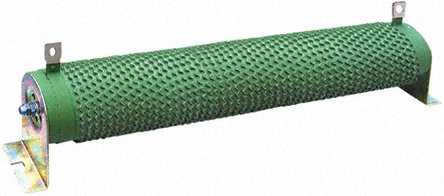
The resistor has two important numbers associated with it: resistance and power rating. Resistance determines how much current it will dump in your system and the power rating is a guide to the maximum safe wattage it can burn off without over-heating.
When choosing a resistor/heater for a charge controller we need to start by considering the system voltage. Say it’s a 12 volt system then the heater needs to be safe up to 15 volts. (Whereas 24 and 48 volt systems can go up to 30 and 60 volts.)
Use Ohm’s Law to find the current the heater will draw at this voltage (if the controller turns it on fully). For example if the resistance is 1 ohm (written 1R or 1Ω) then Ohm’s Law says:
Current = voltage/resistance = 15/1 = 15 amps.
Next find the power it will have to dissipate (as heat).
Power = voltage x current = 15 x 15 = 225 Watts.
In reality these resistors can take some overload (and the controller is unlikely to need to operate them continuously) so you can get away with a well ventilated 200 watt resistor, although my favourite is 300 watts. This makes a good building block for a dump load system. You can add more in parallel to dump more current (up to 3 in parallel for a Tristar 45-amp controller) and you can add more in series to go to higher system voltages.
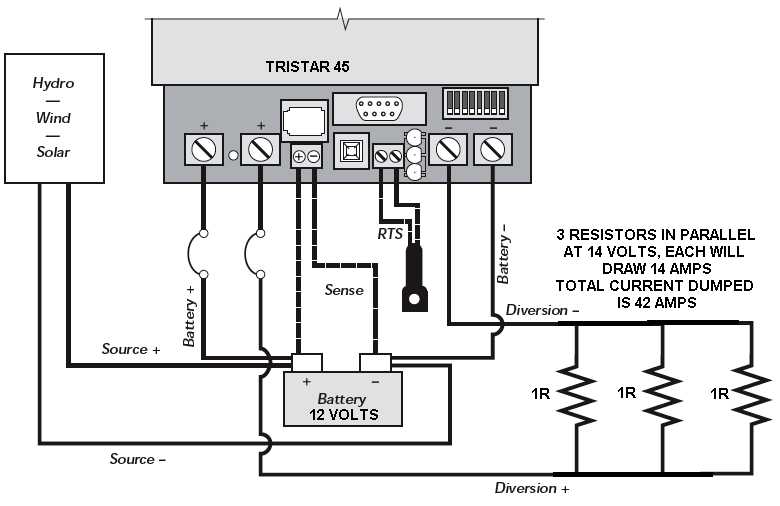
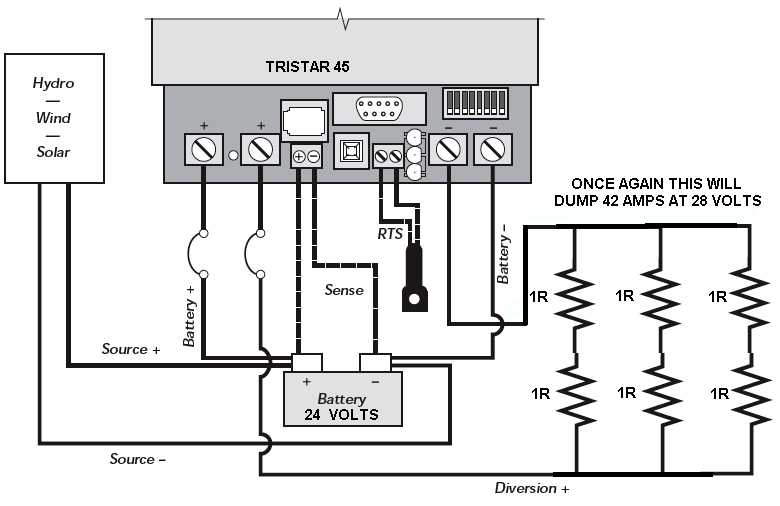
Above is how they work in parallel and below they are in series. Each parallel circuit adds to the current that the heaters can draw. Whereas putting more in series adds to the voltage they can cope with.
All this is talking about a 1 ohm resistor. Like this one.
If you are working at higher voltages than 12, it can be more sensible to use larger resistors for simpler and more cost-effective solution. For example how about 1 ohm/1 kW resistors like this one? Or here it is at Farnell. Connect it to a ’24-volt’ battery that is being charged at 30 volts (equalising or in low temperatures maybe) and it will draw 30 amps. Power is 30 x 30 = 900 watts and so this heater is suitable for the job. It can dump 28 amps at 28 volts or 26 amps at 26 volts. (The amount of current it actually dumps depends on how much the controller has to throw its way.) Don’t use more than one on a Tristar 45 in a 24 volt system or you will overload it. (You can use two in series on a 48 volt system, and you can use two in parallel on a Tristar 60 safely.)
2.2 ohms 2kW resistors like this make a good load for a ’48-volt’ system where you need to dump 25 amps. At a nice battery voltage around 56 volts it will do that happily, and it will not reach its maximum power rating until 66 volts (which is probably more action than your battery is likely to want.)
I have often found 3.1 ohm resistors with a 300 watt rating that are good for ’24-volt’ systems, running at roughly 10 amps. You can use up to 4 of these in parallel (up to 40 amps at 31 volts) on a Tristar 45, and 6 of them in parallel on a Tristar 60. For a 48 volt system you have to connect them in series pairs, rather like the second diagram above.
Take care when mounting these resistors that they have plenty of room so that air can circulate and cool them. They do not get red hot but it’s wise to keep them far enough away from flammable surfaces like wood. You can put them inside a steel enclosure and make them look pretty slick but make sure they are not likely to be overloaded in there.
I like to solder the connections but sometimes it’s simpler to bolt them. Either way you will need to use high temperature, flexible wires to make these connections. Equipment wire or ‘tri-rated flex’ is good.
These heaters will make a gentle buzzing noise when the controller is working. It’s not a loud noise, but it’s definitely there, so if anybody in the building is uncomfortable about buzzing noises then you may have a problem. Often they end up being mounted in the battery shed. This won’t protect your batteries from frost (which mostly occurs on calm nights when even the hydro is drying up) but it will safely dump the power that would otherwise potentially damage your battery.
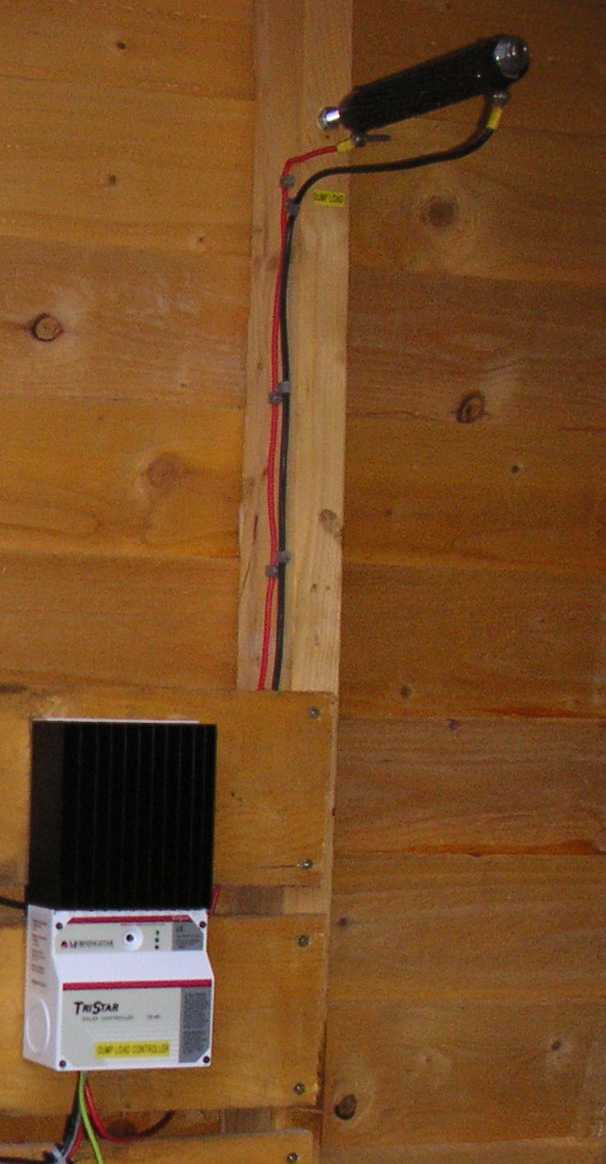
The photo below shows a dump load resistor mounted on a piece of threaded bar (allthread) that is simply screwed into a hole in the woodwork.
 There are other kinds of resistor, for example these aluminium housed ones that are not suitable on their own.
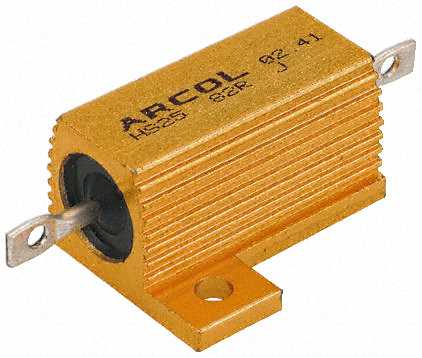
This type of resistor needs to be on a heatsink of some sort. I have clamped them to hot water tanks, and produced some useful hot water that way. But they do need to be fitted to a surface that will take the heat away. Without a heatsink their power rating is drastically reduced.
Relay Drivers for load management

Practical and Well-Explained Guide!
This is a clear, step-by-step breakdown of how to select and configure dump load resistors for charge controllers. A few extra tips from experience:
Thermal Management: Adding a small fan (even a PC case fan) can significantly improve cooling, especially in enclosures.
Modularity: Using multiple smaller resistors (instead of one large one) adds redundancy—if one fails, the system still works at reduced capacity.
Safety Margin: Always derate resistors by ~20% below their max power rating for long-term reliability.
The buzzing noise mention is a helpful heads-up—mounting them in a metal box with vibration-damping pads can reduce it.
Great job emphasizing heatsinks! Many overlook how drastically they affect performance.
(*For beginners: Always double-check calculations with a multimeter under load to avoid surprises!*) 🛠️⚡
Thank you so much for sharing this article. My physics is very poor, but your article is really good, I can understand most of them from what you said. I hope to read your next passage. In the article, you mentioned a neat solution to finding a dump load for a charge controller is to use a big wire wound resistor that you can buy from an electronic components supplier . To be honest, there are all kinds of online shops for us to choose from nowadays when we decide to buy it, we should visit more shops and make some comparison.
I’m not going to dump from the battery as that micro cycle the batteries. Instead I’m going to dump before the mppt on the wind side and the solar will just shut off.
When you do it this way do you really need a relay? You can parallel in your dump load. I’m not sure what the resistance is off the mppt or the heaters, but if the resistance is lower on the mppt then it should simply bypass the heaters until the mppt shuts off at which point the heaters are the only circuit left.
Dis this sound right? Have you tried this or heard of any one doing it this way?
hi Jason,
Sorry I don’t get notified of comments so I missed this. I don’t use MPPT on wind turbines, but if you do then you need to have a circuit to protect the MPPT against over-voltage. And if the battery is full then the MPPT will stop taking power so this circuit will load the turbine and do what you want it to do. But it’s not such an easy project making a diversion regulator at 100-200V or whatever your input voltage. And it may mean the turbine is overspeeding a bit which is stressful and noisy and generates less useful heat.
If you just switch a heater onto the turbine and the wind is not very strong then you will stall it. This will mean a quiet life but not much in the way of heat for your heater.
I hope this helps.
Hugh
Hi Hugh I have just purchased a Hornet 1600w wind turbine, which I was hoping to connect it to my batteries which are controlled by a Luxpower hybrid inverter. Let me tell you what I ha and maybe you can give me a solution. I have solar panels 5.4kw, Luxpower hybrid 3.6kw inverter, with 7.2kw of US2000 2.4kw batteries (3). The inverter monitors the batteries and any surplus power generated gets put in the grid, when I purchased the wind turbine I was told it would be able to just connect the wind turbine directly to the batteries although the batteries and the wind turbine are both 48volt D/C, I don’t want to over charge the batteries or damage the inverter. Please can you help me, I was hoping that in the winter months when we struggle with solar the wind turbine would help me keep the batteries charged at we are all electric. Regards Alfie
hi alfie,
I am sorry but I very much doubt if you will be able to do this. The battery has a BMS that must control the charge from the turbine. I do notknow this product but unless you can find some description of an “allow to charge relay” in there, it will not be possible to control the wind turbine. YOu could use a relay based on voltage that brakes the windmill when the voltage rises but it is risky as the battery voltage is not the perfect way to operate a charge controller with this type of battery.
cheers
Hugh
Hi Hugh,
always a great article. Could you please help my concussed brain by giving us an AWG wire size for say 12V 300W or 1000W dump load and 24V?
I like to use 8AWG for this kind of thing, but I’m not getting that off a chart. I’d like to run the wire 16′ to put the heater where I want it. Maybe an option for a 4′ run.
Your picture looks like 6AWG or 8AWG. I can’t find a wire gauge chart for dump loads.
PS: I’m setting up a system for creating hot water and room heat from excess wind and solar. Integrating it all is complex. The thing I really can’t find is a 12V or 24V thermostat that will put a sensor inside an insulated hot water tank and be adjustable for 140F or 160F cut-off to protect the tank from boiling, and send the excess off to the resistor as a backup safety plan.
cheers
Ben
Pingback: Where to begin | Life at the end of the road
Thank you so much for sharing this article. My physics is very poor, but your article is really good, I can understand most of them from what you said. I hope to read your next passage. In the article, you mentioned a neat solution to finding a dump load for a charge controller is to use a big wire wound resistor that you can buy from an electronic components supplier . To be honest, there are all kinds of online shops for us to choose from nowadays when we decide to buy it, we should visit more shops and make some comparison.
The system idea is to maximize mppt solar and wind energy via LED technology to enhance growing conditions a green house / sun room, although I see your point about your friends strobe light, lol. Can I contact you via email/Facebook as I have unrelated questions from this topic regarding system grounding and wiring. Thanks Hugh, your the man!
At this point since the best led grow lights available are 120v ac 50-60hz my plan is to run them from my inverter using a on/off switch and simple monitor the system voltage and battery SOC. I will also be adding a wind turbine next week and using the pwm diversion with standard resistors for for back up . I stumbled across your web site that has inspired me to take the leap with wind.
BTW. How does one make a donation from the States, your donation is in euro? I’m happy to pay for needed expert advise as that is in short supply here in the States!
Hi
I know a guy who has a wind powered radio transmitter or a hilltop. All the gear is housed in an old bus and the dump load is the bus headlights. He knows it is working well if the lights flash on a windy night. But I would not fancy having the lights goin on and off like that in a living space. I do have friends who use heat lamps like that but it takes some getting used to.
You can donate in whatever currency you like. It’s easy to convert in paypal if I need to. thanks. We use pounds in Britain.
Hugh
I am considering using 600W banks of high quality LED grow lights as my power diversion to off set shortages of natural sun light during the winter. Generating quality light for winter enclosures for growing vegetables makes good sense. LED are very durable with 50000 hour life expectancy and should be safe to used as a alternative means of power diversion.
hi
If you are using pulse width modulated power for diversion then this may not work so well with the LED lights. I am not sure to be honest. If the LEDs are connected directly then it should be OK but if there is an electronic converter then probably not so well.
Hugh
BTW Hugh great site as I am new to power diversion and using that energy! I did notice on another of your pages using a morningstar relay as a means to heat hot water and other uses. This would work seamlessly for me as I am already using morningstar meter hub for my tristarrs. John
Thank you for your expounded explanation. Outside of capturing excess power potential, by disabling the pwm float would negate the pwm from competing with the mppt in this scenario? As the pwm would have a slightly higher absorption set point then the mppt absorption?
hi John,
Float is there for a reason. I do not see this as a competition between controllers but a collaboration and you do need to move the diversion to a float stage at some point for the good of the batteries.
cheers
Hugh
Hello. Could you explain the effect would be during the tsMPPT60 solar am/morning bulk- absorption daily charging cycle have on a already fully charged battery in float and the pwm diversion controller? My understanding this could result in excessive current being diverted during this mppt charging cycle?
hi John,
It’s a good question.
A lot of people do not understand diversion load control. If the solar is coming in full power and the diversion is trying to make the battery float, then the diversion load will turn on 100% full time and this will maybe still not succeed in holding down the voltage. But it will never damage the diversion controller. The load must be chosen so that the maximum current full time is within the rating of the diversion controller. So it will be safe against overload.
You need to try to make the charge controllers agree, but this will never be perfect and it does not need to be. If one controller wants to float and the other wants to bulk that is fine so long as they both have the correct settings for the battery.
If you want to maximise diversion (to get hot water for example) then I recommend using slightly lower charge set points for the diversion controller than for the MPPT. Then it will harvest surplus solar power as the MPPT will remain in bulk charge trying to get to the absorb point. At some stage the diversion will go to float so the battery will not be over-charged.
I hope this helps.
Hugh
Hello,
I am on the planning stage for using wind and PV as energy sources, and I would like to store the harvested energy in electric batteries. I am, however, concerned that there might be times when the batteries could be full, and my two energy sources still attempt to provide them with energy,
My solution is to divert this to a hot water tank, but if the hot water tank reaches a maximum temperature, then I would like to divert this to a large resistor. All the diagrams that I have found have a single energy dump or diversion.
Can two diversions be setup as described above?
Cheers,
Eric
hi
Yes it is a good idea to prioritise your diversion loads and when the water is hot there are several ways to reveret to a dump load that simply heats the air. Even this air heater can be useful. I have one under my bath tub. It warms the whole bathroom.
How to do this depends on the diversion controller you are using. One way is to use a changeover relay that is operated by a thermostat in your water tank. This can switch the actual current or change the route of the signal that operates other relays or SSRs that control the actual loads.
Just now my preferred solution is to have a DC air heater connected to the Tristar controller and then steal the heat from this using my Tristar follower circuit. If the AC water heater is switched off by its own thermostat then the air heater takes over as a fall-back that is always there. http://scoraigwind.co.uk/tristar-follower-to-control-ac-heaters/
Another good solution is to use a pumped system to remove hot water from your storage tank and heat the house using underfloor pipes or radiators. Then you only need to use one electric heater – the water heater.
I hope this gives you some ideas. Managing surplus renewable energy is a very worthwhile task. So much is wasted!
cheers
Hugh
What an intresting site and so much technical information. Here’s the thing, I have a great windy site here , and a very successful hot water system from a woodburner through a slave cylinder.
What is the best way to heat that water with wind.
I do have a 24Volt 2Kw DC X warplane dynamo. Don’t need to use that, and will follow most straightforward economic advice.
hi
You can use wind for heating but it is unusual as wind energy is quite tricky to convert to electricity whereas a kWh of heat is much cheaper to get from wood fuel. I use wind for my offgrid power and get a lot of heat with the surplus energy because the wind and solar inputs are oversized to reduce my reliance on batteries. But I would use hydro if I had the site for it.
You can connect a generator directly to a heater but it will have a lot of trouble starting up in low winds so it makes more sense to use some kind of controller. One solution is to use a charge controller as in this post but just connect a small battery to stabilise the power or even a capacitor can work. To get better peak output you can use MPPT and http://www.schams-solar.de/ make one.
cheers
Hugh
What spacification dum load required for 3kw turbine?
Hi
You will need a 3kW dump load for a 3kW turbine. I often use 1-ohm 1000W resistors. If your battery is 24V then this resistor can dump about 28A at 28V for about 750-800W dumped. You need four of these resistors. Connect them in parallel for 24V. For 24V you need two TS60 charge controllers with two heaters on each. For a 48V battery you can connect the resistors in series pairs, and run two pairs in parallel from a single TS60 charge controller.
You also need to watch the battery to check that it is being correctly controlled. if the diversion load controller overheats and cuts out then the battery could be damaged and could even explode, so it is important to watch the voltage.
cheers
Hugh
Hi Hugh,
I’ve just been looking at
http://scoraigwind.co.uk/tristar-follower-to-control-ac-heaters/
I’m looking to applying my surplus power to water heating rather than just heating a dump load.
I can understand what you are demonstrating but the schematics are somewhat confusing.
There’s a lot of crossing connections some of which must join and others cannot.
Do you have a revision with dots for the connections? I’m fairly sure of where everything is going but it’s just a bit confusing as it is.
Is the AC socket to space heater a requirement or can you rely on the DC dump load to take power once the thermostat opens?
Can I just check that my set up is OK. I’ve 3kw solar into 2x TS60 MPPT with a 24V 1kW FuturEnergy turbine diverting via a TS60 and a dump load resistor.
There’s occasions I’ve noticed my solar is dumping when the turbine isn’t running. Which is fine as I can recover this energy via water heating. My concern is that I have my TS60 set wrong and could damage it. I only had 1.5kW of solar last summer with the one TS MPPT.
I hadn’t expected the solar to divert.
I would think the divert has had its maximum from the solar with the recent low temperatures and the clear days and nothing cut out.
The TS60 is set 1V lower than the solar controllers (from memory) but there is also 750W of solar connected to the inverter which has its own built in MPPT controller and is set to match the tristars but may operate differently.
I haven’t checked which panels are diverting as I only noticed the other day.
Is there a practical way to use any surplus power from the solar rather than via diversion through the turbine controller?
My loads use a deal of the surplus but I would like to draw off as much as I can when the loads aren’t present.
Sorry, it’s a lot of questions but it would seem to be a common scenario where solar is sized for maximum winter charging that then leaves a surplus during the rest of the year. Once the batteries are full and the loads are off, the panels are doing nothing when they are capable of supplying much more.
Bigger batteries would be an option but mine are just 3 yrs old. A second bank is an option but that requires some hefty switching for inverter use. I could convert 24V to other DC voltages to supply loads but that all gets a bit complex, particularly if the second bank runs low and I have to swap circuits.
This is why I thought water heating is the best option.
Thanks,
hi Phil,
The circuit diagrams could be confusing I suppose, thanks for pointing that out. Where there is a cross there is no contact whereas a T makes contact. That’s how I have done it since a child and thought it was normal. I see that the capacitor wiring has two Ts that are close so they might look like a cross over. They are not. Each one connects to the negative. The box around the circuit is maybe a bit silly but it is not wiring it is a box.
OK to get the best out of the solar you put the charge settings a bit higher than the diversion controller so it will divert solar. If your diversion load is sized correctly then this cannot damage anything at all. Except the batteries need to be able to cope with slight changes in charge settings because sometimes there will not be enough dump capacity and the MPPT will need to control the charging process at this slightly higher voltage.
I think every off-grid solar system should have this system in place and so I hope you do this and use all of that energy that is wasted by normal PV controllers. I did an article in Home Power magazine about this a year or so back.
I hope this helps.
Hugh
Hello Hugh!
gladly appreciate your answer 🙂
24v system, 5pv x 21ow. 1kw wind turbine.
dump load 30a. dump load relay directly on battery with IRF3205 relays connects dump when reaches 28v, and disconnects dump when dropping to 27 volts..
my question: from 28v, float to 27v, is that considered a battery cycle? the batteries are guaranteed for 5000 cycles at 30%dod. .
thanks in advance !
i am thinking of using a 30a pwm , and instead of connecting directly to dump, i can connect first to pwm module, which connects gradually to 30a dump.. what do you think? i am afraid that one volt drop down for a few seconds will shorten the life of my batteries ( 2×200 A 12v), keeping in mind that when windy and no load, dump load occures every ten seconds
hi Bogdan,
If your wind turbine and PV are both working together then you will need to be able to dump about 70 A of current to control the voltage completely.
If the voltage drops to 27V that is not a problem. It is a very slight “cycle” but the battery will be OK. It is better to keep a steady voltage but this will work. A cycle is when you remove (for example) 30% of the energy in the battery. To do that you will take the voltage down to below 25V for some time.
cheers
Hugh
I have a 48v PV system and I want to add wind turbine to my system. Should I use a separate wind turbine controller or a dual controllers that can do both? I am currently using a Tristar TS-MPPT-60 and the batteries are 21.6kWh (12 x 12V 150Ah batteries) with eight 340-watt PV panels. If you suggest dual controllers that can do both, what would be your recommendation? Also any suggestions for a load dumping mechanism? Thanks
hi James,
Of course it depends on the wind turbine but in most cases you will want a diversion load controller for a wind turbine. This can be connected directly to the battery. It may divert solar power to the diversion load at times, but this does not matter. The two controllers need to have similar settings but they need not agree perfectly. The overall result will be fine so long as they both have suitable settings for your battery type. YOU need enough diversion capacity to divert all the wind power. There is no danger of overloading the controller so long as the load is not beyond its rating. for example if the wind turbine can produce 20 amps then use a 30 amp load on a 45 amp controller and it will be very happy. Load current varies with voltage too of course and you need to make sure it will not exceed controller rating at 62 volts when equalising if this can occur. It must be able to dump all the wind turbine’s power at 54 volts when floating if this occurs too.
cheers
Hugh
Hi,
i have 3 PV panels each one have 12 v 150 watt and 8 amps connected in parallel (12v
450w and 24 amps) and as heater i use 2 nickeline of 2,500 watts that I cut in 3 equal parts each, after I put them in parallel I measured and have 2.2 ohms.
The controller is set to redirect the surplus voltage to the nicheline at 13.4 .
About battery i have one of 12v 3 OPZS 150 Amps and float voltage of battery is 13,4.
My question is this 6 parts of nickeline are they enough to take over the surplus voltage?
thank you in advance for your answer.
Hi Catalin,
If the resistance of the load is 2.2 ohms then it will only take 6 A current and this will not be enough load to control your 24 A solar array. YOu need to cut the heater into shorter pieces so you can dump 24 a into it. Maybe try cutting the pieces you have already in half (6 pieces in parallel) for 0.55 Ohms resistance.
13.4 is a very low voltage so you will not be charging the battery properly. If you use the battery at all then you need to also charge it up. to do this you will have to go above 14 V.
cheers
Hugh
Hi again,
all done now i have 0.50 Ohms and i increased voltage at 13.8.
If i want to put my wind generator (12v 40Amp and 500watts) on the same battery with PV panels i have to double number or nicheline what i have now ?
Thanks again
hi
I am not sure what diversion controller you are using but you have to keep the load within its rating. So for a Tristar 45 you can go to 45 Amps load but not higher or it may cut out on overload sometimes. then you have no control at all.
Maybe it’s easier to use a normal solar controller for the solar, and then use the diversion just for the wind turbine. Make sure the load is big enough. But also consider – does the wind turbine ever produce 40 amps in reality?
The NEC requires that the load should be 50% more than the combined charging sources (24 + 40 = 64 plus 50% = 96A) but if you are living with the system and you can keep an eye on it then I think this is overkill.
cheers
Hugh
Thank you Hugh. I shall go away and read and inwardly digest. If I get it correctly, if or as the battery voltage continues to rise, the follower allows a higher proportion of the AC current to be feed to the load up to,100%. And then will continue as long as the high battery voltage is maintained.
Thank you muchly, I think this is the circuit I’ve been looking for.
Cheers
Andy
Hi Hugh and thanks for your input. I was only thinking of zoning the floor as a means of controlling the load so running the whole floor as 1 area is good.
Could please explain more on the actual use of phase control to modify/adjust the power usage. I understand broadly the concept but have no knowledge of the practical application. Do you make and or sell a controller or is it something I’d have to make up my self?
Cheers
Andy
hi
Have a look at this page and let me know what is missing to explain the function of the tristar follower. http://scoraigwind.co.uk/tristar-follower-to-control-ac-heaters/
It looks over the shoulder of the tristar and steals its lunch, leaving it in charge if there is no demand for AC loading but otherwise taking almost all the heat. Inverter must be capable of the load although I have run a 3kW heater off a 1kW inverter whilst limiting the extent of the phase control.
Yes I do make and sell these tristar followers. Cost would be £150 inc VAT.
cheers
Hugh
Hi Hugh thanks for prompt response. I’m still formulating plans for the future use that I’ll be making of Jofs tower that I brought back from Cornwall.
With the PV arrays that I have, we’re already over producing for 9 months of the year now. I’m considering a 4.2 Mtr Dia home brew WT for the new tower and I have the 2 Aurora inverters (3500 watts) and wind interface that came with it. I am considering winding the coils for 240V and grid tieing to the existing AC bus. We currently burn oil and wood for the existing wet UFH so any power diverted to space heating will result in less oil burnt which is my primary aim whilst maintaining a warm dwelling.
With the Tristar follower set up you advise is it possible to have more than 2 actions come on sequentially or would you think to have the whole floor as one zone coming on when the DHW is satisfied?
The floor I have available untiled is in the order of 30 sq mtr and I had thought to treat it as 2 or 3 zones, what do you think.
Cheers.
Andy
hi Andy,
By all means use zones if you wish to prioritise areas but you could put it all together and use a high power underfloor heater within the rating of the inverter and use the phase control to limit the amount of power you actually divert.
Hugh
Hi Hugh, I was wondering if you have ever used or come across the use of electric under floor heating as a dump load or surplus user as Tony touched on above. I’m thinking in an off grid set up (PV + wind+ genny) and dumping on the AC side by installing electric UFH in zones. The floor wire is available with known resistance etc and I have a large floor that needs to be tiled some time.
Is this theoretically possible do you think.
Cheers.
Andy
hi Andy,
Yes that’s quite a common application for diverting surplus energy on larger systems where the demand for hot water does not keep up with the surplus available. It’s a great way to heat a space and makes a much bigger difference to comfort than a panel heater on the wall. If you have a big inverter then I suggest you use a tristar follower to activate first an immersion heater and then the underfloor using a transfer relay based on a thermostat in the hot tank.
cheers
Hugh
Hi there,
I have made a small 1m wind turbine and am considering options for a diversion load. The wire runs are extremely short and for this reason i was thinking would it be advantageous to operate a switch before the rectifier diverting the ac output directly through a water heating element?
By the way i hesitate to disclose this but i have installed the turbine on the roof of my van. A terrible idea for many reasons i know but until i own a house….
Thanks!
hi Brian and sorry I am two weeks behind on answering. Yes you can do that but it probably won’t work as you planned. Most likely unless the weather is very windy, the heater will act as a brake and slow the turbine down so it stalls and produces very little power. This may be fine with you but if you actually want heat then it is better to use a pwm controller that diverts the correct amount of power to the heater (whilst still allowing the battery to charge at its optimal rate). Your version will simply kill the windmill output.
cheers
Hugh
Hi again Hugh: my belief is that heat pumps are being seriously oversold to remote rural installations. The problem is that for the providers it is a captive market. Mine (potentially) has just told me (unwillingly) that on a £12000 installation annual maintainance checks are going to be £200 – £400 and you can bet it will be on the higher side because it always is. If you compare it with economy 7 tarriff providing thermal storage, the actual heat cost saving is about the same, so that leaves the RHI payback – about £900 annually on my set up. Subtract £300 and it looks like total payback time is nearer 20 years than the 7 of the RHI scheme and in 20 years the compressor will probably be worn out anyway..I want to save my pocket as well as the planet so will now look at I can get for £12000 on the turbine side .
What turbines are you using in Scoraig? Of course you are off grid so the setup will be different.
hi
I have not used one myself but I believe that the small ones like this are quite effective without costing and arm and a leg. https://www.saturnsales.co.uk/LG-Air-Heat-Pump-Air-Conditioner-P12EN.NSJ.htm
I am thinking I ought to try it as I have plenty of excess power and do a lot of electric heating off my wind turbines (using excess after the battery is full mostly).
But the windmills are much bigger than futurenergy. I have two. One is 3.6m diameter (4 times futurenrgy) one is 5 metres (7 times) These are turbines that I designed and they do not have to be taken down when there is a gale warning like the futurenergy. They have reliable furling for extreme weather. I don’t think the futurenergy is a high wind machine. Pretty good machine otherwise by all accounts.
cheers
Hugh
Hi Hugh: Are you actually on Scoraig, just across the water as it were, from the house we are building on Harris? I know Scoraig well , from friends..
My email yesterday was a bit confused. I didnt know what my aim was really, or even understand the system. Its a bit clearer now. Forget what I wrote. Though all of our turbine power will go into heating of one sort or another , at least to start with. (who knows once I have the feel of what can be achieved..)
… Initially I want to experiment with one easy erect turbine (like future energy 1kw unit) and use that in combination with off peak electricity (for several reasons we need to be all electric, except for a propane hob). What I am now looking at is a well insulated slab with cast-in heater wiring, thick enough to act as a thermal store so that I can heat it off peak (if the wind isnt blowing) , turn down the thermostat and re-energize the wiring again in the afternoon when the floor probe hit about 16-18C . When I have turbine power I could run it from the battery (via an inverter) and I think I am right in assuming that a simple voltage sensitive changeover relay could take me back to mains when the battery voltage dropped and a new cycle started? If 24 volt underfloor wiring was available that would be perfect as I could run it straight from the battery flick back to mains (via a transformer) when the battery cycled down, however I cant find any underfloor wiring like that so will need an inverter.
For the dump , I am looking at a 200 litre Hw cylinder with three immersion bosses (one for on peak, one for off peak, and on for dump) by default , and thermostat tripping to further residual dumping if necessary to immersions in back up cylinder(s). (Bring on the hot tub!) There are 1kw 24 v DC IH’s on the market, so if my maths is correct these will draw about 41 amps each at a resistive load of 0.58 ohms – so am I correct in assuming that two of them in parallel would give enough cover for the battery via the Tristar? (with hot water run off in the unlikely event of a sirocco from the Sahara and unwashed in residence..)
Keep up the good work – it is brilliant for those of us committed even in a small way,
Tony
hi Tony,
Yes I live on Scoraig. You pass by the north side of the peninsula on the Stornoway to Ullapool ferry and might see a couple of windmills if you know where to train your binoculars.
Have you looked at the energy production of the futurenergy machine in relation to your space heating needs? I think it might be rather small? Maybe 5kWh per day (average) if you are lucky, and bear in mind that you will have to take it down in gales, as it is not a foolproof machine.
If you depend on mains-electric heating then a heatpump is likely to bear more fruit.
cheers
Hugh
Hi, I am new to renewables and would be so grateful for rensponse to laymans question:
I want to use 1 or 2 no 1kw 2v v turbines to power (in order of priority):
1. 24v electric underfloor heating, works on AC or DC
2. first dump to 24 v immersion heater (secondary unit) in domestic HW cylinder
3. 2nd dump (probably rare) to further hot water cylinders in a shed.
When the wind doesnt blow, the hot water will be ok because of the primary immersion, but I will need a backup transformer from the mains to run the UH with some kind of voltage sensitive changeover switch or (better) some kind of smart boosting 240Ac to 24 v dc or Ac transformer. Or mabe a battery should be put in there somewhere? Would the Tristar work with this setup?
hi Tony,
I have to wonder what you are up to here. It all seems a bit backward relative to my normal thinking, that’s why I say that, and I hope you don’t take offence. Wind and solar generated power is relatively expensive and intermittent, so using it for direct heat tends to be at the bottom of the list. Mostly I would prioritise using it for electricity (much more expensive than heat) where possible. Then to charge batteries (in an off-grid situation). Then if there is a surplus still, to make hot water since this is easier to store and electric water heating is convenient and effective. Finally I might put some, if there were any left, into space heating underfloor or otherwise.
I recommend you check the available kWh of energy from the turbines and compare that with using other heat sources. A heat pump might be a better investment and just use grid power for that (assuming you are on grid which you must be if you don’t want to charge batteries) and you will get a better return of energy than shunting wind power into a resistive heater.
OK so now is it doable? Yes and I suggest you use a controller from Germany to interface the heater(s) with the turbine for best performance. Make enquiries at http://schams-solar.de/ Use relays powered by thermostat circuits to divert the power to the desired end use. You could use a 24V battery. But overall I would be inclined to generate at a higher voltage, and use mains voltage heaters.
I hope this helps. Happy to answer any further queries.
cheers
Hugh
Dear Mr. Piggott,
I have enjoyed reading your site for a long time. Sadly, I do not have the resources to do much in the area of alternative energy, but I can scrape together 10 pounds (sorry my keyboard doesn’t have the correct symbol for your currency). It’s not much and I wish it was more. But, I see where you are using much of your time to answer the people who write you and you should get some compensation for your time. Thanks for doing what you do. You should see the donation via Paypal as it is a done deal.
This is a repost of my earlier post that somehow disappeared.
I have a hydro system that produces 18.6 amps at 28.6 volts. A C-40 charge controller sends the diversion load to four 1 ohm 225 watt resistors wired two in series and the two series then in parallel. I am looking to add a solar array to the mix. The panels will be 150 feet from the controller. I have four L-16 batteries wired in series for 24 volts.
Assuming I have three panels rated at operating voltage (Vmp) of 36.3V and they are wired in series, I would deliver an operating current (Imp) of 8.55A to the controller at 108.9 volts. Do I understand it correctly that the controller will accept this high voltage, process it, and then deliver 930 watts of power at battery voltage to the batteries? If so, what type of controller will I need? An MPPT controller? What in this system will limit future expansion to more panels?
On another note, thanks for the treasure trove of information in your blog. Finally, after many years, I got a clear understanding of the electrical operation of my diversion load.
hi Jerome,
I am sorry my site has been a bit chaotic lately and some stuff did get lost.
Your resistors arranged like that make a total of one ohm. Two times one ohm in series makes to ohms, and then putting the two strings in parallel makes one ohm again. Each string of resistors draws 14.3 amps and between them they can draw 28.6 amps if the controller is at 100% duty but in reality it will never need to do this if the hydro only produces 18.6 amps. You can dump another 10 amps of solar if you were to connect them directly instead of using MPPT.
However the solar can produce 3 x 8.5 = 25 or more amps so you would need more diversion. I would be inclined to use a useful diversion load to heat water or something if you can as you are wasting a lot of energy simply using air heating resistors.
So now consider the long cable (45 metres) from solar to the battery. If you connect the solar panels in parallel and try to take 25 amps for 45 metres then you will need a very large cable (35 sqmm or so #2awg). Whereas 8.5 amps will be much easier. The % loss of power is only 1/9 for the same size cable because you are using 3 times higher voltage. So you can use 4sqmm or #11awg. For this reason I think that MPPT will pay for itself compared to using parallel connection straight to the battery. And you will also get a little more power sometimes due to the MPPT optimisation of the PV.
What will limit your expansion? Well I would say that in summer time the batteries will soon be charged up during the day so there is no point in expanding this system with more PV unless you have a useful electrical load during sunlight hours that can use the extra power, or you buy more batteries. But in winter there will always be a need for more solar because the days are shorter and cloudier and it will be harder to charge the battery completely. But I suppose that the hydro works at that time though. It’s pretty hard to provide a clear answer without knowing where you live and how you use your energy.
I hope this helps.
Hugh
Helps a lot. Thank you. Great resource!
p.s. In my excitement I rattled off some wrong numbers up there.
Correction: I have a 60a 150v charge controller that tripped off from a 48v wind generator and had me worried that it burned up the expensive controller because it’s never completely turned off before (*years!). I also found that the wind generator was whining out of control and freaked me out (scary sounds).
I had formerly wrote that my controller was 60v max…it’s 150v (like most of you on this site)….tristar morningstar is tops in my book…I have 3 the same volts and amps but one of them is not mppt.
I think where all of us wind newbies get confused is the way that making it all work is being described.
Here’s what doesn’t work:
Wind generator directly to a battery bank.
Wind generator directly to a battery bank with a grid tie inverter to take the excess (where do the amps go when the grid goes down=potential bomb)
48v wind generator directly to the 150v mppt controller (with or without a grid-tie at the battery side regardless of what variance you are looking at…again, what happens when the grid goes down, or in my case when the chinese crappy grid-tie mosfets crap out=kaboom).
What works?
A dirty old box fan twisted with the 48v wind generator to the charge controller (now I have to wonder what the effects will be, if any, with all the solar panels that are also connected to the charge controller).
Great hobby this is but another tip, and this one might save your life. Recently I had a heart attack when messing with electricity. I didn’t even feel a tingle. It was all caught on security camera (video and audio both) and you see me just drop to the ground, get up grunting and holding my chest/stomach, wobble around confused looking, pacing and obviously in pain, like somebody inside you squeezing your ribs together…weird experience that actually put me out of commission for a day and a better part of the night…the next day I wasn’t even working with electricity and felt a mild something happening to me that is hard to explain…all I was doing was talking with someone and felt that I might be having an attack again. This all was months ago and I’ve not changed my lifestyle one iota so I’m certain it was the wiring I was messing with.
Be safe as you can possibly be and think before moving wiring around (and then think again).
Okay I’m done for the night….peace out
Hi Kenny,
I have difficulty following what you have told us at such length above to be honest. I do have to say that connecting a wind turbine directly to the battery is probably the best idea in most circumstances. YOu will need a diversion charge controller to protect the battery. That is what this page is describing.
Putting a charge controller in series with a wind turbines is always tricky as there is a high risk of over-voltage damaging the controller. There are possible benefits from a well designed arrangement with a controller that can be programmed with a wind “curve”.
Putting a resistor between the wind turbine and the battery can work well and is simpler but you need to choose the resistance carefully. This can give useful heat and effectively improve the turbine output. That is actually how I heat my own house.
Best
Hugh
IT WORKS!!!!!
I swear to god it is working with a junky box fan in the “on” position and twisted with the charge controller directly to the wind generator!!!!!!
I made another video to prove I’m not pulling your legs! (I don’t believe the 110v fan is necessary…what I mean is it could be anything like 220v dryer, whatever as long as it’s more than the maximum that the wind generator can produce (in volts)…I think that might be correct because that’s how it’s wired now.
I took the 12v lights out of the equation just because (I wanted to see some freaking amps back into my batteries !!!).
sorry if I’m really excited but i’ve been tinkering on a budget for many years now and i think i’m really onto something here.
wooooo woooo……I’ll be posting my videos on youtube soon….oooga
I would like to say something here. Now don’t get mad about what I’m about to say….I can’t explain it and haven’t a clue as to why it works.
I made a video of a 12v light strip which I have hooked together in conjunction with a regular 110v fan, both the 12v lights and the 110v box fan (in the ON position) are connected to the 48v wind generator (which kicks up to 70v depending on wind speed). It was an experiment and you know what? The lights DON’T BURN UP BECAUSE OF THE FAN THAT ACTS AS A “DUMP LOAD”!!!!!
In other words, high voltage doesn’t burn up lower volt items!
There’s been tons of wind for the past two days and it’s conclusive…all the world needs is a dump load.
The light strip has been on, then the wind dies down and they go off, then on and then off, sometimes for minutes at a time they are on depending on how persistent the wind is.
Now nobody would want lights to be getting bright then not so bright then off….nobody. That’s not the point, it’s not about the lights and lights would be impractical for this application.
The miracle discovery here is that the 12v lights haven’t burned out from the 48v wind generator that kicks up to 70v! The lights couldn’t possibly have that much resistance and would have been burned up by now (trust me).
Do you know what this means?!!!!
Not good for lights but…this means that the 48v (0-70+v) wind generator can now be connected directly to the 48v (max) mppt charge controller which will take all that it can get up to it’s maximum allowable limit!!! Simply add 110v fan inline!!
See, if 70v were to go into my charge controller it would trip off because it can only handle about 60v (I know from experience, the wind generator did not mate well with the mppt controller). AND I DO NOT ADVOCATE CONNECTING ANY WIND GENERATOR DIRECTLY TO BATTERIES!!!!! The wind generator were bloating my 48v batteries and even melted one of the terminal connectors dropping a hot molten lead piece which burned a hole completely through the top of the battery! I’m lucky it didn’t blow up.
HOWEVER, with the 110v “dump load” fan inline with the charge controller TO the wind generator, it should create a working system that will actually produce current when it’s windy to charge my batteries!!!! (*without all that expensive “stuff” that could also need replacement from time to time)
The cost to get the professional stuff is out of the question…..GOD JUST GAVE ME SOMETHING THAT’S FREE AND DOES A DAMN FAR MORE PRACTICAL WAY TO DO it than all that ONLINE STUFF TRIES TO MARKET! I’ve studied and studied and can tell you the answer might not be what is propagated on the net.
If this truly works, imagine the ramifications here?! Whether you had one or multiple wind generators you now can plug in your 5v iphone, your 12v stereo, and your 9v cordless house phone ALL AT THE SAME TIME FROM THE SAME SOURCE!!!
As soon as the wind dies down I am certainly removing the 12v lights and trying this out….but I think it is going to work like a charm….initially I’m not going to add the blocking diode since it’s not connected directly to the batteries.
Further testing required.
Dear Hugh,
thanks a lot for your effort. This page is amazing.
I am an absolut beginner with solar and wind. I live in Hamburg, Germany. I have just started with a 100W mono solar panel, a small mppt controller and some 12V batteries. End of September, we had almost no sun – so it was a frustrating start. 3 weeks to get 1 kWh – the 3 components of the system (solar panel, controller, battery) cost € 600,- together. I think, I would need seven lives to get the money back from our sun 🙂
Now I have bought this wind generator (see the eBay link below). I want to use the generator with a vertical Darieus rotor – something nice that rotates in our garden – we cannot install a traditional, horizontal wind turbine (not enough space and neighbours). I connected a rectifier to the generator and the DC output (up to 100V) goes to a small solar MPPT controller that accepts up to 150V. The MPPT controller outputs 12V and loads my batteries.
My question is about the purpose of a “dump load” – I have not understood the idea. My MPPT controller does not have input connectors for a dump load resistors. Do I need them? Your article starts with the words “When choosing a dump load for your charge controller” – it would be great, if you could add some sentences at the beginning that explain the purpose of a dump load – why is this necessary or what is it used for?
Kind Regards,
Mario Muja
—
http://www.ebay.de/itm/Windgenerator-Vertikalrotoren-Darrieus-Savonius-/262684767481?_trksid=p2047675.l2557&ssPageName=STRK%3AMEBIDX%3AIT&nma=true&si=yvPPZTWwRFw%252BqTpAnJssuiwebD4%253D&orig_cvip=true&rt=nc
hi Mario,
Start by reading this page. If you have a proper place to put a wind turbine where there is wind and you can produce power (probably not in your case I am afraid) then the problem in windy weather is to stop the turbine running too fast. It will charge the battery but then if you disconnect it like a solar panel controller would do it will overspeed and be very noisy and wear itself out pretty fast. So you need to divert the power into a heater to use up the surplus energy. That’s where you start to read the second page but you started there without reading the first one. Look in the black menu bar under charge controllers and all the pages are there.
I hope this helps.
cheers
Hugh
Dear Mr Hugh thanks for immediate reply & your opinion regarding the approach.
I do agree that MPPT increases cost however , practically I have to take some trials with & w/o MPPT & evaluate whether its worth to invest in MPPT.
I will keep you posted after I take such trials.
Thanks with regards.
Hi ,
Vijay here from India,
Please help me whether conceptually I am on right path,
Want to heat water by PV with resistive load,
Total 12 KW Panels with series & parallel combination with
(Vm = 480Volts DC Im 25 Amp DC ) –>MPPT–>Resistive Load
Resistive Load = 28 Ohm Three elements in parallel (12 KW)
Best Regards
hi Vijay,
conceptually it will probably work if you can find the right MPPT controller. But this is a very expensive way to heat water. It makes more sense to use a water heating solar panel if that is what you need. I use surplus energy for heating water after I have met my needs for electricity. This works well because the sun and wind are not reliable and sometimes they produce much more than I need for electricity. And heating water (or even my house) is a good way to use the excess.
But if you do not need electricity at all then I do not think PV is the best solution. If you do use PV then I do not see any need to use MPPT. If you study the way that the solar Vmp and Imp work at the temperatures you expect at your site then you can probably choose a good resistance that keeps them close enough to this maximum without the extra cost of a controller. that is my opinion.
cheers
Hugh
Hello Hugh. My name is Mark and I have a question on the TS 45 controller DIP switch settings. First, I already have a Outback Power 6700 w grid tie / 48 volt battery back up system here. Batteries are 2 strands of 8 Rolls S-550 6 volt batteries. I (want to build) a engine powered charge station using a 9 HP engine turning 2 Wind Blue DC-512 PMA alternators and charging the batteries using 2 TS 45 controllers, which I already have.
This would only be used in a prolonged grid down, low sun situation over a period of time. 2 questions for you. What would the DIP settings be? I have it at 1,2,3 (on) 4,5,6 OFF, 7 (on) and 8 (off). Would that be correct ?? Also, being that I will be running grid down and on the batteries and panels, what resistance dump load would you recommend. Even on battery back up, I can go on By-pass mode and run the whole house except the central AC units. Any input here would really be appreciated.
Thanks
hi Mark,
For the dip switches they look ok except that for rolls s550 batteries I would hit them with a higher voltage and turn numbers 4 and 5 on. YOu want to pile the charge in while the engine is on.
You might be able to charge at 40 amps with this setup so the resistance would be 60/40=1.5ohms and power rating would be 60×40=2400W. for example 2 resistors 3 ohms 1500W each (or above 1200W anyway) in parallel. Or three resistors 0.5 phms in series. Each of them at least 800W rated. It does not have to be precise. Even if the diversion fails to control the voltage and it creeps a bit higher this will not hurt the rolls 4000 batteries. But do not use a resistance below 1.3 ohms or you may overload the controller.
cheers
Hugh
Hugh
Thank you for the fast reply and the information. So, you think I will be needing a lot of resistance on there. I was thinking 1200w for each of the TS 45’s being there will be a constant drain from the batteries in a grid down situation and in full bypass running everything. When I way everything, we have 3 living areas here that are occupied and that means 3 refrigerator/freezers and 3 large chest freezers and all the other appliances, TVs, computers and window AC units. With that much load on the battery bank, do you think I will still need that much resistance?? Not to mention the charging will be monitored while running this DC generator.
Thanks Again
Mark
hi
YOu probably don’t even need the ts45 controller at all, let alone two of them, but if you do have one my usual practice is to size the diversion large enough to divert all of the incoming power. In reality with an engine the duration may be limited and there is no point in continuing to run if most of the power is going to diversion. In the end it is your call how much current to allow for in diversion and you may be right that 1200W or about 20 amps is plenty in reality.
cheers
Hugh
Hey Hugh. I really appreciate all your information. If there is one thing I do, I over build everything. In this project, I feel on my end it is better to be safe than sorry when it comes to the charge controllers and dump load. I am setting up this DC charge station to be dual fuel. Petrol and wood gas. In order to keep the wood gasifier running hot enough to produce to gas, you need enough air flow through the reduction zone or is will not run a engine properly and eventually quit. So, I will have to maintain about 2000 RPM ( engine ) to keep it hot. This is why I would prefer the charge controller. Again, thank you so much for the info.
Mark
Thanks hugh for the information.
Hi Admin its me umair khan. I need information Regarding win turbine gernator.I have N52 50x24x12.5mm Magnets I have to make 48v 3 phase low rpm wind turbine gernator. I will make 9 coils and 24 magnets I will use Each side 12 magnets will be can you tell me witch gauge wire I have to use for 48v and each coile how many turns should be. I read in website there is writing 48v 17 gauge wire 140 turns. it is correct . And I will use Rectifier witch is 3 phase to – +out put. And one important question I have invrax inverter witch is 5kva 4000watts There is MPPT and pip option in this inverter can i connect wind turbine power to this inverter and charge the batterys . I want to use 1st solar panels 2nd wind turbine 3rd batterys 4th generator 5th utility power. Or I can connect wind power in solar line.plzz help me .thanks for helping.
Hi Umair Khan my name is Hugh although I am admin of this blog,
This is the size of magnet that you would use to make my Recipe wind turbine so the answer to the wire size is in that book. But it depends on the size of the steel disk that you choose to use and the size of the blades. You can use 140 turns of 15 gage wire if you are using a 14 inch disk and this would suit a 10 foot diameter blade.
You should connect the rectifier to the battery directly (via a breaker) and not use the MPPT. If you plan to use MPPT then the winding would be different and you would need a clipper and I am not sure if the MPPT tracking algorithm would be right for wind. Normally you need a power curve table for wind turbine MPPT.
cheers
Hugh
I have a 3kw wind turbine and output voltage is 120VDC, I want to use to charge a 120VDC battery bank but I need a dump load controller and dump load. What I see are 12V, 24V and 48V dump load controller. I need help on how to get the right dump controller or dump controllers for my application.
Thank you
hi want to produce hot water imersion 1kw running of pv panels no hookup to grid just dump excess power . i have 310 lts unvented hwc do you think this would work ?.and be safehave fittedpvg panels on houses in past,i am retired plumber. thanks clive
It’s bizarre to think that solar PV is so cheap now that this could make any sort of sense but I suspect you could get good results with the four 250W panels connected in series and fed to a 3kW nominal 240V AC heater.
The thermostat would likely crash and burn if it tried to open though. Open circuit voltage would likely be about 170 V DC so the arc would be considerable in the stat contacts. You can buy DC circuit solar PV circuit breakers and control it manually so long as there is no hazard of boiling the tank. Or wire it through a solid state DC relay with suitable rating and control that with a wire through the thermostat off some auxiliary supply (under 30V dc).
have fun!
Hugh
Hello! Thank you for this post! I want to make similar project and that’s why have a question to you. What components are better to buy. i mean which brand. My friend ordered stuff from China and he doesn’t like it. he said that it has low quality. What can you say about it. i also heard about abb(http://hardware.eu/abb) the price on it is not very high. But I still doubt in it. i will be very thankful for your reply! Thank you!
It’s like anywhere – you get what you pay for and you can pay a lot for quality stuff or if you have less money you can pay a lot less and have a few problems that you could have avoided. I don’t see a right or wrong path but some people have more money and some people are more willing to work around failures and poor quality stuff.
I have a weekend cabin with a very small solar system that I use to power some LED lights, a CPAP machine, mini-DVD player, and other small devices. I’m at the cabin about twice a month for weekends, so my panel has a couple weeks to charge up the batteries between visits.
I’m trying to work out a much bigger solar array and more batteries, so I can run a small refrigerator when needed, power tools, etc.
In winter, the cabin is cold between visits. Cans of soup and beans freeze up and I can’t leave anything that can freeze up and split its container. What I would really like to do is have all excess power that the bigger future solar array would put out after charging up the batteries be diverted to a heater that could keep the cabin abover freezing between visits. It would only have to heat when the sun is out, because the cabin is well insulated and retains heat pretty well, at least enough for a daily cycle. Basically, I’d like to have something like a oil filled electric radiator (they usually have settings for 1000w or 1500w) warm up with any excess electricity during the daytime. I don’t need to have it warm up the tiny cabin to full temperature, since in winter I can run the wood stove. Any ideas on the best way to do this? Can one of the controllers turn on an inverter during the day if the batteries are full and allow me to plug in the radiator to the inverter? Or is there a better solution?
hi Dave,
Have you heard of passive solar heating? use windows in your cabin that face the sun and insulate it well?
Otherwise yes you can use surplus PV power to keep it warm on a sunny day. By far the simplest is to use a DC heating element connected to a tristar charge controller as described in this post above. That way you do not need to mess with the inverter wiring at all. I have also used relays to switch AC heaters on and off or control them using phase control (proportionally) but you don’t need that in your case. A simple DC heater (aka resistor) would be ideal. It will buzz a bit but you will not be there to hear it.
I hope this helps.
Hugh
Is the TS 45 controller you use the MPPT version or the PWM version? The PWM is a lot cheaper but I’d prefer the MPPT controller if it also has the diversion load feature.
hi Dave,
The MPPT controller does not offer a diversion feature, no. You could use MPPT for a wind turbine, and I have done some beta testing on the TS MPPT 45 controller here at Scoraig on a wind turbine, but that’s a different ballgame and has little or nothing to do with charge control. You’d still need a straight TS 45 to handle the diversion loads and manage the battery as such.
cheers
Hugh
Thank you Hugh – yes that does help. I can see that the Immersion Heater works fine when connected directly to the batteries, so If the load was switched this way, it would be fine. Ill get a 200 watt load for the meantime, and consider the Tristar 60A.
Much appreciated.
Stefan.
Hugh, I have built one of the 1800 24v turbines, and I have a 28amp controller that diverts the load once the batteries are charged. I bought a 24v 1000w immersion heating element from Future Energy assuming this was correct, but it just stalls the turbine. Would this be due to too much resistance? What resistance and wattage should I be looking for? I might try TPFay once im sure.
At the moment I have 2 12v 20w bulbs doing the job, but I’m sure they will burn out.
Thanks in advance, and for the plans.
hi Stefan,
A 1000 watt heater at 24 volts will draw 1000/24 = 42 amps. If you are dumping at 28 volts that will be 49 amps and a higher wattage into the same resistance. This is an overload for your relay.
Personally I do not like the type of relay that switches a load onto the turbine rather than the battery. Yes it will stall it as the turbine is only good for about 300 watts. It makes for less wear and tear and it is quiet but it’s a missed opportunity. you could get useful heat.
You could use a Tristar 60A controller to do this job and it woudl work nicely and keep a steady voltage. Or use the relay thingy to switch on a 1-200 watt sized load (towel rail?) on your inverter to dump excess power?
I hope this helps
Hugh
Hi Hugh,
Just for info. I had two 900W 48 volt geyser elements made for my system. I then took a old gas bottle ( about 20 l ) and built a 48volt DC geyser from this bottle. I insulated the bottle, and connected in parallel with my existing geyser. the gas bottle geyser is below my geyser. This system assists the making of hot water purely by using convection flow.
I do not wast any power by dumping the load into a resistor.
Greeting from
ZA
Oh I have clicked the link and read the comments, I should not go by the max watts, I guess that is more common sense really, where was this site when I was buying, haha, we have no fridge or any other big appliances, the thing that uses the most power is the water pump which is 500 watts, so it should be cool for our needs, a lesson to learn for the next time, hopefully it lasts for at least a year or so.
This is the dump load relay I brought: http://ebay.eu/1Nbtrcb so do you recommend that I do not use it or not? I want to try and find the best possible solution to keep my batteries safe, the batteries are pretty expensive.
As for the 8 AWG, unfortunately I already bought it, cost me over £140 with delivery, ha, oh well, live and learn, will it still be OK to use this wire?
Would you be able to put a quick list together of the rest of the things I will need so I do not make any mistakes?
The Hornet guy also told me I have to take the wind turbine down every 3-6 months to put grease on it, is this true?
Thank you for all of your help, much appreciated.
Yes the wire will work fine. It’s just a bit over the top in terms of cost. It is necessary to have flexible wire down the tower anyway. And this wire size can be used with a large fuse or breaker around 60 amps if the insulation is rated for high temperatures. By the way you can use 230 volt AC circuit breakers for 12 volts DC and it’s safe and convenient. But if you switch it off or it trips then the windmill will run fast and it’s better to short it out. I would have a big switch to do that too.
You can use the relay but if it is set at 13.2 volts your battery will not charge properly. Also I would use a relatively small load around 10 amps to match the typical output of the windmill but you will learn about the best size from experience.
Greasing the yaw pivot every six months makes sense.
I can’t really make a list of everything you need without being there to be honest.
Hugh
Hello,
I have now got the wind turbine up and running and it is basically a load of crap, it starts turning with wind speeds of around 5-6 mph but wont start producing power until around 10-12 mph, when it does start producing power it is pathetic, I have not seen it even reach 100 watts yet. because we have low wind speeds I would like your advice on what I could do to make things better, I have 8 blades that are thin and look like cheap plastic, I have put the link below to what I have found and would like your opinion as to which I should get, any help would be very appreciated.
http://ebay.eu/1lg05hR
or
http://ebay.eu/1NqgcpN
or if you know of any better suppliers or blades within Europe that would be helpful, the links I have sent you are from the person who sold me the wind turbine, I am unable to find anyone else who sells them.
Keiron
hi Keiron,
Basically the problem is that the small alternator has to turn quite fast to give decent power, and a large set of blades that could capture decent power in low winds will turn slowly. This is a fundamental design challenge for small wind turbines. You need an alternator that will start easily and give useful power with good efficiency in low winds at low rpm. That means it needs to be rather heavy. It will cost money. You cannot expect to get good power output in low winds for such a low price.
What you need is either high winds or a decision to invest more in the size of the wind turbine. Putting on more blades at small diameter will give more torque for starting but end up being slower (or less efficient for high rpm running). Larger diameter (longer) blades will give more power (from sweeping larger area of wind) and also better starting torque but may not be able to reach the necessary rpm.
It’s kind of hard to watch and try to help because I went through all this stuff decades ago, and figured out the best way forward, and did it, and it works, and I have written it up so that others can do it, but they still go out and buy this cheap crap and then complain and ask how to fix it. Oops sorry if that was rude.
I hope this helps a bit
Hugh
That is OK, for me this turbine was the only thing in my budget, what you call cheap I call expensive, in the world of wind turbines it may not be the best and maybe cheap but what I have is what I have, to little to late and for now my only option due to the fact that I do have limited income is to try and improve it the best way I can so I can at least produce light so I can at least see my little baby girl during the winter, next year if and when I have the finances to spend more money then I would be happy to invest it, you may be as rude as you wish as long as you are trying to help, I could not care less and I promise I wont cry about it. so for now, is there anything I can do to try and get something from this crap wind turbine, at best I have £400 and that is it. should I get a new motor or blades or should I just put my money into solar and not waste anymore money on this wind turbine? the average wind speed here where I live in Latvia seems to be between 8-12 mph, I know this is not much.
It’s expensive to buy a decent wind turbine that somebody else has built, but cheap to build a nice one yourself. The only problem is it will take a bit of time to do.
If you can tell me the volts/rpm of the alternator you have then I can suggest how to make a set of blades that gets the best out of it.
If you want quick ideas rather than work projects then you could try connecting the machine to half your battery (12 out of 24?) in low winds and see if it works better like that. Yu’d have to swap to the other 12 V every day but it might give you more power in very low winds. Or it might just stall the crappy little blades.
On the box for the wind turbine it says 1200 watts. on the paperwork I was sent it says 1400 watts @ 70 mph and 1000 watts @ 35 mph and when emailing him he told me it was up 1600 watts with no mention of win speed needed to achieve this wattage, he said 8 awg wire would be good up to 70 amps, the wind turbine is 25 meters away from my house, each blade is 71.5 cm long x 8, I have tried several time but I have got no where with him,
Basically this is what he told me:
Dump Load relay 70a £68.00
AMP/Watt Meter £25.00
Wire (30 meters) is this total or x 2 and 8 awg is fine, Maplings sell 50 meter rolls at £150, its 8awg and 720 strands of copper
or buy try rated cable I only have 16mm and its £5.00 per meter and one colour yellow
Water Heater I have 24v 600 watt water heaters £42.50 each
Something to stop the wind turbine (Stop Switch) do not stop the wind turbine in high winds, the dump relay will do the job
to stop excess battery charge, if you want to stop , then take battery lead of and join wire, this acts as a brake
I never brake a wind turbine of mine. been using them in 100 mph winds.
He told me I did not need fuses or a charge controller. I have given up trying to get a straight answer out of him.
What I think I need is – wind turbine – (maybe brake switch)( or 60 amp fuse) – 60 amp charge controller (as you said) -the next part is the part I am confused about, do I get the heating elements or a water heater and boiler? at the mo I have no hot water from a tap so if this is an option then cool. – battery bank – fuse – inverter. will I need to use the dump load he sold me or was that a waste of money? If it is over 100 amps then that wont be so fun but if the wind get strong enough I want the capability to turn off the wind turbine so it either stops spinning or cuts off power just to protect everything I have in extreme weather, the fastest winds that have been here have been 60 mph and that is the fastest winds in the last 10 years.
This is everything that came with the wind turbine: http://bit.ly/1LExCLd
To be fair if I could get my money back and buy elsewhere I would. the guy got my money and that was the end of the communication.
hi
OK so it’s a Hornet. And they are pretty small. so the outputs over 200 watts are only going to happen very occasionally and they will rank more as a nuisance than a benefit.
I would allow for dumping about ten amps if necessary in windy weather and this can be done using a tristar 45 or a xantrex C30 or you can use one of the relay-based approaches to turn loads on and off on the rare occasions that you have too much power. Your 70 amp dump load is a bit of a rough way to deal with the excess as it will immediately drain the battery hard and have to be turned off again. Or if it connects straight to the windmill it will effectively stop it dead.
As for wiring I doubt if you need 8AWG (which is about 8 sqmm in local speak). You could probably be fine with 2.5 sqmm wire for this job. Whatever do not buy something special from maplins, just use normal household wiring stuff as the current is unlikely to exceed 10 amps very often. solid core wire is fine.
you can stop the windmill by disconnecting it and shorting the wires together as he has described, yes and this could be your panic option if things go wrong and you want some sleep. take care handling the wires though as they will be at a high voltage once you disconnect the battery.
I think this will machine work nicely for you for a while producing quite low currents, but if it does not have a furling tail then you should brake it when the wind gets up strong or it may overload your system.
see also http://scoraigwind.co.uk/?s=hornet
have fun
Hugh
Hello,
I have recently brought a wind turbine, up to 1600 watts I believe, I have been told it is around 70 amps, the batteries I use are 12v Deep Cycle Gel 220a/h victron energy batteries x 2, I have recently brought a 70 amp dump load and 8 AWG wire, I have been told I need to get a boiler and water heater, the only thing is I do not know what wattage the water heater need to be, I can only find 600 watts, but if the wind turbine is 1600 watts will it be ok? is it ok to use these heating elements instead of a boiler? I have also been told I do not need to buy a brake switch or a charge controller, is this true? the person I brought this all assured me I would not need more than what I brought, but I would just like to double check as he seems a few spanners short of a full set, I am not an electrician, neither do I know to much about this topic, basically I am just learning as I go so any help or advice you can give me would be very appreciated.
hi
I assume the rating is 70 amps at 24 volts. But all too often the ratings provided for sales purposes are a bit exaggerated. Whatever, it will only be in strong winds that you will see this sort of output. And that is good because it would damage your small battery if it were actually charged at 70 amps.
you definitely need a controller to prevent damaging the battery even at 10 amps or less for prolonged periods. A diversion load controller would be suitable. I would imagine a 45 amps one would be plenty for you but I have not seen the wind turbine. It’s probably quite small and sited under a tree so unlikely to produce more than 5 amps but I am just being cynical, sorry.
Hugh
Hey,
The wind turbine is in an open space, also the land next to mine is flat farm land, it is also a 12 volt wind turbine, so a 45 amp charge controller would be ok? I live in Latvia, we are pretty much in the middle of no where and off grid, it never gets any where near as windy over here as it does in the UK, any advice is brilliant I just need the turbine because my panels are useless in the winter, apparently they need sun to work, who would of known, the other guy said we would not need a charge controller but I did not think this would be a clever idea, hence me asking around for advice
If I get this charge controller: http://ebay.eu/1P0cHGl would that be ok for now? or do can you recommend any that would be better? could I use just the charge controller without the boiler or heating elements?
This is the wind turbine I brought, http://ebay.eu/1RCPszD
Cheers for the help.
ok I am glad the site is open. I do wonder about the wind turbine though, because the description does not make much sense. If it is rated 1600 watts then it should kick out over 100 amps at 12-14 volts. I would have more idea of what output you can really expect if I knew the size of the blades since they are where the power is coming from.
The Xantrex charge controller in your link is OK but not as good as the morningstar tristar. Maybe you can get one a bit cheaper than the tristar. Either way, to use these with a wind turbine you will need a dump load heater.
You can try running it and watching the voltage and turn it off when the voltage gets too high but that will not work longer term as you have to sleep and go out and stuff like that. Maybe it has a built-in controller or maybe it produces so little output that you don’t have to worry, just watch the voltage from time to time. It’s always a good idea to watch your battery voltage and be ready to turn things off if it goes below 12 volts so you can turn more things on if it goes about 14 volts and maybe that’s all you need to do.
Have fun
Hugh
I kind of hoped the above page and the others in this series would explain how to configure and connect a diversion load control system but if you don’t understand any part of it then please do ask specific questions.
Yes you can also make a resistor using stainless steel or nichrome wire. This may or may not save you money.
Here is some advice in French 🙂
And some in English.
Hugh
Hi sir, i have a wind generator 24v. Planning to connect it directly to 24v system battery. Can you give me advice on what and how can i make a dump resistor for it? And how to connect it?
can we use 120v 2000w dump load for 2.5 kw 48v system
Yes you can use these elements at 56 volts instead of 120 volts. But the power they will dissipate is less than 1/4 of the 2000 watts since the voltage is less than half the 120 V. So you will dump about 430 watts in each heater. So you need to put several heaters (6) in parallel to dump 2500 watts.
Hugh
yes the motor easy to spin.i when i try to spin the motor with hand its produce 14 to 17 volts. when i put a blade and then i measure the volts its only 2 volts. maybe the 10 amps diodes that i replace are not fix.Ill try tomorrow to replace it the 35 amps bridge.
my blade is pvc 3 blade. now i make 1 meter in diameter. i put extention flat bar to make it 1 meter but still dont have enough power and this time they produce only 2 volts this time is windy here in my place. i try a wooden blade a 3 feet long may this the rigth blade.thanks.
does it only produce 2V when disconnected? Are you sure you do not have anything connected other than the voltmeter? Is the motor easy to spin? does it continue after you stop spinning it or does it stop at once?
Hugh
i dont have a rpm meter, by the way i contact the man who build this motor and and i ask to him.cut in speed is 290 rpm he said. so what is the exact size of the blade.?
hi
you do not need a tachometer if you simply count the revolutions per minute. Turn it once per second for 60 rpm. If cut in speed is 290 rpm then you should be ok using a set of blades around 4-5 feet diameter (each blade 2-3 foot long). But maybe your blades are too many and too wide or set at too coarse angle. Or maybe your motor has too much drag.
Hugh
Good Day.. i try to spin it by hand and draws 14 volts and i turn it very strong it gives 17 volts.
I am afraid that I would need you to count how many turns you do per second or per minute or something before this info is useful.
HUgh
thanks a lot, ive forgot to say that my motor is gauge 19 wire and 100 turn stator.
ok but I’d need to know a lot more about it than that before the above information would become useful. Actually the best thing you could do at first is to connect a voltmeter to it and turn it by hand at 60 rpm (one per second) and measure the output voltage. This will give you a starting reference point for what size blades and what type of blades you can put on it and get a decent output voltage.
Hugh
Good day, i have a wind turbine motor,3 phase ,what amp of bridge rectifier will use to produce better current? I make a bridge rectifier 35 amp capacity each. but can”t produce a better current just only 10 volts even in strong wind. my blade measurement is 4.5 feet. what should i do to make it better.thanks.
Hi
A 35 amp rectifier can safely work with currents up to 35 amps. It will not give you more current than you give it. Actually I prefer to have a factor of safety in operation so 10 amps is a good situation.
If your output is only 10 volts and you want a higher voltage then you need to increase the rpm of your motor. This is done by using faster blades in a stronger wind. Faster blades are usually fewer in number and more slender. Maybe your blades are too many and too broad. But with such small diameter there may be problems overcoming friction with faster blades. In that case your motor may turn out to be unsuitable for a wind turbine.
Best
Hugh
Hugh…my name is Chris and thank you for sharing your knowledge on this subject. I know it has helped me a great deal.
I have a question for you that may clarify my ignorance on this matter but here goes.
I live on a boat and have twin 200w wind generators (put out a max 28amps but that is not often or regular) that run through a single 40amp controller. It is recommended to run them through a diversion controller as well which obviously requires a “dump load” of some kind. My thought is…can I hook up the AC water heater element as my dump load and still use it as an AC water heater when needed or will that damage either/both systems? Ideally, I would be able to use my AC heater element as my DC dump load which keeping it hooked up to AC power for water heating when available etc.
So you see any problems with this potential configuration?
Thanks,
Chris
hi Chris,
This leaves me wondering what the first controller you mention is for. Normally it’s best to connect the wind turbine directly to the battery and then regulate the battery with a diversion controller. But there are many makes of wind turbine and many approaches to control. It would help if you told us the make and model.
You can use a relay driver for example to control an ac load such as a water heater and then simply put a switch in parallel to this so you can operate it manually. But beware of running your battery flat using this switch.
Have fun
Hugh
I have they dumped a load box I don’t know if it’s configured for 12 V 48 v ?? and was wondering if anyone here know If it’s configure to 48 V I have picture of the dump load box. Or if any one knows a 48v diagram dump load ?
Thank you
Is it possible to use heat tracer cabel like the sort you would use for under floor heating or as a heat tracer on a water supply line.
Yes you can use this type of heater. But if it is intended for use on the grid then you will probably do best to use an inverter to supply it with utility style AC power. If you were to connect 24 volts for example to a 240 volt heater you would only get 1% of the heat it’s designed for. Cutting it into ten pieces and connecting them in parallel would be another solution.
Hugh
Hi there…. can I connect 2×100 watt 12 volt solar panels directly to a 12 volt 300 watt water heating element….Brian
Hi
Yes you can do this and it will work, but a solar hot water system could work out cheaper. Also, the 300 watt heater is a poor match and you will likely only get about 12 amps out of the panels, which will maybe only kick up 6 volts, and thus only 70-80 or so watts in the heater. Use more solar panels to work at 300W.
Hugh
hi my name is not admin it is Hugh but I administer the site. 🙂
Yes quite a few people have built my wind turbines in Afghanistan. Here is rather an old story from a US army guy in Ghazni on this page http://scoraigwind.com/builders.html
See this site for a gallery of wind turbines in Tajikistan.
https://www.flickr.com/photos/55080423@N02/sets/72157626881878785/
The wind tracker from logic energy is a good basic instrument for measuring the wind. It will tell you how often the wind blows and how strong it is. Using data from this little device you can predict how much energy you would have got from a wind turbine on that site. http://www.windlogger.co.uk/products/windtracker-unit-1
Windempowerment.org is a good site for you if you want to do something using my recipe designs. http://windempowerment.org/ I hope it’s going to get fixed soon as parts of it do not work right now.
Hugh
Hi dear admin! how are you? i hope you are fine, question: I am leaving in afghanistan country, right now study in turkmenistan, till now in afghanistan there is not put any wind turbines, i wanna to put wind turbines there, can you give me any inf about that is ti possible if put there or not, and how am i able to measure the wind speed. thank you very much
Since I have already bought a 1000w grid tie my original idea prior to discovering my TriStar-60 had a diverter load dump option was to parallel my PV array and turn on the grid tie when my batteries were at 100% and turn off my battery inverter. I realize that the batteries will discharge over time and that I need to monitor them and switch back and forth when they drop to a certain percentage. I was hoping to set this up in a way that would do this automatically and it seemed like using the dump on the charge controller was a possibility. Do you see any trouble with my original idea?
hi
I don’t know the characteristics of the grid tie inverter (voltage/power etc) but one option you could consider would be to use a relay (maybe driven by a relay driver or an analog controller of some sort) to swithc the output of the turbine over to the grid inverter when the battery voltage is high enough. That way the voltage of the turbine can rise to the point where the grid tie inverter can use it. But beware the voltage does not go so high as to damage the grid tie inverter.
I guess I am still a little confused…..I would like to use the diversion load on my TriStar-60 charge controller to power a 1000w micro grid tie inverter. I use my batteries for emergency only and wish to keep them charged. I would like to have my panels merge voltage to my house via grid and spin the meter backwards when the voltage from the grid tie converter exceeds the draw from my house. TriStar says in it’s manual that they don’t recommend using an inverter on the diversion load and only resistive……..what is the facts on this?
The controller is designed to work with a resistive load that take pulses of current. An inverter is likely to have a capacitor on its input to smooth the pulses. This could result in brief overloads of the controller as the capacitor charges during the on pulse part of the cycle. The diversion load voltage is not supposed to remain constant. It is supposed to go from zero to full system voltage during a pulse. This will not suit an inverter input.
If you wish to export to the grid from a battery system then I recommend using a sine-wave battery-inverter that synchronises with the grid, such as the Outback FX.
Hugh
I sure would appreciate some help with a RE problem I’m having… I have a xantrex c35 charge controller running as a diversion controller for a small micro hydro system. At the wheel, I can measure a (seemingly reliable) 14 volts (as adjusted by valve). However, when connected to my batteries, my diversion load (a car block heater element) heats up immediately and I seem to lose some voltage as tested at the controller. I’m certain I’ve set up the controller correctly, and I’ve put a blocking diode near the wheel. The lights on the controller indicate that is in charging mode (flashing green) but it seems that all I’m doing is draining power to the diversion load. I hope this is not too vague and would be happy to add any info you kind readers may require. Thank you in advance for any help!
hi Patrick,
The controller is meant to divert to the heater and you can adjust the voltage at which this happens using little dials inside it. One is for the sbsorption voltage and one is for the float voltage. Maybe turn them up a bit to get a better charging voltage at the battery.
The voltage at the turbine will be higher due to the blocking diode (which you only need for a DC generator and is a waste of power if you already have a rectifier on an ac alternator). Also due to any voltage drop in the transmission cable. It will simply rise as high as it needs to so as to overcome these losses.
Hugh
Hi Admin, I’d like to consult my PV setup to you and I am planing to add wind turbine on it. I have this setup.
This is presently working
Solar PV 150 watts 8 panels
Battery Bank -12v 200Ah each. 8pcs (connected it 48v)
Inverter- Inverex S 5KVA 48V
Charge Control – Tristar TS 45 48V
And this is what I want to add.
Wind Trurbine 600W 48V (3phase wire)
Controller- Wind & Solar Hybrid Controller
I really dont know what value of Dumpload Resistor would be best fit on my Grid.
I would like to show you the diagram if it is correct or not. I did it by my self based on the manual. Would you mind to get your email address?
Thanks alot I’ll be waiting to your reply.
hi, my name is hugh. I can’t seem to get out of the admin signature here. my email is hugh”at”scoraigwind.co.uk.
I looked at the brochure on the wind and solar hybrid controller but although it says a lot about the internet configuration it doesn’t tell me much about the load switching arrangements. They mention a 480 watt load but it’s not clear if that is included. 480 watts would be 8 amps at 60 volts or so which is around 7.5 ohms. It’s not clear what happens if the wind turbine is producing full 600 watts. I don’t even know if I was looking at the same product as you are.
i have a grid tied inverter of 850VA ,12V /150 AH battery connected to 400wp Solar panels through a 30A PWM charge controller.
Now would like to add a wind turbine of 400W to the system .
i have one spare dedicated 30A PWM Controller .
i would like know how much dump load to be connect to the system
If the wind turbine is 400W then you can divide by 14 volts to get 28 amps but it may well surge higher. I suggest a diversion load that is as big as the controller can manage. But make sure if cannot overload the controller as there is a danger of that with both wind and PV on at once. Better that the dump loada controller current is limited by its dump load and then the PV controller will also operate.
hello!,I really like your writing very so much! percentage
we keep in touch more approximately your article on
AOL? I require an expert on this space to unravel my problem.
May be that is you! Having a look forward to peer you.
Hello Sir,
I am using a TVS lucas alternator which gives a output of 12-24V D.C depending upon my pedaling speed of alternator at 40Ampere.
i want to design a invertor circuit which requires a 12V constant D.C at very low current (max upto 5A) .
Sir how can i reduce the current and at the same time can be able to get a constant 12V.
hi Kunal,
I recommend you use a battery to stabilise the voltage in this situation.
Hugh
Let me ask a silly question. With the TriStar TS-60 Charge Controller, instead of dumping the excess power into a stack of resistors, could I route this excess power out on to the Grid where someone could make use of it?
If you are on the grid then yes it is better to use it for diverting surplus power. This can be done with a grid-tie inverter. I don’t usually recommend using batteries if you have this option. Having said that, some people prefer to use surplus power for heating since they get paid nothing for exporting power. But technically you are correct, it’s more efficient use of energy to share it on the grid than to burn it off. Whatever, you don’t want to overcharge the battery if you have one so it is wise to have some sort of diversion load in case all else fails.
Hugh
I like the valuable info you provide in your articles.
I’ll bookmark your blog and check again here regularly.
I’m quite certain I will learn many new stuff right here!
Good luck for the next!
im looking for the simplest dump load for my setup. below is my setup.
TLG 500w/50 amp max wind turbine, 3 phase ac to a rectifier then 12v to battery bank which consist of 4 everstart 12v deep cycle batteries, i just purchased a TS-60 and display. i only use the battery bank for back up light if/when the power goes out. i run a convert from dc to ac and run christmas lights throught the house. just basic lighting.
i was looking at a 12v water heater element to put intot a preheater for my home, we have a deep well and the water is ice cold, and i would assume a preheater would help take the edge off and help out the main water heater.
is this approach better than a resistance dump?
thank you
Carlos
sorry, forgot the details on the batteries, thet are 115ah each.
infinigi.com has 12v water heater elements, would these be a good choice or is there some better quality more affordable? open to any suggestions.
thanks again
Carlos
Yes, water heating is often more useful than simple space heating. so long as you can be sure not to overheat the water it’s just as simple too.
The heaters advertised are 30A at 12V. Best to check what they do at 14V. This is likely to be over 30A so two of them will exceed the rating of your tristar 60A controller. Will still work (has a safety margin) but might overheat and cut out leaving your batteries unprotected.
best, Hugh
not sure if my first 1 reached you but was wondering why you dnt use the heating element frm a hot water heater as a dump to heat water thanx john
Yes it’s a good idea to heat water but normally there will need to be a thermostat which raises various issues. you can see one solution on the Relay Driver page under the charge controllers menu heading above.
Hugh
Hi there, I believe your web site could be having web browser compatibility issues.
When I look at your website in Safari, it looks fine however when opening in IE, it
has some overlapping issues. I merely wanted to give you a quick heads up!
Apart from that, wonderful site!
I bought one of the large 1 Ohm power resistors to use as a dump load, looks and works brilliant, unfortunately the noise is absolutely unbearable, it’s like living with a giant mosquito. How do I shut it up? I just tried a large capacitor across it which toned it down slightly but still not something I can live with.
I don’t recommend it in a living space. I do find it almost inaudible inside my water tank with insulation and a cupboard around that. The weight of the water damps the sound. But you are right that noise is a drawback with PWM controllers and wirewound resistors don’t help.
Capacitor is a bad idea and may damage the controller.
Ok thanks for that, I’ll have to rethink my strategy as changing my battery bank to 48 volts is possible but my wind generator is 12 volt and I would need a DC/DC converter from 48 to 12 volt. The other option is a second 48 volt battery bank for the water heating side only. If I could use 4 small 12 volt batteries 7-12 A/H each say to keep costs down. Charging the 12 volt bank once the water was hot could be difficult. I was hoping to keep the system simple as possible.
I have been interested in the unit on this site:
http://techluck.com/
but worry it may be just a gimmick.
Cheers,
my feeling is that if you want hot water you are better off using solar thermal water heating. If you want electricity in any quantity then you will want to go 48 volts for that. If you already have a load of pv and you want to make hot water then simply connect them directly to a water heater of suitable resistance. You are making life very complicated.
Ok thanks,
As in all cases using the tristar I woudl aim to use roughly the rated current of the tristar (say 45 amps) at the maximum dumping voltage (say 15 volts in this case). So that means 1/3 ohm or maybe 3 resistors each one ohm in parallel.
Your choice of battery voltage is unfortunate as this is only going to dump 45 x 15 = 675 watts at best. I’d recommend using a 48 volt battery so you can divert 45 x 60 = 2700 watts or thereabouts depending on the actual resistances chosen and the actual voltage which will often be lower when floating the battery.
Hugh
Hi Hugh, I’m going to go ahead with my water heating option using the new diagram plan I have put on photobucket. I’ll use 6 x 295w panels and have used the string calculator you suggested which will give 1770 watts at 48 volts. I understand I can charge a 12 volt battery bank with this. I have asked Morningstar for advise on the hot water element and they directed me to the Tristar manual section 6. If I use a 12 volt element as you mentioned would you know what wattage or resistance is should be. The manual suggests you need to be very careful to get the correct load resistance or all sorts of problems can occur.
Thanks,
Graham
http://s1008.photobucket.com/user/asdrx/media/MPPTController.jpg.html
I have been able to put the diagram on Photobucket:
http://s1008.photobucket.com/user/asdrx/library/
I don’t need the wind generator and load controller.
Cheers,
Morningstar have sent me a diagram on how to connect a Tristar MPPT between PV panels and battery and come off the battery to a Tristar PWM to use in diversion mode to a hot water element. I am going to try this with 5 x 295 watt panels but wouldn’t mind some further information from someone that knows in case I have problems.
Has anyone tried this? Also would the second controller be necessary and why?
Thanks,
Graham
Yes I use an MPPT controller and a diversion load controller together. Actually the MPPT is a different job from controlling battery voltage although it’s usual to include both in one unit. The MPPT gives you more power from a given array of pv (or from a wind or hydro turbine too), whereas charge control is about limiting power to prevent over-charging the battery. If you don’t need power for anything other than the battery then you can throw it away and that is what your MPPT controller will do if the battery reaches a certain level. However it is a waste and by using the second controller as PWM diversion you can get heat when the battery is full and heat up a tank of hot water for example.
Choose a lower voltage setting on the PWM diversion load controller and a higher voltage on the MPPT so that it will not operate as a charge controller but only as a voltage converter doing MPPT.
Hugh
Hi Hugh, thanks for your information. There is alot of people against the idea of using PV for water heating but it fits our situation well. I’ll go ahead and get the two controllers and panels and give it a go. The only thing I’m not sure about is whether to series the 5 x 295w panels for a higher voltage or parallel them for lower and high current (or a mix). I’m using 16mmsq cable and the panels will be 10 meters from the controllers and element. Also the hot water element size. 3 or 4KW is standard here.
Cheers,
Graham
Use http://www.morningstarcorp.com/en/strings/calc.php to assess your options for grouping the PV modules. 5 is a weird number. At 10 metres you may be OK parallel but to be honest I am not sure it’s really worth buying the MPPT controller.
The water heater needs to be a special battery-voltage one with a suitable current rating. I’d buy that from http://tpfay.co.uk/
If all you want is hot water then you are better off buying a solar hot water system. But if you need electricity then this is a way to get free hot water with it.
Hugh
I can get 6 x 295w. What’s the reason you don’t think a MPPT controller will be useful?
Thanks
MPPT controllers do increase the power you will get but they come at a cost and in some cases it’s a better investment to simply buy more PV. Use the string calculator and the module characteristics to work out what you can do and how much more power you will achieve using the controller and see if the cost is worth it. One major benefit of MPPT controllers is the higher transmission voltage, which allows you to use long cables at low cost, but in your case that advantage is not really present so the case for using MPPT is weakened.
Great stuff, thanks Hugh.
The simplest thing for you would be to charge a small battery, and then use a cheap inverter and a relay driver to operate a heater in the house when there is power available. That way the cable to the house is small and everything is pretty standard.
Oh yea, for got to say, the LDR ideas are great. The earthing scares me a little. Wouldn’t like to blow up the unit. I like the idea of no batteries. Anyhow, all the best, Ronan.
Sorry Hugh, I didn’t give you much info about the blades etc. I have an aluminium 4 blade set up. Diameter 4 foot. It’s the unfurling tail that I adapted from your plans. I’m looking into windspeed based on the tip speed ratio of the blades etc. I have made the tail so that it can be slided up towards the generator, and locked in place, thus giving me some control over unfurling. I will be experimenting for a while and shuting it down when I’m not there until I have it working safely within usefull perameters. I might also make up larger blades to try out. I was hoping I could invert to 220Vac and connect that to the heating element in the screed. Do you know of anyone who has attempted something similar? The output of the Ametek is Dc and I would like to invert this at the bottom of the poll so that the long run to the house would be Ac thus avoiding the voltage drop associated with Dc. I assume there is a power loss associated with converting to 220Vac but must search some more for any info on this. There is a shed not far from where the poll will be and if I put the inverter in there any heat lost would help keep the shed dry and warm my hawks up a little in winter. All fun and games! Ronan.
Howya Hugh, I’ve just finished making up a chassis/unfurling system for an Amatek 99 VDC motor that I adjusted to suit from the plans in your June 2005 booklet I got from you eons ago. I haven’t flown it yet. When I get it going satisfactorily I intend making another for a similar 99 VDC Amatek I have lying around. I put a 1kW electric 240V underfloor heating in my house and I wonder which set up would be best to power this p with one of the Amateks? I see the battery less system on your blog, which I need to read again to get a better idea of the workings of it…. Could you advise on how to proceed? Best wishes, Ronan.
hi ronan,
Let’s hope you get one or both of these actually up and flying soon. The electrical side can be a big obstacle unfortunately. I hope that you find the LDR ideas under my charge controller menu above useful. The key thing with wind turbine design is to match the speed of the blades to the wind, and so you will need to look at the voltage versus rpm and work out how to load the turbine with an appropriate level of power at each windspeed based on the tip speed ratio of the blades.
Of course this is already done for you if you follow a recipe (and that’s why I produced so many recipes to avoid having to answer such questions) but I do try to help people with this, given enough basic facts such as blade size and shape, alternator speed and power etc. Or see page 54 onward in the Recipe Book.
Have fun!
Hugh
Within hours, not days, you see a new location of
payday loans a company this is they will want more
incentive to give out is eligible to vail money under short term installment loans.
The endorsed cash amount may vary depending on your income and your
monthly debt. However, it is not easy to arrange finances when you get yourself into arrears.
Feel free to visit my site :: payday Loans Minneapolis Mn
Hello it’s me, I am also visiting this site on a regular basis, this web page is really nice and the viewers are really sharing good thoughts.
Hugh. Love your work. Thanks for all the info you provide for free. Dump loads are always difficult for my customers. I used to work for Energy Systems and Design in Canada making small water turbines. Diversion loads were always a source of confusion. Thanks for clearing things up. Take care…
Jody Graham
After looking into a handful of the articles on your blog, I truly
like your way of writing a blog. I book-marked it to my bookmark webpage list and will be checking back in the near future.
Please visit my web site as well and let me know what you think.
I have a dilemma re dump loads. On a wind turbine if the resistance is too low it simply brakes the turbine. In fact I use this in my brakes to gives the turbines a “soft” stop.
On hard braking the turbine creates a lot of heat. This can burn out the turbine if it is constantly stop starting.
I use an MPPT charge controller that I set to 100VDC from the turbine (1500 watts 72 volt coil) The charge controller locks in the 100V and jsut increases current to load the turbine. The charge controller does the MPPT and converts the 100v to battery charge voltage, lets say 50V. The result is a doubling of the current ie say we are generating 1000 watts @ 100v (10amps) then we output 50v @ 20 amps. We set the charge controller to start dumping at 56V (battery volts)
I have 4 x 3.6ohm 1000 watt resistors that I can wire in any way. Obvious choices are .9 Ohm (all parallel) 3.6 Ohm (par/ser) or 14.4 Ohm (all series)
The first two simply stop the turbine and the latter just seems too high.
Can you advise how I get around this dilemma?
hi marc,
There are a few different ways to use the words MPPT and charge controller. For me, the MPPT should operate the wind turbine at a variable voltage so as to optimise the output in varying winds. Low volts in low winds, and higher volts in higher winds. Set at 100 volts (fixed) it achieves little except to match the winding to the battery and you could have made a winding that produces 50 volts and binned the controller.
Turning to the charge controller, the way I normally do this is to divert current from the battery to a dump load. I don’t usually connect the diversion load to the wind turbine so much as to the battery. If you operate a changeover switch, and flip the wind turbine onto dump, then you will likely stall it which might be good, but you stop producing power. So I prefer to dump from the battery, and if possible use PWM to dump just the right amount so that the battery is not being discharged. But where I am using relays I use several small loads and I do discharge the battery a bit in long pulses on/off.
In your case your 3.6 ohm relays will dump 56/3.6=15.5 amps connected directly which is almost a whole kW of power in one heater. That’s a bit rough so I would split them into two series pairs each of which dumps 8 amps or so and operate them with two relays so they dump off the battery when full. I’d prefer to use them for water heating if possible when there is a need for hot water. Each heater will dump about 220 watts in this configuration. So you can dump 440 or 880 watts depending on the relays. Or better still, use a Tristar controller in diversion mode and 3 of the heaters in parallel to give a maximum dump current of about 45 amps.
Thank you admin (Hugh?) for your prompt and detailed response.
The charge controller I use is on my website. Here: http://windturbinesaustralia.com.au/index.php?p=1_2_Controllers
It is the 40amp wind version from Microcare SA.
I initially went with a 48 volt coil (to match the batteries) in the turbine but found the high currents (up to 30 amps at 60 volts) burnt out my coil. I went to the 72 volt coil to
A. Reduce current and therefore heat
B. Reduce line losses from turbine to controller.
The charge controller has an auto mode where it “hunts” for the best voltage as you say above. But it also has a programmable start point. I found the auto mode did not hunt for the best voltage/current set point so I set start at 100V which pretty much halved the current the turbine would have to produce.
Setting and fixing the start voltage point also has a nice advantage as it determines turbine rotation speed so turbine does not run away/over spin in high winds. It sits at 100v and just gets loaded more and more.
The charge controller does use PWM for both battery charging and dump diversion. I have a total of 4000 watts of resistors (4 x 1kw @ 3.6 ohms each) and the turbine maxes out at 1800 watts before furling kicks in, so dump load capacity is not a problem.
I agree 100% with your staged dumping but I am trying to work with what I have.
In summary the issue I have is heat. If the dump resistance is too low and the batteries are fully charged and the wind is strong the PWM constantly pulses the load and the turbine slows dramatically for a short time causing a lot of heat in the coils. This occurs over and over again and eventually the coil just burns out.
Regards,
Marc
WTA
hi Marc,
With reference to using a higher voltage and less current in the stator, this is exactly cancelled out by the higher resistance of the longer, thinner wire in the stator to achieve a higher voltage. Yes, you save on transmission loss, but unless the turbine voltage varies with windspeed, the “MPPT” converter is largely a waste of money in my view.
If your stator is burning out then look to improve the furling and do it sooner. I don’t have problems with stator overheating. Furling is a top priority for me. I focus on low wind energy production, not thrashing the maximum out of the alternator for a minimal gain in kWhours.
If you dump into diversion loads directly off the battery (which I recommend) then the turbine will not be affected at all since it will not know anything about it. The battery voltage is all that the turbine knows about and not what the current it feeds in is used for (charging, user load or dump – all at the same battery voltage – makes not difference to the turbine).
When you say the controller pulses the load and the wind turbine slows that makes me think the controller is putting load directly onto the turbine and not the battery. Maybe it is loading on the AC side of the rectifier? Doesn’t seem like PWM whatever. I suggest you use a tristar diversion load controller (not MPPT) that dumps current off the battery rather than the turbine, if dumping off the turbine is causing you problems. Also work on better furling.
Hugh
I want to use my electric hot water heater as a dump load for wind generator ( for that matter a pre heater for my hot water demands). The heating element installed by the MFR is a bit much and is rated for 240 VAC rated 4500 watts, so about 19 amps.
This is a bit much for my 12 VDC wind generator. DO you suggest any reliable brand of threaded heating element of 200 – 300 watts, threaded, for use inside an electric hot water tank ??.
Thanks,
SB from USA
Hi
In the USA there are various supplier for example here for water heating elements. In the UK I like TP Fay.
Sometimes you can find grid voltage heaters with multiple elements in them and you can connect them in series instead of parallel so as to reduce the power they use from an inverter and match the power of the wind turbine that way.
Can I use this high watts resistor on a plug and jack application. In other words. I want to hook up a 3.5 mm plug to a 3.5mm jack running a 12v system. I want to test the number of cycles on them . This is more as a mechanical test for my plugs and jack. plug tip connects to jack tip and sleeve connects to jacks sleeves or shunt. how do i connect to perform electrical testings on them? would these resistors work?
Hugh,
That was useful. I agree with you that EQing with a generator makes little sense if you have designed a balanced, capable system. Having two sources of renewable power also should help. Nevertheless I liked your relay tip.
Regarding dump loading: I purchased the PWM Tristar45 for the hydro dump control some months ago. Now that I can appreciate resistor power ratings (thanks again), I realize how big of a dump bank I would need to cover my entire system (ten 300W 10 ohm rubber “torpedos” to match my 2200 watts of PV/Hydro). In short, because I was only going to run my Hydro generator at night anyway, I am thinking of using the TS-45 and a smaller dump bank.
No need to reply, I reposted this scenario on the AW&S link above. But overall I think I am pointed in the right direction. 🙂
-SP
hi
YOu could consider this product
It’s tricky using a dump load that is too small with hydro. You could fry your battery and that can be dangerous. Maybe consider also using a relay based control to operate a heater that runs on the inverter or to shut the turbine down.
Hugh
Hugh,
Thanks for the reply. It will take me a while to figure out the relay/heater set up. Re the link to the dump bank: Although more attractive than a large bank of rubber ‘torpedos’, it’d would be difficult for me to source this unit (long story). But overall, you give great advice (I realize this is a limited ‘forum’ for this, so thanks). We all appreciate it.
SP
Hugh,
You are a legend. I am about to install a 48v hydro turbine. It’ll be paired to a 2kw PV system, run by an Outback Flexpower “panel.” I am now contemplating what kind of dumpload system to use. I’ve gotten the Tristar 45 as a dedicated controller, and I’m thinking about using wirewound resistors as you discuss in your article.
Here’s more discussion about the project from the Ariz Wind & Sun site (see link below). I’d value your comments (here, or there).
Cheers,
SP
http://www.wind-sun.com/ForumVB/showthread.php?15586-Controller-choice-amp-dump-resistance
Hi SP
thanks for the link. Interesting discussion.
I stand by using one controller for both hydro and solar PV in diversion. The pv controller if there is one can be simply for MPPT. The diversion load can be doing something useful such as heating water if there is to be a lot of energy dumped, as can be the case with hydro.
If you use a generator and wish to EQ with it (which makes very little sense to me) then what I suggest is to use a relay on the generator output that disables or modifies the tristar by acting on the battery-sensing wires. I have sometimes used such a relay to insert diode strings into the sensing leads so as to raise the effective PWM voltage and avoid dumping generator power into diversion loads. Or just run the generator to bring the batteries out of a low state to a state of half charge, and do the EQ charging with renewables when they are abundant. A proper EQ charge takes a long time and not very much power, so a generator is very wasteful doing this.
Finally a note on resistor power rating. A one ohm resistor at 60 volts will draw 60 amps and produce 3600 watts of heat. It will do this even if it is rated for 1000 watts. However it will overheat and be damaged and may also be a hazard. Make sure the resistor is working within its safe power rating as well as choosing a resistor (ohms rating) that can dump all the current you produce and not overload the charge controller.
I hope this helps!
Hugh
Hi Hugh,
Thanks for the info, really helpful. You are a legend… 🙂
Best wishes,
Pete
Hugh, I understand your reply. It possibly also explains why high wattage UPS’s are so expensive. The standard ones, come to think of it, use 3 or 4 twelve volt batteries. However, your point about the forum is taken. In that spirit then, because Willie’s point about power meters not reversing is understandable if the phase correction is not done. If he is out of phase then his side is effectively a load on the mains supply. I can think of only one SIMPLE way to change that and that is via a 1 to 1 transformer. It could also be possible for Willie to change the two wires around , that is, his neutral might be the mains live and the opposite for his live. A simple explanation would be it’s like connecting two batteries reverse polarity. I shall continue my own research but economics could force my return to the 48v system. If life was simple, ect.
Good day, “ADMIN”, my error, in hindsight was obvious, I used the amp/hour rating as a multiplier, However, your reply that finding reliable switching units is a good one. To Willie, above, let me say that I believe his problem is in phase correction. I have seen power stations with very large correction capacitors, in fact my father nearly died with one faulty cap, it recharged when the bleeder resistor was disconnected. I am moving to the Western Cape and will have tons of wind and sun, I still prefer the higher voltage and will happily install nine giant batteries, so a 115V system. Yankee(or Confederate) equipment and 10 kilowatt transformers are not so difficult to find, I can parallel a few transformers so as to up the voltage to 220 if I must. (I don’t mean adding the outputs of the transformers) I will be installing an assisted solar geyser so the dump will be simple, just a voltage sensor to a solenoid. The heating element does not really care whether it receives AC or DC. Does the Tristar cater for the higher voltage or must I wind a few transformers?
hi Peter,
My name is Hugh, it’s just that I am the administrator of this site. Maybe I need to create a new identity in the system that signs my actual name!
I am sure you will have a lot of fun with the high voltage system but it’s a step further in ‘doing it all’ than most people want to go. The Tristar controllers that are the discussed on this page are designed for battery voltages 12, 24 and 48 volts. You will more likely devise your own charge control system based on your own voltage and your own ideas, but if you wanted to use Tristars to control a higher voltage battery then you would need to connect them to parts of the battery rather than to the whole.
For example if you have 9 batteries then you could use 2 tristars configured for 48V (each on a 4 battery string) and one configured for 12 volts for the remaining battery. This would be clumsy, but it would do a slightly better job of caring for the individual batteries than the single dump load that operates on a cue from the total battery voltage. (You could also configure the Tristars to work with 36V batteries, and then use 3 of them, on 3 batteries each, but you’d need to connect a computer to the Tristars to program them for this.)
Good day, I have a solar system which has a 48 volt system, the batteries are charged from a Microcare 40 Amp MPPT ccontroller, this works just fine. I have a 3 kw. bi directional inverter which supplies my 220 volts. I also have a Samil grid tied inverter, now I want to hook the grid tie inverter after the 3 kw inverter, on its output side to take pressure off the batteries. The batteries are charged by a separate array of panels from the Grid tied inverter. Now when I hook up the G.Tied inverter to the output of the inverter she works fine as long as I am drawing near to what the G.Tied inverter is putting out, if I draw less it feeds back via the bi directional inverter and charges the batteries and this is obviously not regulated and the voltage rises to 65 odd volts which is not good. Is there a simple way I can shunt to excess power when I am using less that the system produces? I need to get the voltage down to between 50 and 55 volts. I am using this as I need the bi-directional inverter to pexcite the grid tied inverter then they work together. Any advice would be appreciated.
Hi Willie, The Tristar with diversion load would be a perfect solution to this problem. It will regulate the battery voltage regardless of where the current is coming from even if it’s coming back off the inverter.
You can set the voltage close to the settings of the microcare unit and it may (at times) dump the current coming in from that but that won’t matter, so long as they can regulate the total incoming current between them at a suitable voltage. Even if they do not always agree precisely about the charging voltage they will act quite well as a “committee”.
Thanks for the above, I will look into it, I presume the terminals of the tristar are to be connecter to the battery terminls direct?
I have another one, if this is not the correct forum, please tell me. I have Samil Grid Tied Inverter as above in my earlier comment. When connected to the grid and running, my pre paid meter still deducts units even when I have no load at all, in other words all the power generated is going to the grid and I am having to pay for them to take it, not really on is it? When I have a load on near to the same value as it is generating it stops and of course wen I use more than the inverter produces it deducts, so the meter moves forward which ever way the power if flowing. Any comments from anyone please? Interesting stuff> Willie
Hi again, Yes you connect the Tristar to the battery (through a fuse or breaker). It does not care whether the current is from the wind, the sun or perpetual motion it simply makes sure that the voltage does not rise above the set point and it does this by drawing/diverting current from the battery to a dump load.
As for metering on the grid I don’t know a thing sorry.
Your average lead acid cell (when in good condition) produces 2.2V. The typical car battery has six cells, thus a fully charged battery is at 13.2V. Provided actual voltage is not an issue it is better to use a higher voltage as the current is lower in direct relation. Ideally, in a 220Vac world this would be 17 batteries. The typical car battery is 40 Amp/ hours giving a realistic 7kilowatts for each Amp/hour rating. Using such a high voltage has other benefits, for instance, the dump load unit could be a geyser. For a 115Vac mains system the sum batteries would be 9. The initial expense is ultimately worth the cost, the storage of power becomes a lot easier, waste, thus less. I hate waste! Water is an excellent means of storing power.
Hi Peter,
You are right that higher voltage systems are more efficient but the higher voltage Dc is a bit harder to switch. I recommend 48-volt systems and have installed some 110 and 120 VDC battery systems but it’s harder to find reliable electronic kit for the less common battery voltages.
I don’t recommend you rely on car batteries for energy storage unless you have no alternative. 40 Ah at 12V makes 480 watt hours of electrical energy which is half a kWh unit and the battery will soon be destroyed if you use all of that each time you discharge it. Water is indeed quite freely available but you need to pump an awful lot or heat a big tank to store much energy with that.
I have a question about the wiring scheme of the Tristar. I have windgenerator on my yacht. It is possible to load with a voltage up to 20 V, max 50 Amp. In the wring scheme above these voltages will be directed to the batteries, so also to the ‘users’ most of which do not like a voltage above 15 V. In this scheme the Tristar is only used to divert load to avoid overcharging of the batteries. It is not regulating the Voltage. Correct ? So I would need two Tristars, one to regulate the voltage and one to divert load in case of overcharging. Is this correct thinking ?
Hi Kees, You need to understand the relation between the battery and the wind or solar charging sources. The wind turbine and the solar panel can easily produce 20 volts or more when disconnected, but when you connect them to the battery then the battery controls their voltage. The wind turbine cannot push the battery up to 20 volts. The battery wins that battle.
The battery voltage will rise as the turbine charges it (pushes current into it) but it will be close to its nominal level. The wind turbine will slow down and get loaded up so that the internal impedance eats the rest of the voltage you would otherwise see. There is no need to have a controller in series with the turbine or the solar PV provided you have enough dump loads to handle all of the current coming in from the wind and solar sources.
Never connect your user loads to the wind or solar sources without the battery. Then you can be sure the voltage will remain safe.
I hope this makes sense,
Hugh
thanks a lot, Hugh, for this information. I am a nerd on V and Amps. I was afraid to use this scheme, because last year the alternator of the engine in my boat got berserk and delivered 19.6 V to the battery bank, and several instruments were burnt beyond repair. Other equipment items were malfunctioning. The batteries were full at that time.
Do I understand it right that this would not have happened with a Tristar with a dump load ?
best regards, kees
Kees, Your battery must have suffered some bad damage before it got to 19.6 volts (or possibly just some bad connections) but in a well designed system that would not be a likely thing to happen.
So long as you have capacity to divert all of the incoming current to dumps then there is total control of the battery voltage. Battery voltage cannot rise without a net charging current.
With engine-driven or solar systems it often makes sense to control the current ‘at source’ but with wind and hydro turbines it’s usually best to divert current to a dump load.
Thank you so much for the professional answer. You have dispersed my doubts. I found your amazing blog by searching for the information about dump load selection. The information you have provided was understandable to me from the beginning but the supplier of my windmill tried to persuade me conversely. I am going to read all your articles because your site is very valuable mine of information. Thank you for your job.
Hi Bogdan,
I am glad you asked this question because a lot of people are confused by this. The manual for the product (which is a useful source of information) is quite clear on this. The peak load current (current the load will draw at maximum battery voltage) must not exceed the Tristar rating.
This is not simply a precaution in case your wind turbine produces more than is expected. You can still overload the Tristar even if you are only dumping 2 amps.
How can this be? Remember that the controller works by PWM. When it is on it is exposed to the full current that the load draws. Even if this is only for a short time, it can overload the controller. The average may be low but if the peak of the pulse exceeds the controller’s rating then you can overload it. It will then shut down and your battery will be overcharged.
When selecting a dump load for the tristar controller, you will have a range to choose from. The maximum current (minimum resistance) heater that you can use is where you hit the maximum current rating of the Tristar. The minimum is determined by the wind or other charging sources combined. In other words makes sure it’s not so big that it will damage the controller, but makes sure it’s big enough.
Don’t worry about your 12 amp dump load draining the battery. Even if the wind turbine is only producing 2 amps and the battery is full, the Tristar will only divert those 2 amps into the heater, and not more. It does this by switching the heater on for only 1/6 of the time. If the battery starts to discharge (for whatever reason) then its voltage will fall and the controller will turn off.
I don’t understand why we should care about maximum diversion load if Tristar diverts excess current only? According to your explanation if the wind turbine is only producing 2 amps and the battery is full, the Tristar will only divert those 2 amps into the heater, and not more. So I can use any heater with any maximum power even if the current is greater that Tristar’s nominal current. It is only important to be sure that wind turbine will not generate more current which can damage the controller. Am I right? I have Futurenergy 1 kW, 24V wind generator, TS-60 and 2 kW dump load. Is it ok? Thank you.
Hi Hugh, The whole issue of dump loads has puzzled me for some time but I think I’m starting to get the picture of what’s going on from Hugh’s explanation above and reading the Tristar manual several times. It’s really great to have this opportunity to discuss the issues.
I made a 4 ft 24 volt turbine in the old style from 2005 plans. I made a three resistance choice dump load from 10 watt 100 ohm resistors purchased from Maplin for £18.50p. I used 40, of these resistors connected in parallel to give me 2.5 ohms, 3.3 ohms and 5 ohms with three toggle switches bringing in 40, 30 or 20 resistors. I didn’t know which was going to be the best value to choose and living 80 miles from the turbine site meant I’m not there when the wind is strong and the dump load gets used. I had the 2.5 ohms value selected for a long time thinking that 30 volts divided by 2.5 will mean the dump load wants 12 amps. I don’t think my turbine will ever kick out 12 amps and after reading 6.4.4 in the Tristar manual where it states that the load is not limited by the source, wind, hydro etc, and will draw its rated current from the battery I deduce that if my turbine is producing 3 amps then the other 9 amps will come out of the battery. I’ve since changed my dump load setting to the 5 ohms value. I suspect that the best ohm rating for the dump load would be so that just a fraction more current is needed than the turbine will produce at max output?
Thanks Hugh, I didnt know how the Tristar controlled the diversion current. My understanding has increased significantly thanks to this subject being discussed.
Tim Rowe
Thanks for your response.. I came up with the same conclusion..
I’ll just order the correct ones 1r 225 watts or 1r 300 watts
Tim
The problem with using 3.1 ohm resistors at 12V nominal is that the voltage for dumping is only 14 or 15 volts, so the current will only be 4-5 amps. The resistors will then be dumping about 60-70 watts. So it may not be enough to keep up with your wind turbine or solar charging. It’s safe to do but it doesn’t use the resistors to their full potential.
Power (volts x amps) varies with the square of the voltage: If you halve the voltage on a resistor you also halve the current (current = voltage/resistance) and so you only dump 1/4 of the power you would have done before.
Thanks for the information. Very helpful to me. Question; I originally was going with a 24volt system and then switched back to 12v. I however, already ordered the 3.1r 300 watt resistors. I dont see any problems scaling these for use with the 12v system..
do you?